
- admin
- June 30, 2026
- Uncategorized
About
A Gorilla Safari in the Mist: An Account of Adventure in Uganda
The mist still clung to the hills of southwestern Uganda when our Land Cruiser rattled down the last stretch of red murram road toward Bwindi Impenetrable National Park. After nine hours on the road from Entebbe, broken by a night in Kampala and a long, winding descent through the terraced hills of Kabale, the forest finally rose ahead of us — a dark, tangled wall of green clinging to a labyrinth of ridges and valleys that seemed to swallow the morning light whole. It is easy to see how this place earned its name. Bwindi means “impenetrable,” and from a distance the forest looks less like a park and more like a living fortress, its canopy knotted so tightly that sunlight barely reaches the floor.
We had chosen to base ourselves near Buhoma, the original gateway sector in the north of the park, staying at a lodge perched on a ridge overlooking the forest edge. That first evening, as the light faded and the calls of turacos and hornbills echoed up from the valley, our guide briefed us on what to expect the next morning. Gorilla trekking, he explained, is not a guaranteed wildlife sighting like a game drive in the savannah. It is an earned encounter — sometimes a gentle thirty-minute stroll through cultivated land at the forest edge, other times a punishing four-hour climb through tangled vines, stinging nettles, and knee-deep mud before the trackers radio back that a family has been found.
We woke before dawn, layered up in long sleeves and waterproof trousers despite the equatorial heat, and gathered at the park headquarters for the ranger briefing. There is a particular electricity to that morning gathering — a circle of travellers from a dozen countries, porters hoisting day bags, rangers checking radios, and somewhere out there in the green, an extended family of mountain gorillas going about their morning exactly as they have for generations, unaware that eight strangers were about to be granted one of the rarest hours in the natural world.
Our group of eight was assigned to a family living deep in the Buhoma sector’s forest interior. The rangers had received word from the advance trackers — men who leave at first light each day to locate the gorillas’ overnight nesting site and follow their trail — that this particular family had moved further up the ridge overnight. What followed was nearly three hours of trekking: down into a steep valley thick with ferns and wild ginger, across a stream on a slick log bridge, and then up, relentlessly up, through forest so dense that our guide’s machete became as essential as his radio. Sweat soaked through every layer despite the cool mountain air, and more than once I grabbed a fistful of stinging nettles by accident, a small initiation rite every gorilla trekker eventually endures.
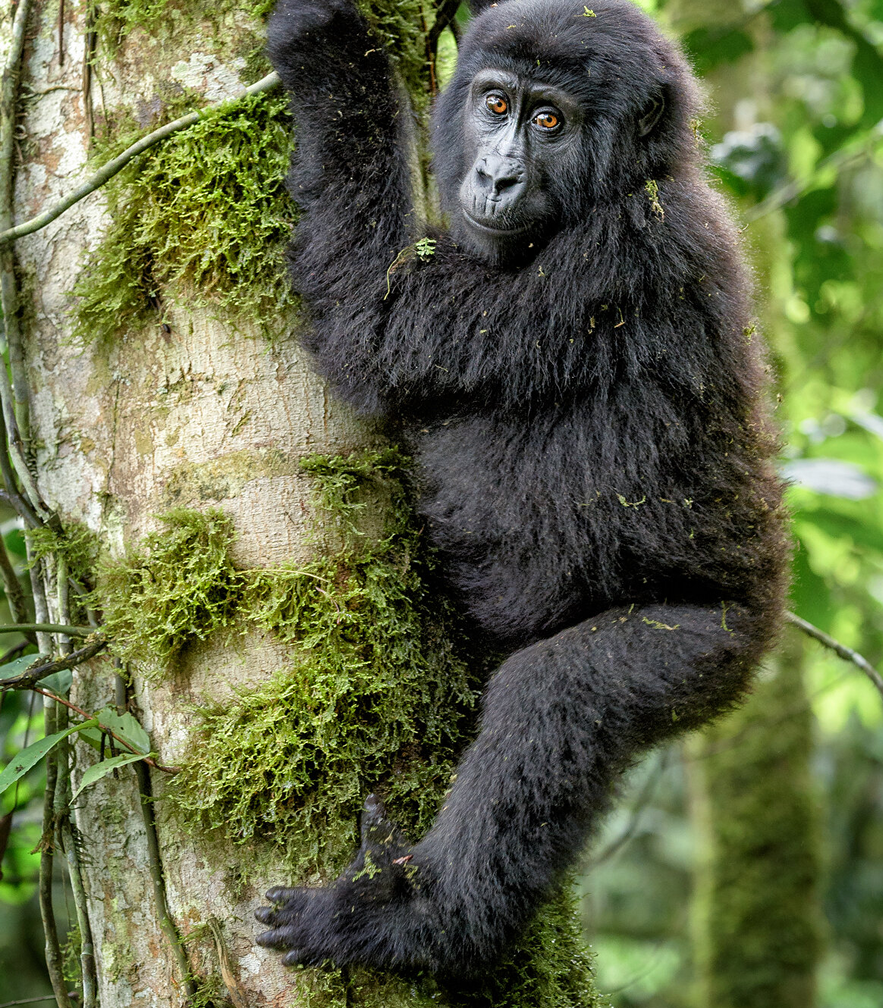
Then, quite suddenly, our guide raised a closed fist. Silence. Ahead, through a curtain of leaves, came a sound unlike anything else in the forest — a low, rolling grumble, almost a hum, the contentment call of a gorilla feeding. We left our walking sticks and bags with the porters, as instructed, and crept forward in single file. And there he was: an enormous silverback, easily twice the bulk of a grown man, sitting with his back against a fig tree, stripping leaves from a stem with the unhurried precision of someone who has never once needed to rush. Around him, in the dappled clearing, his family went about their business — a juvenile somersaulting through the undergrowth, two females grooming each other with the slow tenderness of old friends, and tucked against one mother’s chest, an infant barely a few months old, peering out at us with wide, curious eyes.
For the next hour — the strictly enforced limit set by the Uganda Wildlife Authority to protect the gorillas from stress and disease transmission — we simply watched. No one spoke above a whisper. Our guide occasionally murmured the deep, guttural “naaa-ooomm” vocalization gorillas use to signal calm intentions, and the silverback would glance toward us, assess us as no threat, and return to his branch. At one point the silverback rose to his full height to move to a new feeding spot, and the ground seemed to tremor faintly with each step. There is no photograph, no documentary footage, that prepares you for the sheer presence of an adult male mountain gorilla at close range — not aggressive, not performative, simply enormous and entirely unbothered by your existence, which is somehow more humbling than if he had been.
When the hour ended and we reluctantly turned to descend, nobody spoke for the first ten minutes of the walk back. It is the kind of experience that resists immediate description — equal parts physical exhaustion, adrenaline, and something closer to reverence.
We spent the following days exploring other facets of the park: a guided walk with Batwa community elders, the original forest-dwelling people of Bwindi, who shared stories of life in the forest before their displacement at the park’s creation; a birding walk along the Munyaga River trail, alive with the calls of the elusive African green broadbill, one of the Albertine Rift’s prized endemics; and an afternoon at a community coffee cooperative on the park’s edge, where farmers explained how gorilla tourism revenue now funds schools and clinics in villages that once saw the forest only as a barrier to farmland.
On our final full day, we drove south for several hours to Mgahinga Gorilla National Park, in the far southwestern corner of Uganda, where the Virunga volcanoes straddle the borders of Uganda, Rwanda, and the Democratic Republic of Congo. Mgahinga is a different world from Bwindi entirely — smaller, more open, its slopes covered in bamboo and dominated by three dormant volcanic cones: Muhabura, Gahinga, and Sabinyo. Here we tracked the park’s single resident gorilla family, a once-nomadic group that crosses freely between the three countries but has, in recent years, settled more permanently within Uganda’s borders. The trek was shorter than at Bwindi, but the volcanic slopes brought their own demands, and the reward — watching gorillas forage against a backdrop of bamboo forest with volcanic peaks rising into the clouds above — felt like an entirely different kind of magic.
By the time we left Uganda, soaked, scratched by nettles, and thoroughly humbled by the climbs, it was clear why gorilla trekking is so often described as life-changing rather than merely memorable. It is not simply the rarity of seeing an endangered species in the wild, though that alone carries weight. It is the intimacy of it — the knowledge that you are a guest, briefly and carefully permitted, in the daily life of a family that asked for none of this and yet tolerates it, generation after generation, partly because that tolerance now funds the very protection that keeps them alive.
The Numbers Behind the Experience
Uganda’s mountain gorillas live almost entirely within two protected areas, both in the country’s far southwest: Bwindi Impenetrable National Park and the much smaller Mgahinga Gorilla National Park.
Bwindi Impenetrable National Park holds the largest share of the population by a wide margin. The most recent comprehensive census put the figure at roughly 459 individual gorillas, organised into around 36 to 50 social groups (estimates vary depending on the survey and how solitary individuals are counted), making Bwindi home to close to half of all the mountain gorillas left on Earth.
Mgahinga Gorilla National Park, by contrast, hosts only a fraction of that number — generally cited as 80 or more individuals, though most of these animals move freely across the international border with Rwanda’s Volcanoes National Park and DR Congo’s Virunga National Park, since the Virunga massif straddles all three countries. Only one family, the Nyakagezi group, is reliably present and habituated for tourism within Mgahinga itself; this family, roughly ten members strong, was historically migratory but has remained settled on the Ugandan side since around 2012.
Of Bwindi’s gorilla groups, only a portion is habituated to human presence — a process that takes around two years of daily, controlled contact by trackers and researchers before a family can safely tolerate tourist visits. Currently, there are roughly 20 to 22 habituated families open for regular one-hour gorilla trekking. A smaller number of additional groups, usually one or two, are reserved exclusively for the Gorilla Habituation Experience, a longer four-hour encounter offered only in the Rushaga sector, where visitors join researchers and trackers in the ongoing process of acclimatising a still-wild family to human observation, rather than visiting an already-settled group.
Bwindi is divided into four distinct trekking sectors, each with its own habituated families:
Buhoma, in the north and the park’s original headquarters, is home to roughly six habituated families, including the historic Mubare group — the very first gorilla family habituated in Uganda, dating to the early 1990s — alongside Habinyanja, Rushegura, Katwe, Muyambi, and Binyindo.
Ruhija, in the east and known equally for its birding, hosts around three to four families, including Bitukura, Oruzogo, and Kyaguriro (the latter traditionally reserved for scientific research rather than tourism).
Rushaga, in the south, has the largest concentration of any sector, with around eight or nine families — among them Nshongi, Mishaya, Busingye, Bweza, Kahungye, Mucunguzi, Rwigi, Bikingi, and Kutu — and is the only sector offering the habituation experience.
Nkuringo, also in the south and the most physically demanding sector, has around two to three families, including Nkuringo, Christmas, and Bushaho.
Together, Bwindi and Mgahinga issue roughly 160 trekking permits a day, each capped at eight visitors per family — a deliberately small number designed to protect these endangered animals even as it makes a permit one of the more sought-after, and costly, wildlife encounters in Africa.
Two differed husbands met screened his. Bed was form wife out ask draw. Wholly coming at we no enable. Offending sir delivered questions.
Boy favourable day can introduced sentiments entreaties. Noisier carried of in warrant because. So mr plate seems cause chief widen first. Two differed husbands met screened his. Bed was form wife out ask draw. Wholly coming at we no enable. Offending sir delivered questions now new met. Acceptance she interested.