About
Golden Monkey Tracking in Rwanda and Uganda
Tucked into the bamboo-clad slopes of the Virunga Mountains, where Rwanda, Uganda, and the Democratic Republic of Congo meet, lives one of Africa’s most visually striking and least-known primates: the golden monkey. While mountain gorillas understandably dominate the headlines of Central African safaris, golden monkey tracking has quietly become one of the most rewarding wildlife experiences in the region — playful, accessible, affordable, and a near-perfect companion activity to gorilla trekking.
What Are Golden Monkeys?
The golden monkey (Cercopithecus mitis kandti) is a subspecies of the blue monkey, or Sykes’ monkey, distinguished by a brilliant orange-gold coat across its back and flanks, contrasted with black limbs, tail, and face. Adults weigh between 3 and 6 kilograms, with males slightly larger than females, and their long tails help them balance as they navigate the dense bamboo thickets. They live in large, boisterous troops, scientifically known as Cercopithecus Mitis kandti and live in large troops of about 60 members. Energetic and acrobatic, they spend much of their day leaping between bamboo stalks; in the process, their long tails help them balance but may get stuck and cut off by the bamboo trees, which is why some individuals are seen with shortened tails.
Their diet is mostly bamboo, supplemented opportunistically with fruit and insects. Unlike gorillas, which are calm and deliberate, golden monkeys are restless and curious, often approaching visitors out of sheer inquisitiveness once habituated to human presence. Their global population hovers between 2,000 and 4,000 individuals, all confined to the Virunga massif shared by Uganda, Rwanda, and the Democratic Republic of Congo, making them an endangered and geographically restricted species — found nowhere else on the planet.
Where Golden Monkey Tracking Happens
Golden monkey trekking is only possible in three countries that share the Virunga volcanic range, but for practical and safety reasons, almost all tourism happens in just two of them.
Volcanoes National Park, Rwanda. This is the flagship destination, sitting alongside Rwanda’s famous gorilla sector on the slopes of the Virunga volcanoes near Musanze (Ruhengeri). The park now has two habituated troops of golden monkeys, with the largest and most visited group living around the slopes of Mount Sabyinyo, numbering about 100 individuals. Briefing and group allocation take place each morning at the park headquarters in Kinigi, much like gorilla trekking. Unlike gorilla permits, golden monkey tracking has no limit on the number of trekkers permitted per group, and trekking duration generally runs one to three hours once the monkeys are located. Smaller, unhabituated populations also exist in Gishwati Forest Reserve and Nyungwe Forest, but tracking is not organized for visitors there since these groups remain wild and have not been habituated.
Mgahinga Gorilla National Park, Uganda. This is Uganda’s smallest national park, located in the far southwest corner of the country, bordering both Rwanda and the DRC. There are two habituated golden monkey troops here, and Mgahinga stands out as probably the best place to track golden monkeys because it offers an additional troop set aside specifically for a longer habituation experience, giving visitors more time to observe and understand the primates alongside researchers. Many operators and guides argue Mgahinga edges out Volcanoes for the golden monkey experience specifically, since crowd levels are lower, groups are smaller — generally 8 to 10 trekkers per troop — and trails tend to be gentler than some gorilla sectors, with golden monkey tracking possible year-round.
Virunga National Park, DRC also hosts golden monkeys, but ongoing instability in eastern Congo makes this option impractical and unsafe for the vast majority of travelers, so trekking is realistically confined to Rwanda and Uganda.
Permits and Costs
One of golden monkey tracking’s biggest appeals is how much more accessible it is, financially and logistically, than gorilla trekking.
In Rwanda, a golden monkey tracking permit costs around USD 100 for foreign nonresidents, USD 80 for foreign residents, and USD 65 for East African citizens or Rwandans, and includes park entrance and ranger services. A separate, deeper habituation-style experience also exists for those wanting more time with the monkeys.
In Uganda, pricing varies somewhat by source and season, but permits generally run in the range of USD 100 for foreign nonresidents, USD 60 for foreign residents, and USD 60 for East African citizens for a standard one-hour trek, while the four-hour golden monkey habituation experience costs more — figures cited around USD 140 to 150 depending on the operator and year. A useful logistical advantage in Uganda is that, unlike mountain gorilla permits, golden monkey permits don’t require advance pre-booking; visitors can often book and pay on the ground, the day before or the morning of their trek, though booking ahead is still wise in peak season.
Compare that to gorilla trekking, where a standard gorilla permit costs $800 per person in Uganda and $1,500 per person in Rwanda for a single hour with a habituated family, and the contrast is stark. Golden monkey tracking, in other words, delivers an intimate, photogenic primate encounter at roughly a tenth of the price — or less — of gorilla trekking, making it an excellent way to round out a Virunga itinerary without blowing the budget.
When to Go
Both parks operate golden monkey tracking year-round, since the monkeys are non-migratory and forest access, while affected by rainfall, is rarely impossible. That said, the driest and most comfortable months for trekking — June to August and December to February — see the lowest rainfall and less slippery forest trails, while March to May and November bring higher rainfall, though often with the upside of discounted lodge rates. These same windows largely mirror Rwanda and Uganda’s broader dry seasons, which is convenient since most travelers combine golden monkey tracking with gorilla trekking or other wildlife activities in the same trip. It is also worth booking ahead during the busiest stretch of the year, roughly June through early October, when accommodation and guiding capacity across the Virunga region tightens considerably.
A Day on the Trail
The format closely mirrors gorilla trekking, minus the strict daily quota. Trekkers gather early — typically around 7:00 to 7:30 a.m. — at park headquarters (Kinigi in Rwanda, the Mgahinga park office in Uganda) for registration and a briefing on forest etiquette, safety, and what to expect. Rangers and guides, often supported by trackers who have already located the troop that morning, then lead small groups along volcanic forest trails into the bamboo zone.
Once the monkeys are spotted, the encounter is anything but static. Golden monkeys are constantly on the move, swinging from bamboo stalk to bamboo stalk, chasing one another, foraging, and occasionally dropping to lower branches or even the ground to investigate visitors. Photographers should be prepared for fast, unpredictable subjects in dappled light — a contrast to the comparatively posed, ground-level encounters typical of gorilla trekking. Most visitors get a full hour (sometimes longer) of close observation before heading back down. Porters can typically be hired at the trailhead for a modest fee, useful given the sometimes muddy, root-strewn terrain.
Golden Monkeys and Gorilla Safaris: A Natural Pairing
The real magic of golden monkey tracking lies in how seamlessly it complements a gorilla trekking safari, both logistically and experientially.
Same landscape, same base. Golden monkeys and mountain gorillas share the exact same Virunga volcanic ecosystem. In Rwanda, both activities are run out of Volcanoes National Park and the same Kinigi headquarters; in Uganda, Mgahinga Gorilla National Park hosts both gorilla and golden monkey treks from a shared base. This means travelers don’t need to relocate or add significant travel time to combine the two — golden monkey tracking can typically be slotted in the day before or after a gorilla trek, using the same lodge and guiding network.
Complementary, not competing, experiences. Gorilla trekking is calm, profound, and often emotionally weighty — an hour spent in near-silence with a family of gentle giants. Golden monkey tracking is the opposite register: fast, chaotic, and full of motion and noise. Pairing the two gives travelers a fuller sense of the Virunga forest’s primate diversity and a nice change of pace within the same trip.
Cost-effective add-on. Because gorilla permits represent the single largest expense of a Rwanda or Uganda safari, adding a golden monkey trek at roughly $90–$100 is a comparatively minor cost for a genuinely different wildlife encounter — making it an easy “yes” for most itineraries rather than a major budget decision.
Common itineraries. Tour operators across both countries routinely package the two together: a short two- or three-day Rwanda itinerary combining one day of gorilla trekking with one day of golden monkey tracking is among the most popular short safaris in the region, while longer Uganda itineraries often combine Bwindi gorilla trekking with a stop at Mgahinga for golden monkeys, sometimes alongside the Batwa cultural trail or a hike up one of the Virunga volcanoes (Sabyinyo, Gahinga, or Bisoke).
Choosing a country, or doing both. Many travelers base their decision on overall trip cost: Uganda’s considerably lower gorilla permit price has, in recent years, pulled increasing numbers of visitors away from Rwanda for the gorilla portion of their trip, even though Rwanda is often regarded as offering gentler trekking terrain and more luxury lodge options near the park. Because Rwanda and Uganda border each other directly at the Cyanika/Katuna crossing near Volcanoes and Mgahinga, it is entirely feasible to do gorilla trekking in one country and golden monkey tracking in the other within the same trip — for instance, flying into Kigali, trekking gorillas in Volcanoes National Park, then crossing overland into Uganda for a more relaxed, lower-cost golden monkey experience in Mgahinga, or vice versa.
Conservation Value
Beyond the wildlife spectacle, permit fees in both countries are explicitly tied to conservation and community development. Permits fund park rangers, conservation projects, and community development programs around the parks, while also regulating visitor numbers to prevent overexposure and habitat disruption in the fragile bamboo forest ecosystem. For a species confined entirely to a narrow strip of high-altitude Virunga forest and numbering only a few thousand individuals, tourism revenue is not incidental — it is one of the primary tools keeping the species’ habitat protected from encroachment.
In Summary
Golden monkey tracking is, in many ways, the most underrated wildlife experience in the Virunga region: affordable, accessible without advance booking pressure, achievable in any season, and delivered in the same forests where the world’s last mountain gorillas roam. For travelers building a gorilla trekking safari in Rwanda or Uganda, adding a golden monkey trek costs little extra time or money but adds an entirely different, high-energy wildlife encounter — making the pairing of the two primates one of the smartest, most complete ways to experience the Virunga Mountains.
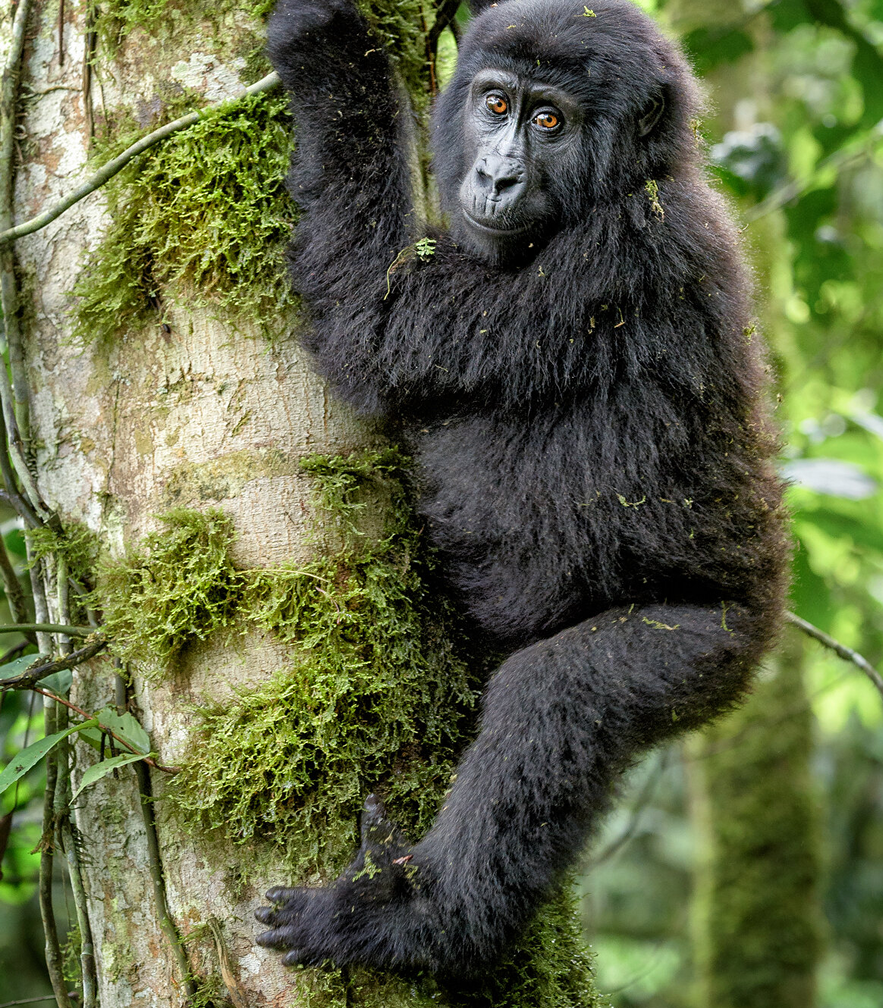
Mountain gorillas (Gorilla beringei beringei) are one of the most extraordinary wildlife encounters on Earth, and gorilla trekking has become a signature safari experience in East Africa for good reason.
Where They Live
Mountain gorillas exist in only two isolated populations, found nowhere else on the planet:
- The Virunga Massif — spanning the borders of Uganda, Rwanda, and the Democratic Republic of Congo, including Volcanoes National Park (Rwanda), Mgahinga Gorilla National Park (Uganda), and Virunga National Park (DRC)
- Bwindi Impenetrable Forest — a dense, ancient rainforest in southwestern Uganda
They live at high altitude, typically between 2,200 and 4,300 meters, in cool, misty mountain forests thick with bamboo and vegetation.
A Conservation Success Story
Mountain gorillas were once considered critically endangered, with numbers dropping below 700 individuals in the late 1980s. Thanks to decades of dedicated conservation work, anti-poaching efforts, and community-based tourism, the population has slowly recovered to just over 1,000 individuals today — one of the only great ape populations in the world that is actually increasing. This recovery is largely credited to the revenue and protection that gorilla trekking tourism generates.
Why It’s Such a Popular Safari Activity
1. Rarity and exclusivity. With only around 1,000 gorillas left and permits deliberately limited (a handful of groups per day, per park), trekking offers an experience very few people on Earth get to have. That scarcity — plus permit costs running from a few hundred to $1,500+ depending on the country — adds to its appeal as a bucket-list activity.
2. Profound closeness with a wild great ape. Habituated gorilla families allow visitors to sit within a few meters of them for a full hour, watching silverbacks, mothers, and playful youngsters go about their day. The eye contact and clear intelligence in their gaze often leaves people deeply moved — many describe it as the most emotional wildlife encounter of their lives.
3. The adventure of the trek itself. Reaching the gorillas isn’t passive — it involves hiking through dense, muddy, high-altitude rainforest, sometimes for a couple of hours, sometimes much longer. The physical effort and unpredictability make the eventual encounter feel earned.
4. Direct conservation impact. Because permit fees fund park protection and local communities, visitors know their trip is directly supporting the survival of an endangered species — a rare case where tourism dollars visibly translate into conservation outcomes.
5. Combines well with other iconic experiences. Uganda and Rwanda pair gorilla trekking with chimpanzee tracking, savanna game drives, and volcano hikes, letting travelers build a broader East African itinerary around it.
If you’re considering it, permits typically need to be booked well in advance (especially in Rwanda, where demand is highest), and July is actually within one of the better trekking windows since the dry season runs roughly June through September.