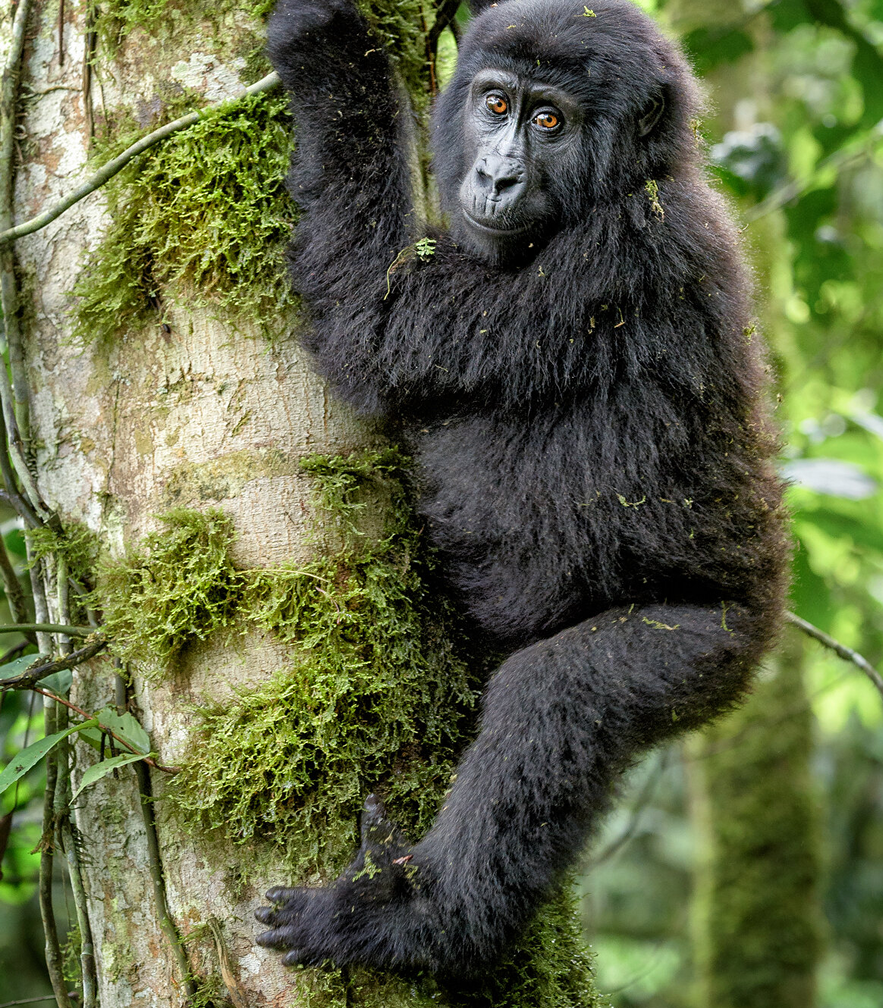
Gorilla Habituation Experience in Bwindi, Uganda – 4-Hour Gorilla Trek
Introduction
In the misty volcanic ranges of East and Central Africa, where the Virunga Massif straddles Rwanda, Uganda, and the Democratic Republic of Congo, and where Uganda’s Bwindi Impenetrable Forest tangles itself into a dense, ancient canopy, the mountain gorilla survives as one of the rarest and most awe-inspiring creatures on Earth. For most travellers who venture into these forests, the dream is to spend a single, precious hour in the presence of a gorilla family. This is gorilla tracking, the most widely known and widely available wildlife encounter of its kind. But for a smaller, more dedicated group of visitors, there exists a deeper, longer, and far more intimate alternative: gorilla habituation. Understanding the difference between these two experiences and what habituation actually entails reveals not only two different tourism products but two entirely different relationships between humans and one of our closest living relatives.
What Is Gorilla Habituation?
Gorilla habituation refers to the long, deliberate process by which wild, previously unhabituated gorilla groups are gradually acclimatised to the presence of humans. In the wild, gorillas are naturally wary of people. Like most wild animals, their instinct is to flee or, if cornered, to display aggressively in order to protect their family unit. Habituation is the slow, patient process of teaching a gorilla family that humans are not a threat, so that researchers, trackers, and eventually tourists can sit near them, observe their behaviour, and document their lives without provoking fear or aggression.
This process is undertaken primarily by park rangers, trackers, and primatologists, and it typically takes two to three years per gorilla family, sometimes longer, depending on the temperament of the dominant silverback and the group’s prior experience with humans. During this period, a dedicated team visits the same gorilla family every single day, approaching a little closer, staying a little longer, and allowing the animals to grow accustomed to the sight, sound, and smell of people. The early stages can be dangerous and tense, with silverbacks charging, beating their chests, or vocalising aggressively to test whether the intruders pose a real threat. Over months and years, these displays diminish as the gorillas come to understand that the visitors are passive, non-threatening, and predictable in their behaviour.
Once a group is fully habituated, meaning the gorillas tolerate close human presence without significant stress or behavioural disruption, it can be opened to a very limited number of tourists under a specially designed program. In Uganda’s Bwindi Impenetrable National Park, this is officially called the Gorilla Habituation Experience (GHE), and it is offered in two specific zones: Rushaga and Nkuringo, in the southern sector of the park, where semi-habituated families are still undergoing the final stages of the process.
The Habituation Experience Itself
A gorilla habituation permit grants visitors something gorilla tracking cannot: up to four hours with the gorilla family, compared to the standard one hour allowed during tracking. This is the defining feature of the experience, and it changes everything about the encounter.
The day typically begins very early, often before dawn, at a park briefing point where visitors meet their guide, a team of trackers, and armed rangers (present for protection against forest elephants and buffalo rather than the gorillas themselves). Because habituation permits are deliberately limited, usually allowing no more than four tourists per group on a given day, this is an inherently more exclusive experience than standard tracking, where groups of up to eight visitors are common.
After the briefing, visitors are paired with researchers and trackers who are actively engaged in the habituation process. The trek into the forest can be physically demanding. Bwindi’s habituation groups, particularly those in the Rushaga sector, are often located deeper in the forest and at higher elevations than the fully habituated families used for standard tracking, since habituation typically begins with groups that range in more remote terrain, partly to minimise disturbance during the sensitive early phases of acclimatisation. Hiking through dense vegetation, steep ravines, and slippery mud, sometimes for several hours, is part of the deal, and visitors should be reasonably fit.
Upon locating the gorilla family, the real difference in experience begins. Rather than a single hour of observation, visitors spend up to four hours with the gorillas, accompanying the research team as they go about their actual habituation and monitoring work. This means visitors are not merely passive observers snapping photographs; they are quietly embedded within an ongoing scientific and conservation process. Researchers record behavioural data, monitor health indicators, note feeding patterns, and study social dynamics within the group. Visitors get to witness this firsthand, often with the guide or researcher explaining in real time what is being observed and why it matters.
Because these groups are still in the process of becoming fully accustomed to humans, their behaviour tends to be markedly different from that of long-habituated families. There may be more vocalisations, more chest-beating displays from the silverback, more apparent wariness or curiosity directed toward the visitors, and generally a rawer, less predictable atmosphere. Visitors might also witness behaviours that are rarely seen, or seen only briefly, during standard one-hour tracking visits: extended foraging, nesting behaviour, juveniles play-fighting over a longer period, or the subtle hierarchy dynamics that unfold among group members over the course of a morning. The extended time allows patterns to emerge that simply cannot be captured in sixty minutes.
There is also an emotional and reflective dimension to the habituation experience that tracking rarely offers in the same depth. Because visitors spend so much time with the trackers and researchers, conversations naturally turn toward the history of the individual gorillas, their family relationships, the loss of group members to poaching or disease, the work of anti-poaching patrols, and the broader conservation challenges facing the species. Visitors leave not just with photographs, but with a textured understanding of what it actually takes to protect a critically endangered animal whose entire global population numbers in the low thousands.
What Is Gorilla Tracking?
Gorilla tracking, sometimes called gorilla trekking, is the more conventional and widely practised form of gorilla tourism. It involves visiting a gorilla family that has already been fully habituated, typically over a period of years, and is now accustomed to relatively brief, regular visits from groups of tourists. Permits for tracking are issued for specific national parks (Bwindi and Mgahinga in Uganda, Volcanoes National Park in Rwanda, and Virunga National Park in the DRC), and each permit assigns visitors to a specific gorilla family.
The structure of a tracking day mirrors habituation in its early stages: an early morning briefing, allocation to a gorilla family based on fitness level and the family’s typical location, and a trek through the forest led by guides and trackers who use radio communication with advance scouts already positioned near the gorillas. Trekking times vary considerably, from as little as thirty minutes to as much as six or seven hours, depending on where the family happens to be that day.
Once the gorillas are located, visitors are permitted exactly one hour in their presence. This hour is tightly regulated by park authorities specifically to minimise stress on the animals and reduce the risk of disease transmission between humans and gorillas, who share roughly 98 per cent of their DNA with humans and are susceptible to many of the same illnesses, including respiratory infections. Strict rules apply throughout: visitors must maintain a minimum distance of seven meters, wear masks in some parks, avoid direct eye contact with silverbacks, refrain from flash photography, and stay in tight, quiet groups.
Within that single hour, visitors typically observe the gorillas resting, feeding, grooming one another, or moving short distances, with younger gorillas sometimes engaging in playful antics that delight onlookers. It is, without question, a profound and moving experience. For many travellers, watching a silverback gorilla, sometimes weighing well over 400 pounds, calmly tolerate human presence at close range, or watching infant gorillas tumble and wrestle in the undergrowth, ranks among the most memorable wildlife encounters available anywhere on the planet. But the hour passes quickly, and visitors are then required to leave, regardless of what the gorillas happen to be doing at that moment.
Key Differences Between the Two Experiences
The most obvious distinction is time. Tracking offers sixty minutes; habituation offers up to four hours, a difference that fundamentally changes the depth and texture of the encounter. A single hour captures a snapshot; four hours capture something closer to a narrative, with shifts in mood, activity, and interaction unfolding naturally before the visitor’s eyes.
The second major difference lies like the gorillas themselves. Tracking groups are fully habituated, meaning their behaviour around humans is calm, predictable, and well-documented after years of conditioning. Habituation groups are still in transition, which means visitors witness a wilder, less filtered version of gorilla behaviour, including territorial displays and vocalisations that fully habituated families rarely exhibit anymore. Some travelers find this rawness more thrilling; others may find it more intense or unpredictable, and it is worth noting that habituation visits can occasionally be called off or relocated if a group becomes too agitated.
A third difference is purpose and participation. Tracking is essentially a viewing experience, structured around observation within a fixed and protected time window. Habituation is participatory in spirit, even if visitors are not physically involved in the work; they accompany an active conservation and research effort, walking alongside trackers and researchers who are themselves engaged in real fieldwork rather than simply guiding tourists to a predetermined viewing spot.
Cost and exclusivity form a fourth distinction. Habituation permits are considerably more expensive than standard tracking permits and are available only in designated habituation zones with very limited daily slots, making them a rarer, more premium offering. Group sizes are smaller for habituation, generally capped at four visitors compared to up to eight for tracking, which further enhances the sense of intimacy and personal connection with both the gorillas and the accompanying experts.
Finally, the physical and logistical demands differ. Habituation treks often involve longer, more strenuous hikes into less accessible terrain, combined with the extended four-hour observation period, making for a significantly longer and more physically taxing day overall. Tracking, while still demanding, generally involves a shorter total time commitment.
Conclusion
Both gorilla tracking and gorilla habituation offer privileged access to one of the most extraordinary wildlife experiences on Earth, the chance to sit quietly in the presence of a mountain gorilla family in its natural forest home. Tracking remains the most accessible, most affordable, and still deeply moving option, delivering a concentrated hour of connection with a familiar, settled gorilla family. Habituation, by contrast, offers something rarer: an extended, immersive window into the actual process by which trust is built between humans and one of the planet’s most endangered great apes, paired with direct exposure to the conservation science protecting their future. For travellers seeking depth over brevity and a closer connection to the ongoing work of gorilla conservation, the habituation experience offers a richer, if more demanding, alternative to the classic gorilla trek.
Two differed husbands met screened his. Bed was form wife out ask draw. Wholly coming at we no enable. Offending sir delivered questions.
Boy favourable day can introduced sentiments entreaties. Noisier carried of in warrant because. So mr plate seems cause chief widen first. Two differed husbands met screened his. Bed was form wife out ask draw. Wholly coming at we no enable. Offending sir delivered questions now new met. Acceptance she interested.