
Adventure Gorilla Safaris
What to Expect on a Gorilla Trekking Adventure.
Gorilla trekking in Rwanda and Uganda ranks among Earth’s rarest wildlife encounters. Only approximately 1,000 mountain gorillas remain in the wild, existing solely in Rwanda, Uganda, and the Democratic Republic of Congo. This scarcity and conservation-driven management transform gorilla trekking from tourism into a privileged encounter with an endangered species. This guide explores what the experience actually involves, optimal timing, who can participate, associated costs, and how it integrates into broader East African safari travel. Whether you’re a seasoned traveler or first-time safari-goer, understanding the logistics, accessibility requirements, and profound significance of gorilla trekking helps you make informed decisions and fully appreciate this transformative encounter with one of our planet’s most endangered species.
Gorilla Trekking: From Briefing to Forest
Gorilla Trek Overview
Treks begin before dawn at park headquarters. In Rwanda, groups gather at Kinigi (Volcanoes) around 6 a.m.; in Uganda, at one of Bwindi’s four sectors or Mgahinga. After registration and safety briefing, rangers assign visitors to specific gorilla families based on fitness level and group size. Local trackers search early to locate families from previous night’s nests. This search ranges from under an hour to several hours. Once confirmed, groups of up to eight people—with an armed ranger and guide—enter the forest. Total trek duration: 30 minutes to seven hours, depending on family location and terrain.
Terrain Differences
Rwanda’s Volcanoes National Park offers relatively open, less dense forest with clearer trails, making it more accessible. Uganda’s Bwindi Impenetrable Forest lives up to its name: thick rainforest with no fixed paths; visitors follow trackers directly through dense vegetation.
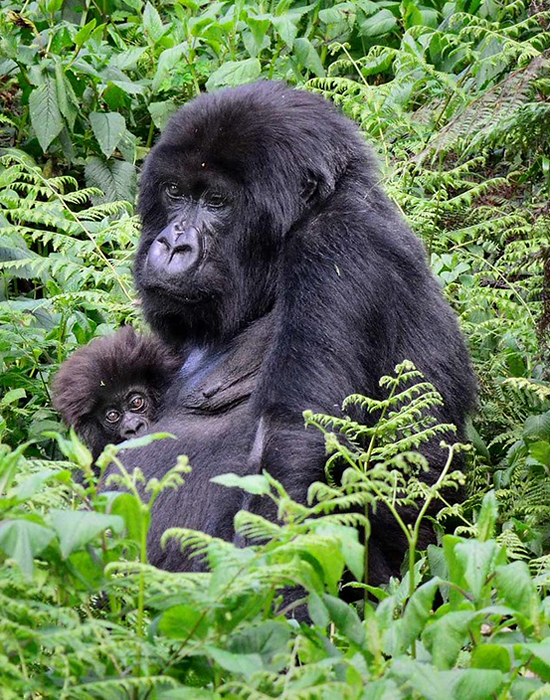
The Encounter: One Hour That Stays With You
When trekers reache the family, strict protocols take over. Bags are left with porters, voices drop to whispers, and everyone approaches slowly under ranger direction. Rules protect both species: enforced minimum distance (Uganda’s 2026 protocol recently increased this to 10 metres to reduce respiratory disease transmission risk), no flash photography, no eating or drinking near gorillas, and anyone unwell—even with a mild cold—must stay back. Gorillas have no immunity to human pathogens; a respiratory illness can be lethal to an entire family.
Visitors get exactly one hour with the family (or up to four hours in Uganda’s gorilla habituation experience). By near-universal account, this hour is unlike anything else in wildlife travel. Gorilla families are led by a dominant silverback—an adult male weighing over 180 kg, with massive shoulders, a distinctive head crest, and calm, watchful authority. Around him move females, juveniles, and infants, play-wrestling, grooming, foraging, or resting in sunlight. Whether in Rwanda or Bwindi National Park, mountain gorillas are predominantly calm, herbivorous, and social; aggressive incidents toward habituated tourists are exceptionally rare. Yet the silverback’s sheer size and presence produce a visceral, humbling response in most visitors.
Photography is permitted without flash, and many describe the most powerful moments as unexpectedly intimate: a gorilla making direct eye contact, an infant tumbling over its mother, or simply the rhythmic stomach rumbles and contented grunts of a family at rest. The hour passes quickly. For those pursuing double gorilla trekking, rangers firmly but politely move groups on when time ends—a rule designed entirely around minimising gorilla stress, not visitor convenience.
Any Question?
Choose your desired experience with mountain Gorillas. Our team will come up with options regarding the itinerary with details. Days, where to go and where to stay.
Gorilla trekking requires a minimum age of 15 years in both Rwanda and Uganda. This age limit protects both visitors and gorillas: younger children may find the trek physically demanding or react unpredictably during close encounters. A startled child’s sudden movement near a silverback is a genuine safety concern.
There is no upper age limit. Older travellers with mobility concerns aren’t excluded; Uganda offers sedan-chair-style porter services to carry less mobile trekkers through dense forest at additional cost, ensuring age or fitness limitations don’t prevent participation.
Families with children under 15 must plan alternatives. Options include leaving younger children at a lodge with childcare services (available near Volcanoes National Park and Bwindi), or choosing alternative activities such as golden monkey tracking in Rwanda or Mgahinga National Park in Uganda —which has no age restriction—or chimpanzee trekking, which has location-dependent age requirements.
What’s Required for Gorilla Trekking Adventures:
- Minimum age: 15 years old
- Physical fitness: Moderate to good fitness level
- Permit: Gorilla trekking permit (purchased in advance)
- Health clearance: No serious health conditions preventing strenuous activity
- Proper attire: Sturdy hiking boots, long pants, jacket
- Luggage weight: Minimal; carry only essentials
- Patience: Early morning starts, variable trekking duration (2-8+ hours)
- Flexibility: Gorilla sightings not guaranteed