Mgahinga National Park – Uganda's Volcanic Gem for Gorilla & Golden Monkey Trekking
Mgahinga National Park | Gorilla & Golden Monkey Trekking
Tucked into the southwestern corner of Uganda, where the borders of three nations converge, Mgahinga Gorilla National Park is one of Africa’s most extraordinary protected areas. Compact yet breathtaking, this park covers 38 square kilometres of high-altitude terrain and forms Uganda’s contribution to the larger Virunga Conservation Area — a jointly managed transboundary ecosystem spanning approximately 434 square kilometres across Uganda, Rwanda, and the Democratic Republic of Congo. Together, these three countries have committed to protecting one of the world’s most biodiverse and culturally significant landscapes.
The park takes its name from a fusion of volcanic heritage and local language. “Gahinga” is a Kinyarwanda word describing the traditional piles of volcanic lava stones that are gathered at field edges during cultivation — a practice that has shaped the agricultural identity of this region for generations. “Mgahinga” itself combines the name of Mount Gahinga with the initial syllable of Mount Muhavura, honouring two of the three majestic volcanoes that define the park’s skyline and spirit.
Three Volcanoes, One Landscape
Dominating the park are three extinct volcanoes — Mount Muhavura (4,127 m), Mount Gahinga (3,474 m), and Mount Sabinyo (3,669 m) — which form the northern section of the Virunga chain. These ancient peaks are not just geological landmarks; they are ecological corridors and cultural monuments that have shaped both the land and the people around them for centuries.
The slopes of the volcanoes fall within a broader afro-montane ecosystem characterised by layered vegetation zones that shift dramatically with altitude. At lower elevations, dense bamboo forests provide vital habitat and food for wildlife, particularly mountain gorillas and golden monkeys. Higher up, the vegetation transitions through Hagenia-Hypericum woodland into open moorland and, near the summits, Afro-alpine heath — a dramatic, near-treeless environment where giant lobelias and groundsels punctuate the mist. This altitudinal zonation gives Mgahinga a visual and ecological richness that few parks of its size can match.
Wildlife and Biodiversity
Mgahinga is home to an impressive array of wildlife. Seventy-six mammal species have been recorded within the park, ranging from forest elephants and Cape buffaloes to bushbucks and leopards. But the park’s two most celebrated residents are its mountain gorillas and golden monkeys.
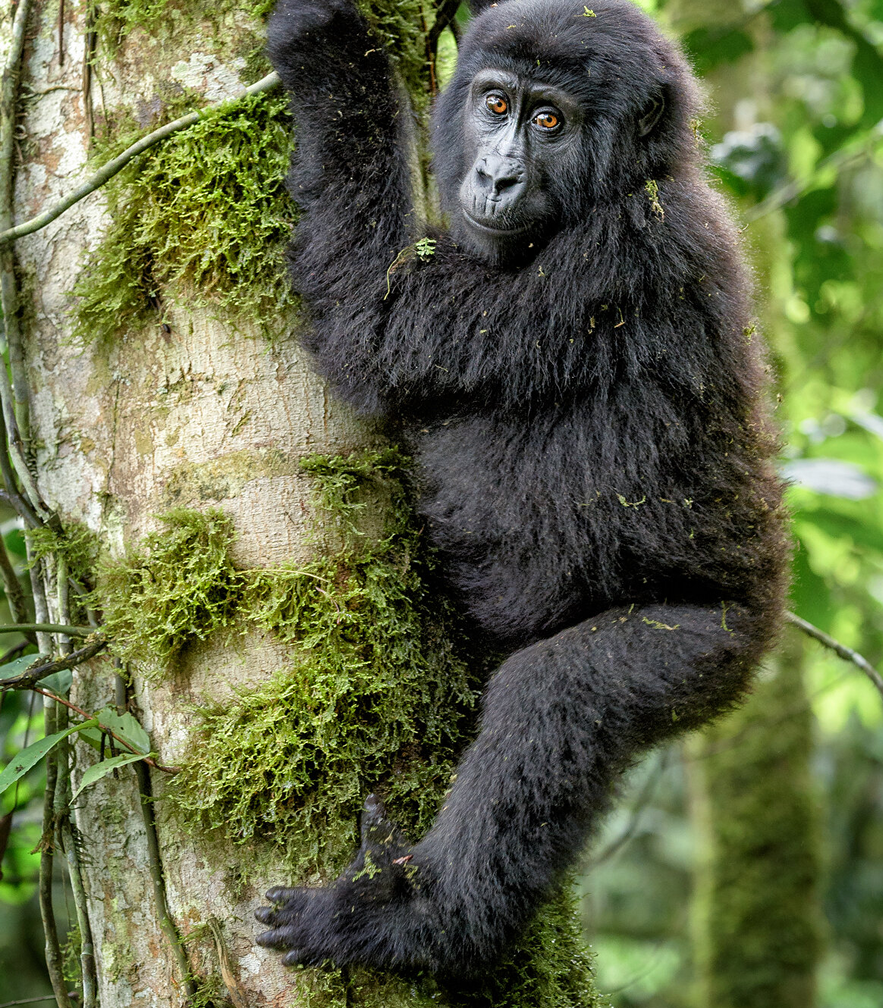
The mountain gorilla family known as Nyakagezi is the park’s only habituated gorilla group and has historically ranged across all three countries in the Virunga Conservation Area. This transboundary movement is a reminder of how interconnected the ecosystem truly is — the gorillas recognise no political borders, and their protection depends on the cooperation of Uganda, Rwanda, and the DRC. Nyakagezi has settled more consistently within Ugandan territory in recent years, making gorilla tracking in Mgahinga a more reliable experience than it once was. However, visitors should always be prepared for the possibility that the family may have crossed into a neighbouring country.
The golden monkey — a striking, flame-coloured primate found only in the Virunga volcanic region — is equally emblematic of the park. Perfectly adapted to the bamboo forest zone, golden monkeys live in large, social troops and are highly entertaining to observe. A habituated troop has been established for trekking, offering visitors an intimate and often playful wildlife encounter that rivals even the gorilla experience in terms of sheer delight.
Birdlife is also exceptional. Over 115 species have been recorded, including the resplendent Rwenzori Turaco, the crowned hornbill, the black kite, and Uganda’s national bird, the grey crowned crane. The park’s varied habitats — from dense forest understorey to bamboo groves and open volcanic ridgelines — attract a wide range of both resident and migratory species, making it a rewarding destination for birders of all levels.
Cultural Significance
Mgahinga is not only a wildlife sanctuary; it is a landscape steeped in human history. The park is a cultural heritage site, featuring prominently in the history, folklore, and traditional healing practices of the local communities who have lived alongside it for generations. Perhaps the most fascinating cultural asset is the Garama Cave, located near the park headquarters at Ntebeko. Stretching 432 metres into the volcanic rock, this cave was once inhabited by the Batwa people — a forest-dwelling community who were among the original custodians of the Virunga forests.
The Batwa, sometimes called the “Keepers of the Forest,” lived as hunter-gatherers in these mountains for thousands of years before the establishment of the national park. Today, Batwa cultural experiences and guided visits to the Garama Cave offer visitors a rare opportunity to learn about the traditions, medicinal plant knowledge, and forest skills of this remarkable community. These experiences are a powerful reminder that conservation and cultural heritage are deeply intertwined, and that responsible tourism should honour both.
Activities
Despite its compact size, Mgahinga offers a rich variety of activities that can fill several days of exploration.
Gorilla Tracking remains the headline experience. Guests set out on foot in the early morning with experienced guides and rangers to locate the Nyakagezi family within the forest. Once found, visitors are allowed one hour in the gorillas’ presence — a strictly regulated protocol designed to minimise disturbance and protect the animals from disease. The encounter, whether brief or extended, is invariably profound. Coming face to face with a silverback mountain gorilla — an animal of tremendous power, intelligence, and startling emotional depth — is widely regarded as one of the defining wildlife experiences on the continent.
Golden Monkey Trekking has grown significantly in popularity and offers its own unique rewards. The vivid colouring of the golden monkey against the green bamboo is visually spectacular, and their curious, energetic nature makes for highly engaging observation.
Volcano Hiking is another major draw. Each of the three volcanoes can be climbed in a single day without the need for specialised mountaineering equipment, making them accessible to anyone with reasonable fitness and a spirit of adventure. The hike up Mount Muhavura, the tallest of the three, offers panoramic views across the Virunga chain into Rwanda and Congo on a clear day — a reward that makes every step of the ascent worthwhile. Mount Sabinyo’s distinctive triple-peaked summit sits astride the tri-border point of all three countries, giving hikers the unique experience of standing in Uganda, Rwanda, and the DRC simultaneously.
Nature Walks departing from the Ntebeko gate include the Sabinyo Gorge Trail and the Rugezi Swamp Trail, both of which are excellent for birdwatching and general wildlife observation. These shorter, lower-altitude walks are ideal for guests who wish to immerse themselves in the forest without committing to a full-day volcano climb.
The Batwa Cultural Experience and visits to the Garama Cave round out the cultural programme, offering an enriching counterpoint to the wildlife activities and providing meaningful economic benefits to the local Batwa community.
Accommodation
A range of accommodation options has developed around Mgahinga to suit different tastes and budgets. Travellers on a limited budget can make use of basic campsites within or near the park boundaries, while mid-range visitors have access to comfortable guesthouses and lodges in and around Kisoro Town. Options include the well-regarded Traveller’s Rest, one of Uganda’s oldest established guesthouses with a history closely tied to gorilla conservation in the region, as well as Sky Blue, Virunga Hotel, Rugigana Campsite, and Mubano Hotel.
For those seeking a more immersive and upmarket experience, Mount Gahinga Rest Camp and Mgahinga Safari Lodge offer lodge-style accommodation within close proximity to the park, combining comfort with spectacular volcanic views. Full-board packages are available at several properties, allowing guests to focus entirely on their park activities without the logistics of organising meals independently.
Whether you choose to overnight in a simple tent beneath the stars or retreat to a cosy lodge with a fire crackling against the mountain chill, the setting is always extraordinary — the silhouettes of three volcanoes against an African sky.
Mgahinga Gorilla National Park may be Uganda’s smallest national park, but in terms of ecological diversity, cultural depth, and sheer transformative power, it punches far above its weight. From the primordial gaze of a mountain gorilla to the ancient echoes of the Garama Cave, this is a place that stays with you long after you have left its misty, volcanic slopes.
Getting There
Mgahinga is situated 13 kilometres from Kisoro Town, which serves as the main gateway to the park. Kisoro lies approximately 540 kilometres from Kampala and is reached via Kabale on a well-maintained paved road. The drive takes roughly eight hours and passes through some of Uganda’s most beautiful scenery, including the terraced hills of Kigezi — often called the “Switzerland of Africa.” Daily public bus services connect Kampala to Kisoro, and shared minibus taxis are also available.
For those wishing to save time, Kisoro is served by a bitumen-surfaced airstrip at Nyakabande, from which scheduled and chartered flights connect to Entebbe and Kigali. Flying in dramatically reduces travel time and allows more of your trip to be spent in the park itself.
From Kisoro Town, the park headquarters at Ntebeko can be reached by public transport, private vehicle, or boda-boda (motorbike taxi). The road is generally passable in a standard vehicle during dry conditions, though a 4WD is advisable during the rainy seasons (March–May and September–November).