
Mountain Gorillas: Characteristics, Behaviour & Where to See Them in Africa
Mountain gorillas (Gorilla beringei beringei) are one of the most striking and closely studied great apes on Earth, famous for their imposing size, complex social lives, and the dramatic high-altitude forests they call home.
Physical Characteristics
Mountain gorillas are the largest living primates, with adult males (silverbacks) weighing between 140–220 kg (300–485 lbs) and standing 1.5–1.8 meters tall when upright. Females are considerably smaller, typically weighing 70–115 kg. Their most distinguishing physical trait is their thick, long, black fur, an adaptation to the cold, high-altitude environments they inhabit, which can drop below freezing at night. This fur is notably longer and denser than that of other gorilla subspecies, especially around the arms, chest, and face.
Mature males develop a distinctive silver-grey saddle of fur across their backs and hips, which is how they earn the name “silverback.” This marks sexual maturity, typically appearing around 12–15 years of age. Silverbacks also have a pronounced sagittal crest, a bony ridge on top of the skull that anchors powerful jaw muscles used for chewing tough vegetation.
Mountain gorillas have broader chests, shorter arms relative to leg length, and a stockier build compared to other great apes, along with a distinctively short, wide muzzle. Their nose prints, like human fingerprints, are unique to each individual, and researchers use them to identify specific gorillas in the wild.
Behaviour and Social Structure
Mountain gorillas live in cohesive family groups, or troops, usually consisting of one dominant silverback, several adult females, and their offspring, though some groups contain multiple silverbacks. Group sizes typically range from 5 to 30 individuals. The silverback serves as the group’s leader and protector, making decisions about movement, feeding, and defence against threats, including rival males or predators.
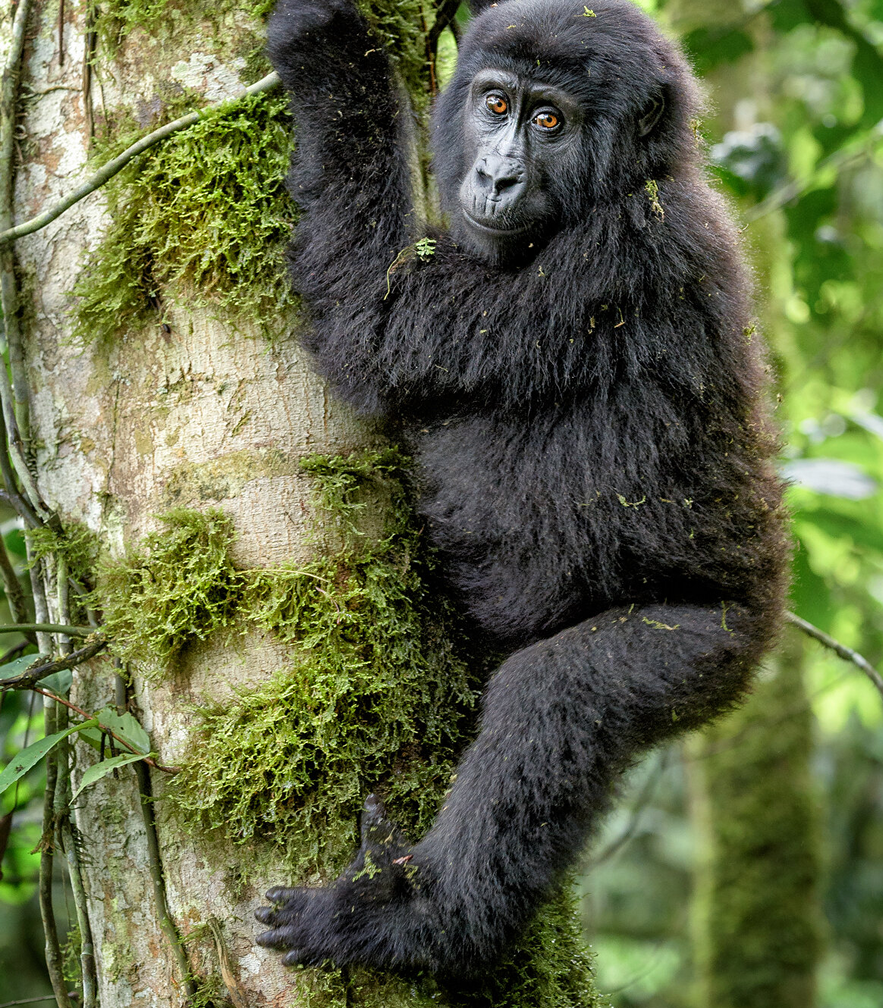
Unlike many primates, mountain gorillas are largely terrestrial and quadrupedal, walking on all fours using a technique called “knuckle-walking.” Their massive size and the density of their mountain habitat make climbing less frequent than in other gorilla populations, though younger gorillas do climb trees to forage or play.
These gorillas are almost entirely herbivorous, consuming a diet dominated by leaves, stems, shoots, bamboo, and wild celery, supplemented occasionally by fruit and small invertebrates. An adult male can eat up to 18–20 kg of vegetation daily. Because their food is abundant in their forest habitat, mountain gorillas don’t need to travel far each day, and they don’t build permanent nests, instead constructing new sleeping nests from surrounding vegetation each night.
Mountain gorillas are known for their gentle, family-oriented temperament despite their imposing strength. They communicate through a range of vocalisations, including grunts, barks, and the iconic chest-beating display, which is used more for communication and assertion of presence than for aggression. Deep social bonds, grooming behaviour, and playful interactions among group members are hallmarks of their daily life.
Habitat
Mountain gorillas live exclusively in high-altitude montane and bamboo forests, typically at elevations between 2,200 and 4,300 meters (7,200–14,100 feet). This cool, misty, and densely vegetated environment shapes many of their physical and behavioural adaptations, from their thick fur to their diet of fibrous mountain vegetation.
Mountain Gorillas vs. Lowland Gorillas
Gorillas are classified into two species: the Eastern gorilla (Gorilla beringei) and the Western gorilla (Gorilla gorilla), each further divided into two subspecies. Mountain gorillas are a subspecies of the Eastern gorilla, while lowland gorillas come in two forms: the Western lowland gorilla (Gorilla gorilla gorilla) and the Eastern lowland gorilla, also called Grauer’s gorilla (Gorilla beringei graueri).
Physical Differences: The most immediately noticeable distinction is fur. Mountain gorillas have thicker, longer, darker fur suited to cold mountain climates, while lowland gorillas, particularly Western lowland gorillas, have shorter, often brownish-grey fur suited to warmer, humid lowland forests. Western lowland gorillas are also generally smaller and more slender than mountain gorillas, with a more pronounced brow ridge and a distinctly reddish tinge to the hair on their heads. Eastern lowland gorillas (Grauer’s gorillas) are the largest of all gorilla subspecies by body mass, though they have shorter fur than mountain gorillas.
Habitat Differences: As their names suggest, habitat is a defining differentiator. Mountain gorillas live in cool, high-altitude forests, while lowland gorillas inhabit tropical and subtropical lowland rainforests, swamp forests, and lowland woodlands at much lower elevations, generally below 1,600 meters.
Dietary Differences: While mountain gorillas rely heavily on leaves, stems, and bamboo shoots due to limited fruit availability at high altitudes, lowland gorillas, especially Western lowland gorillas, have a more varied diet that includes a significantly higher proportion of fruit, along with leaves, seeds, bark, and occasionally termites or ants. This dietary difference means lowland gorillas often travel further and range more widely in search of fruiting trees, and they climb trees more frequently than mountain gorillas.
Social and Behavioural Differences: Both subspecies live in family groups led by a silverback, but lowland gorillas tend to have somewhat smaller group sizes on average and are more elusive and harder to study due to the density of their forest habitat and lower visibility. Mountain gorillas, having been the subject of decades of habituation efforts (famously pioneered by primatologist Dian Fossey), are comparatively well-studied and, in certain protected areas, habituated to human presence for tourism and research.
Conservation Status: Mountain gorillas were long considered critically endangered, though their population has slowly recovered thanks to intensive conservation efforts, anti-poaching patrols, and controlled tourism, leading to a reclassification to “endangered” in 2018. Western lowland gorillas remain critically endangered, threatened by poaching, disease (notably Ebola outbreaks), and habitat loss from logging and agriculture. Eastern lowland gorillas (Grauer’s gorillas) have suffered catastrophic population declines, over 70% in some estimates, due to civil conflict, mining, and bushmeat hunting in the Democratic Republic of Congo, making them critically endangered as well.
Geographic Distribution Across Africa
Gorillas are found exclusively in equatorial Africa, split between two widely separated regions: Central-West Africa and East-Central Africa. There is no overlap between mountain gorillas and lowland gorillas geographically; they occupy entirely different parts of the continent, separated by roughly 1,000 kilometres of terrain that includes the Congo Basin.
Mountain Gorillas are found in only two isolated locations in East-Central Africa. The first is the Virunga Massif, a chain of volcanic mountains spanning the borders of Rwanda, Uganda, and the Democratic Republic of Congo, protected across three national parks: Volcanoes National Park (Rwanda), Mgahinga Gorilla National Park (Uganda), and Virunga National Park (DRC). The second population lives in Bwindi Impenetrable National Park in southwestern Uganda, a separate forest not connected to the Virunga range. Altogether, mountain gorillas number just over 1,000 individuals, all confined to these two small pockets of habitat.
Western Lowland Gorillas have the widest distribution of any gorilla subspecies, spread across the dense rainforests of Central-West Africa, including Cameroon, the Republic of Congo, Gabon, Equatorial Guinea, and the Central African Republic, with a small population in Angola’s Cabinda exclave. This subspecies accounts for the vast majority of the world’s gorilla population, estimated at over 300,000 individuals, though their remote rainforest habitat makes precise counts difficult.
Eastern Lowland Gorillas (Grauer’s Gorillas) are found solely in the eastern Democratic Republic of Congo, in lowland and montane rainforests west of the Albertine Rift, including areas around Kahuzi-Biéga National Park and Maiko National Park. Their population has plummeted to an estimated 3,800 individuals or fewer due to ongoing regional instability.
Cross River Gorillas, a distinct and critically endangered population sometimes classified as a fourth subspecies of the Western gorilla, occupy a small forested region along the Nigeria–Cameroon border, with fewer than 300 individuals remaining, making them the rarest great ape subspecies in the world.
In summary, gorilla distribution reflects a story of geographic isolation and environmental adaptation: mountain gorillas thrive in cold, high-altitude volcanic forests confined to a tiny mountainous corner of East Africa, while lowland gorillas occupy far more expansive, warmer rainforest habitats stretching across Central and West Africa. Each population’s physical traits, diet, and behaviour have been shaped by millennia of adaptation to these strikingly different environments, underscoring how much habitat shapes species even within the same broader lineage.
Adventure Gorilla Tours in Rwanda and Uganda: The Ultimate Guide
There are wildlife encounters, and then there is gorilla trekking. No amount of documentary footage, no wildlife photograph, however brilliant, can prepare you for the moment a wild mountain gorilla turns its ancient, intelligent eyes on yours. It is a look that crosses the boundary between species — a recognition so deep and so immediate that most trekkers describe leaving the forest fundamentally changed. For those who have experienced it, gorilla trekking in the Virunga massif and Uganda’s jungle heartlands ranks as one of the most profoundly moving wildlife encounters on Earth.
Rwanda and Uganda together hold the vast majority of the world’s remaining mountain gorillas (Gorilla beringei beringei), a subspecies so endangered that scientists once feared it would be extinct by the end of the twentieth century. Thanks to decades of conservation effort, community engagement, and carefully managed ecotourism, their numbers have climbed from fewer than 300 individuals in the 1980s to over 1,000 today. Trekking to see them is not merely an indulgence — it is one of the most impactful things a visitor can do to ensure these animals remain on the planet.
This guide covers the major destinations for adventure gorilla tours across both countries, explains the essential differences between them, walks you through the permit process, identifies the best times to visit, and explains how self-drive car hire unlocks the full adventure for independent travellers.