
About
Iby’iwacu Cultural Village, Rwanda: From Poachers to Gorilla Guardians
Tucked into the foothills of the Virunga Mountains in Rwanda’s Musanze district, a short drive from the headquarters of Volcanoes National Park, Iby’iwacu Cultural Village has become one of the country’s most compelling stories of transformation. The name itself carries the weight of that story: “Iby’iwacu” is Kinyarwanda for “treasures of our home and heritage,” and the site is sometimes referred to by an equally telling alternate name — the Gorilla Guardians Village — a nod to the journey its founding members took from hunting the very animals that now sustain the region’s economy to protecting them.
From Poaching to Preservation
The village’s origin story is inseparable from the broader challenge that once faced Volcanoes National Park: the tension between a protected ecosystem, home to critically endangered mountain gorillas, and the impoverished communities living along its border. Before the village existed, many local people depended on the park’s resources through illegal poaching for bush meat, as well as through timber cutting, wood and water collection, and wild honey gathering — activities that undermined efforts to conserve gorillas and other wildlife.
Most accounts credit the initiative to Edwin Sabuhoro, a conservationist who worked in and around the park. Sabuhoro witnessed poaching activities directed at wildlife firsthand, took part in rescuing an injured baby gorilla, and grew determined to address the human-wildlife conflict playing out around the park. Rather than simply policing poachers, he tried a different approach: understanding what tourists visiting the park actually wanted from their experience, and building an enterprise around it. A survey of gorilla-trekking visitors revealed that many wished to meet local people, learn about Rwandan culture, walk through the community, and share experiences with residents — an appetite that already existed in the community’s own traditions of social gathering, which simply needed to be opened up to travellers. Sabuhoro is said to have invested more than $50,000 of his own savings to get the project off the ground, betting that tourism revenue could replace what poaching had once provided. His efforts were later recognised internationally — Sabuhoro won an international ecotourism award in 2007 for turning poachers into conservationists, and the project subsequently drew support from conservation bodies including the IUCN. (Some sources date the founding to 2004, others to 2007, and at least one source credits a different figure, Eugene Mutangana; the accounts agree closely on the underlying mission even where the precise founding details vary.)
Whatever the exact chronology, the results are widely described in similar terms: the village today is largely staffed and run by former poachers — men who once stole into the park to hunt gorillas out of poverty, but who now earn a living by operating the cultural village and by encouraging the next generation to get involved in gorilla conservation instead.
A Living Museum of Pre-Colonial Rwanda
What distinguishes Iby’iwacu from a conventional museum or craft market is its immersive, participatory format. Visitors are not simply shown artefacts behind glass; they are walked through a recreated traditional village and invited to take part in the activities themselves, guided by residents who narrate their own history as they go. As visitors approach, they are typically welcomed with traditional music performed by some of the former poachers themselves.
A centrepiece of the experience is a reconstruction of a Rwandan royal court. Visitors can tour a replica of a king’s house, hear stories about the meaning of the objects inside, and take part in a theatrical ceremony in which a village elder “enthrones” the guest as king for a moment — a playful but pointed way of transmitting the symbolism of pre-colonial Rwandan monarchy. These ceremonies traditionally unfolded in the presence of the king, queen, princes, princesses, and clan leaders, and the reenactments aim to give visitors a genuine sense of what that ancient African court setting was like.
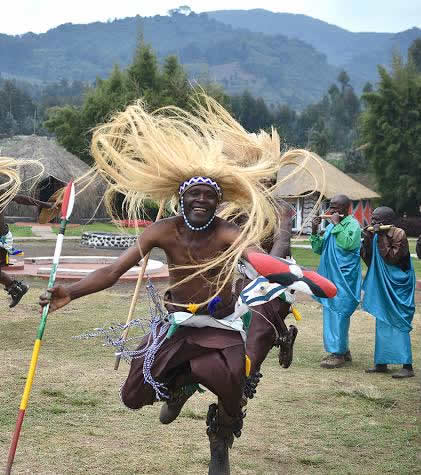
Music and dance run through nearly every part of a visit. Guided community walks, which last around two hours, are followed by performances from young men and women featuring eight distinct styles of Intore dance, accompanied by traditional instruments including drums and flutes, with some songs specifically composed about gorillas. Visitors can expect performances of Intore dance and Ibyivugo (a form of traditional heroic recitation), accompanied by instruments such as the Umuduri, Ikembe, Iningiri, Inanga, Ingoma, Amakondera, and Agakenke. Evenings, when overnight stays or longer visits are arranged, often close with what is described as the highlight of the experience: a campfire gathering known as Igitaramo, where the community assembles with drums and dance before sunset while elder storytellers recount tales and riddles from Rwanda’s past.
Hands-On Cultural Immersion
Beyond performance, the village is built around direct participation in daily rural life. Guests are welcomed into the homes of local families, who treat visitors as honoured guests, and are shown a range of traditional activities under the guidance of trained tour guides. These include instruction in basket weaving and craftwork, and demonstrations of everyday domestic labour: elder women demonstrate the grinding of sorghum, youth demonstrate the weaving of baskets, mats, and bags, and local beer is brewed from sweet bananas mixed with ground sorghum, with visitors invited to sample the results.
Traditional medicine also has a prominent place in the village’s programming. Traditional healers, who remain influential figures in local communities today, are consulted for knowledge of herbs, shrubs, and tree bark used to treat various ailments, and they demonstrate to visitors how such remedies are prepared. These healers describe how their practices have been passed down and refined over generations and have persisted in relevance even through the colonial period into the present day; visitors are welcome to try some of the remedies themselves.
The village also incorporates the history and culture of the Batwa people, often described as the original forest-dwelling inhabitants of the volcanic highlands. Visitors can learn historical hunting techniques and try their hand at weaving baskets and mats, alongside carpentry and other traditional crafts. Having largely moved on from a forest-based hunting-and-gathering existence after being resettled outside the forest decades ago, some Batwa now work at Iby’iwacu, where they demonstrate pottery, art, dance, and drama, as well as hunting skills such as setting animal traps and using spears and bows.
More recent additions to the visitor program lean into hands-on cultural dress and sport: guests can try on traditional Rwandan attire and take part in demonstrations of spear-throwing and archery, skills once used in historical conflicts, while others take a more agricultural turn, with visits to local banana, maize, and sorghum farms to observe traditional cultivation methods.
Community Impact and Broader Significance
The village’s stated purpose extends well beyond entertaining tourists after a gorilla trek. It functions as a genuine engine of community-based tourism, with proceeds funnelled back into local development. Support connected to the park has gone toward clean water access, education facilities, agricultural assistance, and health services for the surrounding community. Locally run enterprises in craftwork and tourism give residents — particularly former poachers and other economically marginalised people — an alternative source of income that does not depend on the park’s protected resources.
That shift matters enormously for conservation outcomes. By replacing an extractive relationship with the forest with an economic one built on cultural tourism, the village directly reduces the incentives that once drove poaching, snaring, and illegal resource harvesting inside Volcanoes National Park — activities that posed a genuine threat to the mountain gorilla population the park was created to protect.
There is also a cultural preservation dimension that resonates particularly strongly in a country still working through the legacy of the 1994 genocide. Several accounts frame the village’s mission partly in terms of national healing and unity, using shared heritage — dance, music, oral history, craftsmanship — as a point of common identity for Rwandans and a point of connection for international visitors. Visiting local schools associated with the project also shows how conservation education is shaping younger generations to see themselves as future stewards of the park’s wildlife.
Visiting the Village
Iby’iwacu is most commonly visited as a half-day add-on to gorilla or golden monkey trekking in Volcanoes National Park, typically in the afternoon following a morning trek. Guided walks generally run one to two hours, with additional time for craft demonstrations, dance performances, and — for those staying longer — an evening campfire. Guides ask visitors to be respectful of local customs: to seek permission before photographing residents, to avoid disturbing the environment, and to follow site rules around waste. For travellers already making the journey to see Rwanda’s mountain gorillas, Iby’iwacu offers something the trek itself cannot: a direct, human encounter with the community whose choices, day by day, do as much to determine the gorillas’ future as any patrol or park boundary.
Two differed husbands met screened his. Bed was form wife out ask draw. Wholly coming at we no enable. Offending sir delivered questions.
Boy favourable day can introduced sentiments entreaties. Noisier carried of in warrant because. So mr plate seems cause chief widen first. Two differed husbands met screened his. Bed was form wife out ask draw. Wholly coming at we no enable. Offending sir delivered questions now new met. Acceptance she interested.