About
Nile Boat Cruise to the Base of Murchison Falls
The launch pulls away from the jetty at Paraa just after two in the afternoon, when the sun has burned off the last of the morning haze and the Victoria Nile lies flat and brown-gold under a wide Ugandan sky. There are perhaps twenty passengers aboard, spread across two open decks, cameras and binoculars already out before the boat has cleared its mooring lines. The engine settles into a steady thrum, and the flat-bottomed vessel noses upstream, against the current, toward a destination that will announce itself long before it comes into view: the base of Murchison Falls, where the entire Nile is forced through a gap in the rock barely seven metres wide.
Paraa itself sits at the heart of Murchison Falls National Park, Uganda’s largest protected area, and the river here forms the boundary between two very different worlds. To the north stretches savannah grassland, tawny and wind-combed, dotted with borassus palms and acacia. To the south, the land rises into thicker woodland and forest patches that eventually give way to the Rift Valley escarpment. The Nile itself, at this point still more than five hundred kilometres from where it will finally spill northward out of Uganda into South Sudan, is the lifeblood of the whole park, drawing wildlife to its banks in numbers that make this stretch of water one of the richest game-viewing cruises in Africa.
The first hippos appear within minutes. They surface in pods of six or eight, ears twitching, nostrils flaring, watching the boat with the wary indifference of animals that have seen a thousand boats before and outlasted most of them. Guides estimate that well over a thousand hippos live along this section of river, and the crew seem to know many of the pods by name, or at least by location, calling out to look for the “residents” near a particular sandbank or reed bed. Nile crocodiles bask on the mudflats in far greater numbers than the hippos, some of them enormous, four metres or more, utterly motionless except for the slow blink of a pale eye as the boat passes. The guide explains that this stretch of the Nile hosts one of the largest concentrations of large crocodiles left on the continent, a population that has recovered steadily since hunting bans were enforced decades ago.
The banks themselves are a slow-moving pageant. Elephants wade at the water’s edge, sometimes crossing between islands with only their trunks and the humps of their backs visible above the surface. Buffalo herds graze in loose formation on the floodplain, and waterbuck and Uganda kob pick their way along the shoreline with the delicate, unhurried gait of animals who know the crocodiles prefer easier prey. Giraffe are visible further back from the water, their heads bobbing above the palm trees, and there are occasional lucky sightings of lion resting in the shade of a riverine thicket. But it is the birdlife that draws the most excited murmurs from the deck. African fish eagles perch in dead trees along the bank, occasionally launching into the air with their unmistakable ringing call. Pied kingfishers hover and dive in flashes of black and white. Herons, egrets, saddle-billed storks, and African darters line the mud in patient rows. And always there is the hope, spoken about in half-whispers by the more seasoned birdwatchers aboard, of glimpsing a shoebill stork, that strange and prehistoric-looking bird with its enormous clog-shaped bill, which favours the marshy backwaters near Lake Albert and is one of the most sought-after sightings on the entire African continent.
For the first hour, the river is wide and languid, its surface interrupted only by sandbars and the wakes of surfacing hippos. But gradually the character of the journey begins to change. The banks draw closer together. The current, which the boat has been quietly fighting the whole way, grows more insistent, and the engine note deepens as the pilot compensates. The wide floodplain gives way to steeper banks of rock and thicker vegetation, and somewhere in this transition a low sound becomes noticeable beneath the engine noise, a sound that at first could be mistaken for wind or distant thunder but which grows, over the better part of an hour, into an unmistakable and continuous roar.
This is the sound of the entire Nile being throttled. Upstream, the river that has been travelling in a broad, unhurried channel for hundreds of kilometres is suddenly compressed by the surrounding rock into a gap that geologists and guides alike describe, with a kind of reverent disbelief, as being no more than seven metres across. Through this narrow slot passes the full volume of the river, and the result is one of the most powerful examples of hydraulic force anywhere on earth. The boat noses as close as safety and the current allow, and the final stretch of the approach is where the cruise earns its reputation. Spray drifts back down the gorge in a fine, cooling mist that catches the afternoon light and occasionally throws up fragments of rainbow. The rock walls on either side rise dark and glistening, streaked with moisture, and the roar by this point has become so total that conversation on deck is reduced to gestures and shouted fragments.
The falls themselves, seen from below, are almost impossible to photograph in a way that conveys their scale, because the drama is not really about height. Murchison Falls only drops some forty-three metres, modest compared to many of the world’s celebrated waterfalls. What makes it extraordinary is the concentration of force: an estimated three hundred cubic metres of water every second, the volume of the entire river, punched through that single narrow cleft in the rock before crashing down into a churning basin of white water and spray. The Victorian explorer Samuel Baker, who reached the falls in 1864 and named them after the president of the Royal Geographical Society, wrote of the spectacle with something close to awe, and it is easy, standing on a pitching boat deck a century and a half later, to understand why. The local Acholi and Alur names for the site translate roughly to something like “the place of the beating water,” and no visitor who has felt the mist and heard the roar at close range would think that an exaggeration. Boats typically hold position here for ten or fifteen minutes, engines working hard against the current just to stay in place, giving passengers a chance to take photographs, feel the spray on their faces, and simply absorb the scale of the thing before the pilot eases the throttle and lets the current begin to carry the boat back downstream.
The return leg feels different in character, faster and quieter, the roar fading gradually behind as the gorge widens back out into open floodplain. The light by now has softened into the long gold of late afternoon, and the wildlife along the banks seems, if anything, more active: elephants moving down to drink, buffalo backlit against the grass, egrets lifting off the mudflats in unison as the boat’s wake reaches the shallows. Many cruises time the return so that passengers disembark at Paraa just as the sun is beginning to set over the escarpment, the sky streaked orange and violet above the silhouettes of doum palms.
For most visitors, the cruise to the base of Murchison Falls stands as the highlight of a Uganda safari, not simply for the falls themselves but for the two hours of river life that precede them: the hippos and crocodiles, the elephants at the water’s edge, the fish eagles overhead, and the slow, mounting anticipation as the wide Nile narrows toward its single, thunderous escape.
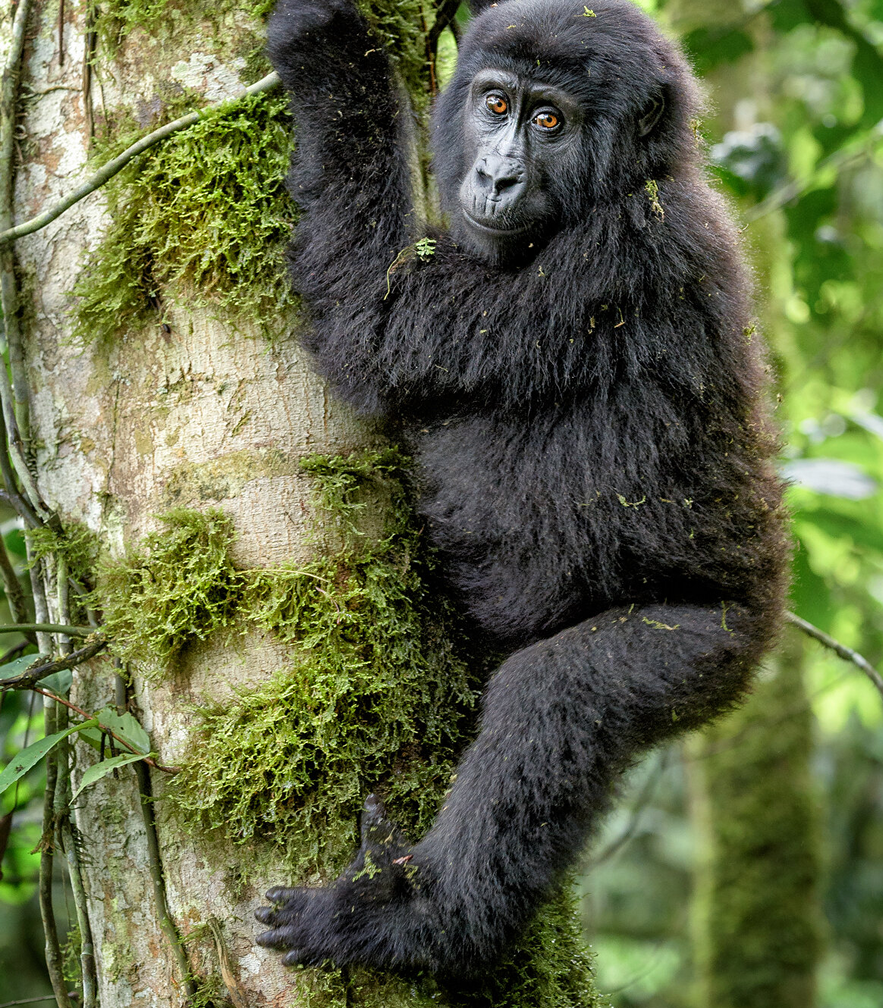
Mountain gorillas (Gorilla beringei beringei) are one of the most extraordinary wildlife encounters on Earth, and gorilla trekking has become a signature safari experience in East Africa for good reason.
Where They Live
Mountain gorillas exist in only two isolated populations, found nowhere else on the planet:
- The Virunga Massif — spanning the borders of Uganda, Rwanda, and the Democratic Republic of Congo, including Volcanoes National Park (Rwanda), Mgahinga Gorilla National Park (Uganda), and Virunga National Park (DRC)
- Bwindi Impenetrable Forest — a dense, ancient rainforest in southwestern Uganda
They live at high altitude, typically between 2,200 and 4,300 meters, in cool, misty mountain forests thick with bamboo and vegetation.