
About
The Kazinga Channel: Queen Elizabeth National Park’s Wildlife Artery
Geography and Origins
The Kazinga Channel is a natural waterway in western Uganda, sitting almost exactly on the equator within the Albertine Rift Valley. It connects Lake Edward (also known by its colonial name, Lake Rutanzige) to Lake George (also called Lake Katunguru), two freshwater lakes that sit at a near-identical altitude. Estimates of its length vary slightly between sources, but it is generally described as roughly 32 to 40 kilometres long, and about 2,500 feet wide, and although it is officially classified as a river, its flow is almost imperceptible to the naked eye. The water feeding this system originates in the snow-capped Rwenzori Mountains, whose glacial and rainfall run-off first fills Lake George before draining slowly westward through the channel into the much larger Lake Edward.
The channel runs beneath the Mweya Peninsula, which has become the operational hub of Queen Elizabeth National Park, home to the park’s main lodges, headquarters, and the primary boat-launching jetty. Geographically, the channel also functions as a natural dividing line within the park: to its south lie the Ishasha sector, famed for its tree-climbing lions, and the Kyambura Gorge, a lush rift valley gorge nicknamed the “Valley of Apes” for its resident chimpanzee community. To the north and east lie the Kasenyi Plains and the open savannah grasslands more typical of classic East African safari scenery.
An Ecological Lifeline
What makes the Kazinga Channel exceptional is not simply its scenery but its role as the ecological backbone of the entire park. Queen Elizabeth National Park spans nearly 2,000 square kilometres of savannah, wetland, and forest, but during the dry seasons, the channel becomes the single most reliable source of water for the animals living within it. As surrounding waterholes shrink or vanish, wildlife converges on its banks in extraordinary densities, transforming the channel into what many describe as a living amphitheatre of nature.
The Kazinga Channel holds one of the largest concentrations of hippopotamus in the world, with population estimates ranging from around 1,600 to over 2,000 individuals along its banks, depending on the season and source. Hippos here follow a very particular daily rhythm: they spend the daylight hours submerged in the water, both to cool their thin, hairless skin from the equatorial sun and to protect themselves from predators, only emerging at night to graze on land, sometimes travelling several kilometres inland before returning to the water before dawn. This nocturnal pattern is also why local fishermen are able to work the channel safely only after dark, once the hippos have moved onto land to feed; during daylight hours their presence in the water makes fishing far too dangerous.
Nile crocodiles bask along the muddy shorelines in large numbers, their presence in the channel itself is something of an ecological story: local guides often recount that volcanic activity in the region once drove crocodiles away from the area, and that they only recolonised the channel later via the Semliki River once volcanic activity subsided. Alongside hippos and crocodiles, elephants, buffalo, waterbuck, warthogs, and various antelope species regularly come down to the water’s edge to drink, wallow, and cool off, especially in the heat of early afternoon. Elephants are frequently seen bathing and even swimming, while buffalo herds numbering in the hundreds sometimes gather at once, an impressive sight from the water.
The channel is equally celebrated among birdwatchers. Queen Elizabeth National Park as a whole hosts over 600 recorded bird species, more than any other protected area in Africa, and a significant share of that diversity is concentrated along the Kazinga Channel itself, which is formally recognised as an Important Birding Area. Commonly sighted species include the African fish eagle, pied and malachite kingfishers, African skimmers, great and long-tailed cormorants, saddle-billed storks, yellow-billed storks, marabou storks, pink-backed and great white pelicans, and Egyptian geese. Birders sometimes get fortunate enough to spot the rare and prehistoric-looking shoebill stork, an endangered species that draws dedicated birding groups from around the world.
Beyond the wildlife, the channel is dotted with small fishing villages along its banks, home to communities who have lived alongside this ecosystem for generations. Passing these villages during a cruise offers a glimpse of daily rural Ugandan life set directly against a backdrop of grazing elephants and basking crocodiles, an unusual and striking juxtaposition of human settlement and untamed wilderness coexisting within a national park.
The Boat Cruise Experience
The boat cruise along the Kazinga Channel is widely regarded as one of the signature activities of a Uganda safari, and for many visitors, it is the highlight of their entire trip. Cruises depart from a jetty near Mweya Peninsula, close to Mweya Safari Lodge, and are operated either by the Uganda Wildlife Authority, which runs larger double-decker vessels capable of carrying up to 40 passengers (with roughly 20 on each deck), or by smaller, more intimate boats run by lodges such as Mweya Safari Lodge, typically seating 10 to 20 people and offering a more personal experience, sometimes with an onboard bar or refreshment service.
Boats generally follow the same basic route, travelling east from near the mouth of Lake Edward along the channel for roughly an hour before turning back, allowing passengers unobstructed views of both banks along the way. The open-sided but covered design of the boats protects passengers from strong equatorial sun or sudden rain while still allowing an unobstructed view of the water and shoreline in every direction.
Explaining the Afternoon Cruise Specifically
Most operators in the park run two scheduled cruises each day: a morning departure and an afternoon or “evening” departure, with exact timings varying somewhat by operator. The afternoon cruise commonly departs somewhere between roughly 1:00 pm and 2:00 pm and runs for two to three hours, often concluding around 4:00 pm to 5:00 pm, coinciding with the golden hours before sunset.
The afternoon slot is frequently recommended by guides and repeat visitors as the better of the two options, for a few concrete reasons tied to animal behaviour and light quality. By early-to-mid afternoon, temperatures in the park are at their peak, driving thirsty animals down to the water’s edge in greater numbers to drink and cool off, so wildlife density and activity along the banks tends to be higher than during the cooler, quieter morning hours. This is also the time when elephants and buffalo herds are most likely to be encountered wading or bathing directly in the channel, rather than simply resting inland.
The quality of light is another major draw. As the afternoon progresses toward early evening, the sun softens and takes on a warm golden tone, ideal for photography: reflections of elephants in the water, backlit birds in flight, and crocodiles glowing on sunlit mudbanks are far more striking in this light than under the harsher, flatter glare of midday. Photographers in particular are often advised to prioritise the afternoon departure and to sit on the upper deck of the boat, where sightlines over the reeds and shoreline vegetation are clearest.
Toward the very end of the cruise, as the boat heads back and the sun begins to set over the Rwenzori foothills and, on clear days, the distant Virunga Mountains across the border in the Democratic Republic of Congo, passengers are often treated to the added spectacle of local fishermen preparing their nets and boats along the banks, readying for the night’s fishing once the hippos move ashore to graze. This blend of dramatic wildlife activity, warm evening light, and glimpses of local life is what gives the afternoon cruise its particular reputation as the more atmospheric and visually rewarding of the two sessions, even though the calmer, cooler morning cruise has its own appeal for visitors who prefer quieter conditions and fewer crowds on the water.
Throughout the cruise, whichever time slot is chosen, experienced park guides accompany passengers, offering commentary on animal behaviour, the ecological history of the channel, and the surrounding communities, turning what could simply be a scenic boat ride into a genuinely informative safari experience on water rather than land.
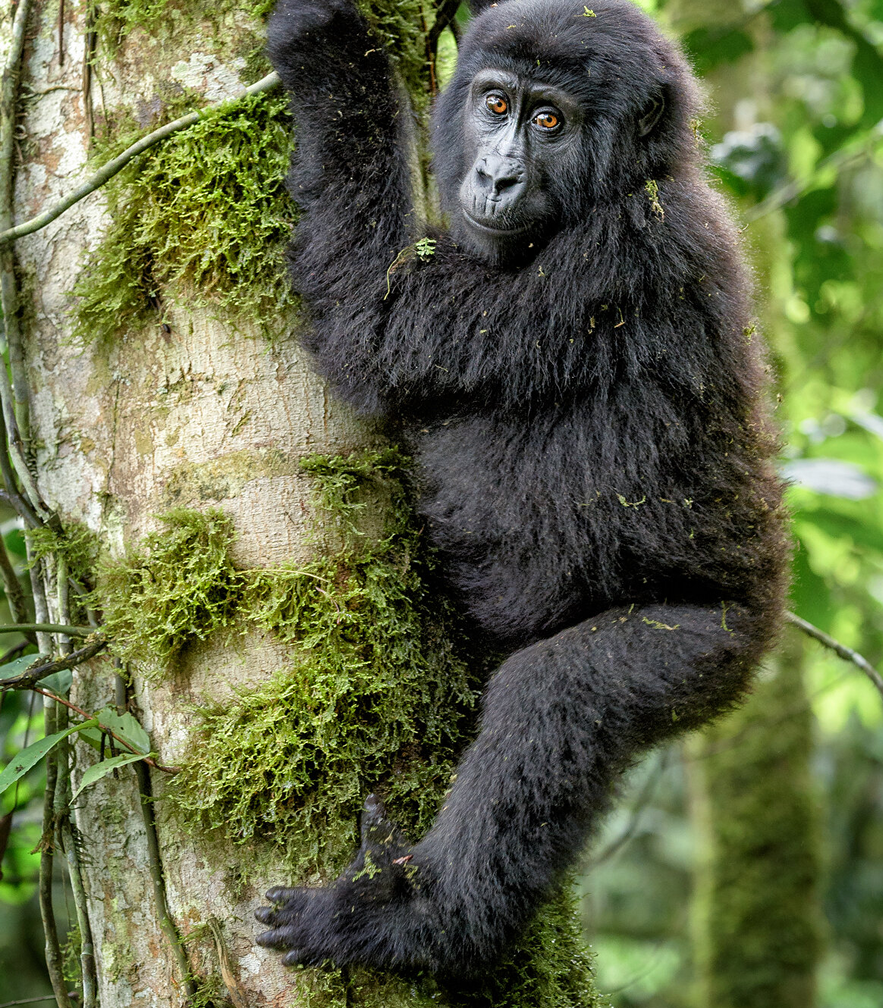
Mountain gorillas (Gorilla beringei beringei) are one of the most extraordinary wildlife encounters on Earth, and gorilla trekking has become a signature safari experience in East Africa for good reason.
Where They Live
Mountain gorillas exist in only two isolated populations, found nowhere else on the planet:
- The Virunga Massif — spanning the borders of Uganda, Rwanda, and the Democratic Republic of Congo, including Volcanoes National Park (Rwanda), Mgahinga Gorilla National Park (Uganda), and Virunga National Park (DRC)
- Bwindi Impenetrable Forest — a dense, ancient rainforest in southwestern Uganda
They live at high altitude, typically between 2,200 and 4,300 meters, in cool, misty mountain forests thick with bamboo and vegetation.
A Conservation Success Story
Mountain gorillas were once considered critically endangered, with numbers dropping below 700 individuals in the late 1980s. Thanks to decades of dedicated conservation work, anti-poaching efforts, and community-based tourism, the population has slowly recovered to just over 1,000 individuals today — one of the only great ape populations in the world that is actually increasing. This recovery is largely credited to the revenue and protection that gorilla trekking tourism generates.
Why It’s Such a Popular Safari Activity
1. Rarity and exclusivity. With only around 1,000 gorillas left and permits deliberately limited (a handful of groups per day, per park), trekking offers an experience very few people on Earth get to have. That scarcity — plus permit costs running from a few hundred to $1,500+ depending on the country — adds to its appeal as a bucket-list activity.
2. Profound closeness with a wild great ape. Habituated gorilla families allow visitors to sit within a few meters of them for a full hour, watching silverbacks, mothers, and playful youngsters go about their day. The eye contact and clear intelligence in their gaze often leaves people deeply moved — many describe it as the most emotional wildlife encounter of their lives.
3. The adventure of the trek itself. Reaching the gorillas isn’t passive — it involves hiking through dense, muddy, high-altitude rainforest, sometimes for a couple of hours, sometimes much longer. The physical effort and unpredictability make the eventual encounter feel earned.
4. Direct conservation impact. Because permit fees fund park protection and local communities, visitors know their trip is directly supporting the survival of an endangered species — a rare case where tourism dollars visibly translate into conservation outcomes.
5. Combines well with other iconic experiences. Uganda and Rwanda pair gorilla trekking with chimpanzee tracking, savanna game drives, and volcano hikes, letting travelers build a broader East African itinerary around it.
If you’re considering it, permits typically need to be booked well in advance (especially in Rwanda, where demand is highest), and July is actually within one of the better trekking windows since the dry season runs roughly June through September.