
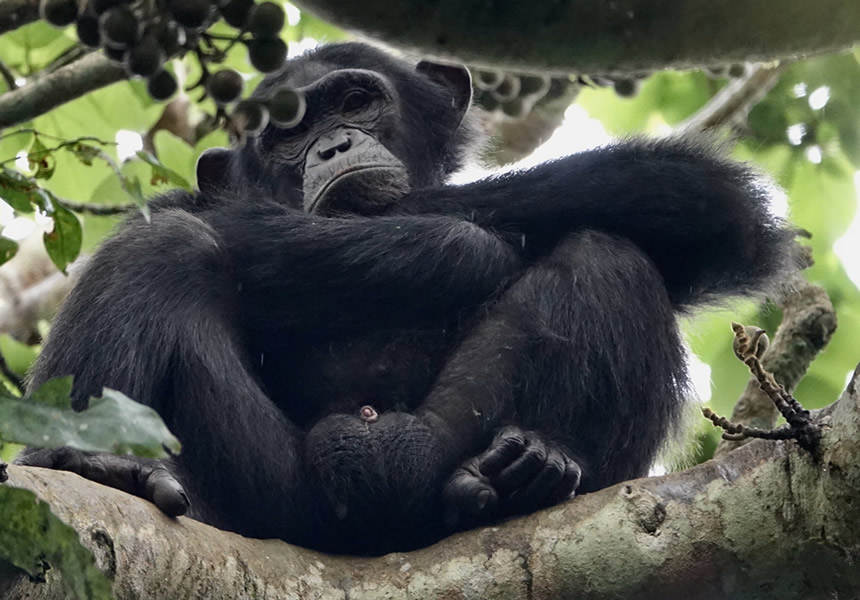
Chimpanzee Habituation Experience in Uganda.
For travelers who want more than a fleeting glimpse of Uganda’s wild chimpanzees, the Chimpanzee Habituation Experience (CHEX) offers something far richer: an entire day immersed in the forest alongside a chimp community, from the moment they open their eyes to the moment they close them again. It stands in contrast to the standard chimpanzee trekking permit, which limits visitors to a single hour of observation once a group has been located. CHEX removes that clock entirely, giving guests a rare, unhurried window into the daily rhythms of one of our closest living relatives.
Where to Do It in Uganda
Only two locations offer the Chimpanzee Habituation Experience (CHEX), each with its own character.
Kibale Forest National Park Uganda’s flagship chimp destination, home to the country’s largest population (1,500+ individuals). Three habituated communities mean strong odds of a rewarding sighting regardless of group assignment. CHEX runs year-round with no seasonal restrictions, making it dependable for off-peak travel. Permits cost $250 per person.
Budongo Forest, Kaniyo Pabidi (Murchison Falls National Park) The only other CHEX location, set in Murchison Falls’ southern reaches. Budongo has Uganda’s second-largest population (roughly 800), but just one habituated community of about 80 chimps. That single group serves both standard one-hour treks and the extended habituation experience, creating a scheduling constraint: during peak season (July–September), the park suspends CHEX to avoid over-visiting the group. Plan outside this window. At $150 per person, Budongo is notably cheaper than Kibale — appealing for budget travelers or those already building a Murchison Falls itinerary.
What a Day of Habituation Actually Looks Like
The experience starts before sunrise, as participants meet trackers and researchers at the trailhead around 6:00 a.m. to catch chimpanzees at “de-nesting,” the moment they wake and leave their overnight nests. From there, guests shadow the same chimp group throughout the day.
Mornings are physically demanding. Hungry chimps move rapidly through the canopy foraging for fruit, leaves, insects, and meat — they’re skilled cooperative hunters, often targeting red colobus monkeys. Guests must jog over rough terrain and dodge vines to keep up.
By early afternoon, the pace slows as rising heat pushes chimps down to rest in the shade. This phase is more observational: guests witness grooming, juvenile play, dominance displays, and mating, with long stationary periods offering prime opportunities for photography and close observation of chimp social dynamics.
As dusk nears, chimps build fresh tree nests for the night — a one-time-use structure repeated daily — marking the end of the day and the group’s return from the forest.
CHEX is flexible: no one is required to stay the full dawn-to-dusk stretch, and participants can leave early if heat, pace, or fatigue become too much. Still, most who commit choose to experience the entire arc, from the morning’s intensity to the afternoon’s calm.
One strict rule applies universally: children under 16 cannot participate in chimp trekking or habituation experiences, both for safety given the terrain and unpredictable wildlife, and to minimize disease transmission risk to the chimpanzees.
Why Pair It With a Murchison Falls Safari
Because Kaniyo Pabidi sits within Murchison Falls National Park, the habituation experience there works particularly well as an add-on to a broader wildlife safari rather than as a standalone trip. Travelers exploring Murchison Falls for its game drives, boat cruises along the Nile, and views of the thundering falls itself can extend their stay by a day to include a full chimpanzee encounter without needing to travel to a separate park entirely. This makes Budongo a logical and efficient choice for anyone whose itinerary already includes Murchison Falls, while Kibale remains the go-to option for travelers prioritizing the chimpanzee experience above all else, or those visiting western Uganda’s primate-rich forests as the centerpiece of their trip.
Whichever location travelers choose, the Chimpanzee Habituation Experience offers something that a one-hour trek simply cannot: the chance to watch a wild chimpanzee community move through an entire day of natural behavior, unhurried and largely undisturbed by the presence of a small group of quiet observers.