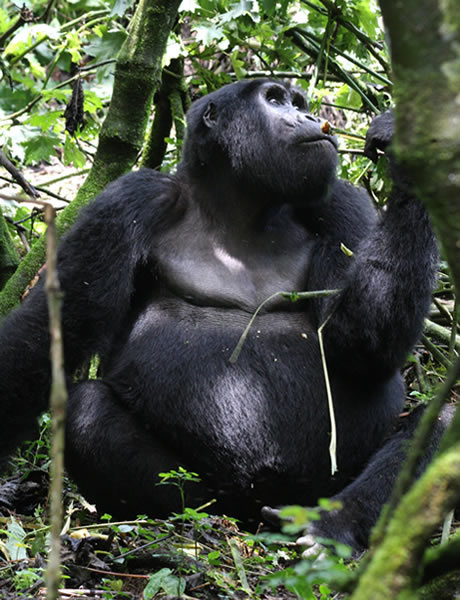
Habituated Gorilla Families of Rwanda and Uganda
Mountain gorillas exist nowhere on Earth except a narrow band of misty volcanic and montane forest straddling three countries: Rwanda, Uganda, and the Democratic Republic of Congo. Of the world’s roughly 1,000 remaining mountain gorillas, the great majority live in two protected areas that welcome visitors — Volcanoes National Park in northern Rwanda and Bwindi Impenetrable National Park in southwestern Uganda, with a smaller population in Uganda’s adjoining Mgahinga Gorilla National Park. What makes it possible for ordinary travellers to sit a few meters from a 200-kilogram silverback is a decades-long process called habituation, in which trackers and rangers spend years accustoming a wild gorilla family to a calm, non-threatening human presence until the animals simply ignore people rather than fleeing or charging.
Bwindi Impenetrable Forest
Buhoma Section
Buhoma Sector
- Mubare – the very first family habituated in Uganda (1993)
- Habinyanja
- Rushegura – split off from Habinyanja
- Katwe
Ruhija Section
Ruhija Sector
- Bitukura
- Oruzogo
- Kyaguriro (the original research group)
- Mukiza – split from Kyaguriro after silverback Rukina’s death
Rushage Section
Rushaga Sector (has the most families)
- Nshongi – originally the largest group ever habituated
- Mishaya – split from Nshongi
- Kahungye
- Bweza
- Busingye
- Mucunguzi
- Bikingi
- Kutu
- Rwigi
- Tindatine
Nkuringo Section
Nkuringo Sector
- Nkuringo – one of the oldest and largest groups
- Christmas
- Bushaho
- Posho
Volcanoes National Park - Rwanda
As for 2026 sources, Volcanoes National Park has around 12 habituated gorilla families open for tourist trekking (plus a few more habituated purely for research). The tourist-visited families most commonly listed are:
- Susa A – the original Dian Fossey research group, later split; famous for a rare set of twins
- Susa B (Karisimbi) – split off from the original Susa group
- Sabyinyo – shares territory with Agashya’s group
- Amahoro – known as one of the calmer, more peaceful families
- Umubano – split from Amahoro
- Agashya (formerly “Group 13”) – led by a dominant silverback who took over from his father Agashya in May 2021
- Kwitonda – a migrant group originally from the Democratic Republic of Congo, named after its dominant silverback whose name means “the humble one”
- Titus – named after the silverback Titus, one of the original gorillas Dian Fossey studied at Karisoke, who as a young gorilla lost most of his family to poachers
- Hirwa – one of the newer habituated groups
- Bwenge
- Ugenda – made up of 11 members, including 2 silverbacks
- Isimbi and Igisha – additional groups that split from the original Susa family in 2009, when the Susa family began splitting into what are today four separate families: Susa, Karisimbi, Isimbi, and Igisha
Some lists also mention Noheli and Muhoza as more recently named/split groups.
There are also a couple of families kept for research only (not open to tourists), including Pablo’s/Shida’s group and Beetsme, from which baby gorillas are sometimes selected for the annual Kwita Izina naming ceremony.
What Habituation Actually Involves
Habituating a gorilla family is neither quick nor casual. Rangers identify a wild, unhabituated troop and then visit it daily, always in the same small numbers, always maintaining a predictable, unaggressive posture — no direct eye contact with the dominant silverback, no sudden movement, minimal noise. Over a period that typically runs two to three years, the gorillas gradually stop treating the humans as a threat. By the end of the process, the family can be approached to within about seven meters by a group of up to eight tourists for a strictly timed one-hour visit, without the animals altering their natural feeding, resting, or social behavior. Uganda also offers a distinct “Gorilla Habituation Experience,” in which a small group of four visitors joins researchers and trackers for up to four hours with a family still partway through habituation — a rawer, less choreographed encounter than a standard trek.
Rwanda’s Volcanoes National Park
Volcanoes National Park sits on the slopes of the Virunga volcanic chain, the same forest where the American primatologist Dian Fossey conducted her pioneering fieldwork from the late 1960s until she died in 1985. Her original study group, the Susa family, remains one of the park’s best-known troops.
Susa was formed in 1974 and is one of the groups Fossey studied.
The family grew to more than 40 members before splintering under the pressure of its own size; the splitting process that began around 2009 eventually produced several distinct families, including Susa itself along with Karisimbi, Isimbi, and Igisha. Susa is famous for a rare pair of twins, Byishimo and Impano, and for ranging so high into the mountains that it can be one of the hardest groups to track.
Rwanda currently maintains somewhere around ten to twelve fully habituated families open to tourism, a number that shifts slightly as groups split, merge, or wander temporarily into Congo or Uganda, alongside a handful of additional families reserved strictly for scientific research. Well-known groups include Susa, Sabyinyo, and Amahoro, with each family ranging from roughly ten to over thirty individuals under the leadership of a dominant silverback, and the daily permit capacity was raised to 96 in 2024.
The Sabyinyo family is famous for its silverback Guhonda, long considered the largest and most powerful alpha in the park; the group ranges on the relatively accessible lower slopes between Mounts Sabyinyo and Gahinga, making it a favourite for less strenuous treks. The Amahoro family, whose name means “peace” in Kinyarwanda, split after the death of its founding silverback into two lineages, Amahoro and Umubano, which still sometimes meet, feed, and travel together for a day or two before separating again. Agashya, formerly known simply as “Group 13” after its founding thirteen members, has one of the more dramatic backstories in the park: it was named for the silverback Agashya, whose name means “news,” after he overthrew the group’s original leader, Nyakarima. The Kwitonda family is unusual for having been habituated across the border in Congo before settling permanently on the Rwandan side around 2004, while Hirwa — Kinyarwanda for “lucky one” — is known for hosting one of the only surviving sets of mountain gorilla twins and for an eventful history that included an extended, near-fatal excursion into Uganda’s Mgahinga Park. Rwanda reinforces the emotional pull of these stories through Kwita Izina, an annual public naming ceremony for gorilla infants that doubles as a high-profile conservation fundraiser.
Trekking a Rwandan family is not cheap: as of 2025, the standard permit runs $1,500 per foreign visitor, among the highest wildlife-viewing fees anywhere in the world, with proceeds funnelled into park protection and neighbouring communities. Treks are capped at eight visitors per family per day, and rangers assign groups to families the morning of the trek based on overnight movements and each visitor’s fitness.
Uganda’s Bwindi Impenetrable National Park
Across the border, Bwindi Impenetrable National Park protects an older, denser forest — technically not part of the Virunga volcanoes at all, but a separate pocket of ancient Afromontane rainforest along the Albertine Rift. Bwindi is a UNESCO World Heritage Site covering roughly 321 square kilometres, and hosts the Bwindi population of mountain gorillas, which by itself makes up almost half of the world’s total.
A 2018 census found 36 social groups totalling 459 mountain gorillas, plus another 16 solitary individuals, living in the park.
Bwindi is organised into four trekking sectors, each with its own cluster of habituated families and its own character.
Buhoma, in the northwest, was the first sector developed for trekking and is known for gentle terrain that suits first-time visitors; its families include Mubare, Rushegura, and Habinyanja.
Mubare holds a special place in the park’s history: it was the very first gorilla family habituated in Bwindi, opened to trekking in 1993, the year after habituation began.
Rushegura split away from Habinyanja and is generally regarded as a large, calm group, while Habinyanja itself takes its name from a Rukiga word for a place with water, referencing the swamp ponds near which it was first encountered.
Ruhija, the highest of the four sectors, is cool and misty and especially prized for birding, home to the Oruzogo and Bitukura families.
Oruzogo is often singled out as the most playful family in the park and became well known after a female there gave birth to twins. Ruhija’s Kyaguriro group has a more turbulent recent history: after its founding silverback died from a lightning strike in 2015, leadership passed to a younger male, and rivalry with an immigrant silverback eventually split the family into Kyaguriro A and Kyaguriro B.
Rushaga, on Bwindi’s southern edge near Kisoro, holds the largest concentration of habituated families in the park and is the only sector offering the four-hour Gorilla Habituation Experience. Its groups include Nshongi, one of the largest habituated families in Bwindi; Mishaya, led by a notably bold and adventurous silverback; and Bweza, Kahungye, Busingye, and Kutu.
Nkuringo, the most remote and physically demanding of the four sectors, rewards trekkers with sweeping views over the forest and the Virunga volcanoes in the distance, along with its own smaller set of habituated families.
Altogether, Bwindi now counts 26 fully habituated gorilla families as of 2026, more than any other single park in the world. A standard Uganda gorilla permit costs $800 per foreign visitor in peak season, dropping to $600 during Uganda Wildlife Authority’s designated low-season months of April, May, and November, while the specialised Habituation Experience runs $1,500. As in Rwanda, groups are capped at eight trekkers per family, with trek length ranging from under an hour to a full day depending on where the gorillas nested the previous night.
Two Populations, One Recovery Story
Genetically and behaviorally, the Bwindi gorillas and the Virunga gorillas of Rwanda, Uganda’s Mgahinga, and Congo are typically treated as two populations of the same mountain gorilla subspecies, though some researchers have proposed that Bwindi’s animals may eventually warrant separate classification. What unites both sides of the border is a genuine conservation turnaround: mountain gorillas were once projected toward extinction, with population estimates as low as a few hundred individuals in the 1980s. Sustained anti-poaching enforcement, revenue-sharing with neighboring communities, and the tourism economy built around habituated families have since driven the total population past 1,000 — one of the few great ape success stories on the planet, and the direct reason that families like Susa, Sabyinyo, Mubare, and Oruzogo now have names, histories, and, in many cases, third and fourth generations of infants born into the forests their grandparents once had to be coaxed into sharing with people at all.
Mountain gorillas (Gorilla beringei beringei) are one of the most extraordinary wildlife encounters on Earth, and gorilla trekking has become a signature safari experience in East Africa for good reason.
Where They Live
Mountain gorillas exist in only two isolated populations, found nowhere else on the planet:
- The Virunga Massif — spanning the borders of Uganda, Rwanda, and the Democratic Republic of Congo, including Volcanoes National Park (Rwanda), Mgahinga Gorilla National Park (Uganda), and Virunga National Park (DRC)
- Bwindi Impenetrable Forest — a dense, ancient rainforest in southwestern Uganda
They live at high altitude, typically between 2,200 and 4,300 meters, in cool, misty mountain forests thick with bamboo and vegetation.
A Conservation Success Story
Mountain gorillas were once considered critically endangered, with numbers dropping below 700 individuals in the late 1980s. Thanks to decades of dedicated conservation work, anti-poaching efforts, and community-based tourism, the population has slowly recovered to just over 1,000 individuals today — one of the only great ape populations in the world that is actually increasing. This recovery is largely credited to the revenue and protection that gorilla trekking tourism generates.
Why It’s Such a Popular Safari Activity
1. Rarity and exclusivity. With only around 1,000 gorillas left and permits deliberately limited (a handful of groups per day, per park), trekking offers an experience very few people on Earth get to have. That scarcity — plus permit costs running from a few hundred to $1,500+ depending on the country — adds to its appeal as a bucket-list activity.
2. Profound closeness with a wild great ape. Habituated gorilla families allow visitors to sit within a few meters of them for a full hour, watching silverbacks, mothers, and playful youngsters go about their day. The eye contact and clear intelligence in their gaze often leaves people deeply moved — many describe it as the most emotional wildlife encounter of their lives.
3. The adventure of the trek itself. Reaching the gorillas isn’t passive — it involves hiking through dense, muddy, high-altitude rainforest, sometimes for a couple of hours, sometimes much longer. The physical effort and unpredictability make the eventual encounter feel earned.
4. Direct conservation impact. Because permit fees fund park protection and local communities, visitors know their trip is directly supporting the survival of an endangered species — a rare case where tourism dollars visibly translate into conservation outcomes.
5. Combines well with other iconic experiences. Uganda and Rwanda pair gorilla trekking with chimpanzee tracking, savanna game drives, and volcano hikes, letting travelers build a broader East African itinerary around it.
If you’re considering it, permits typically need to be booked well in advance (especially in Rwanda, where demand is highest), and July is actually within one of the better trekking windows since the dry season runs roughly June through September.