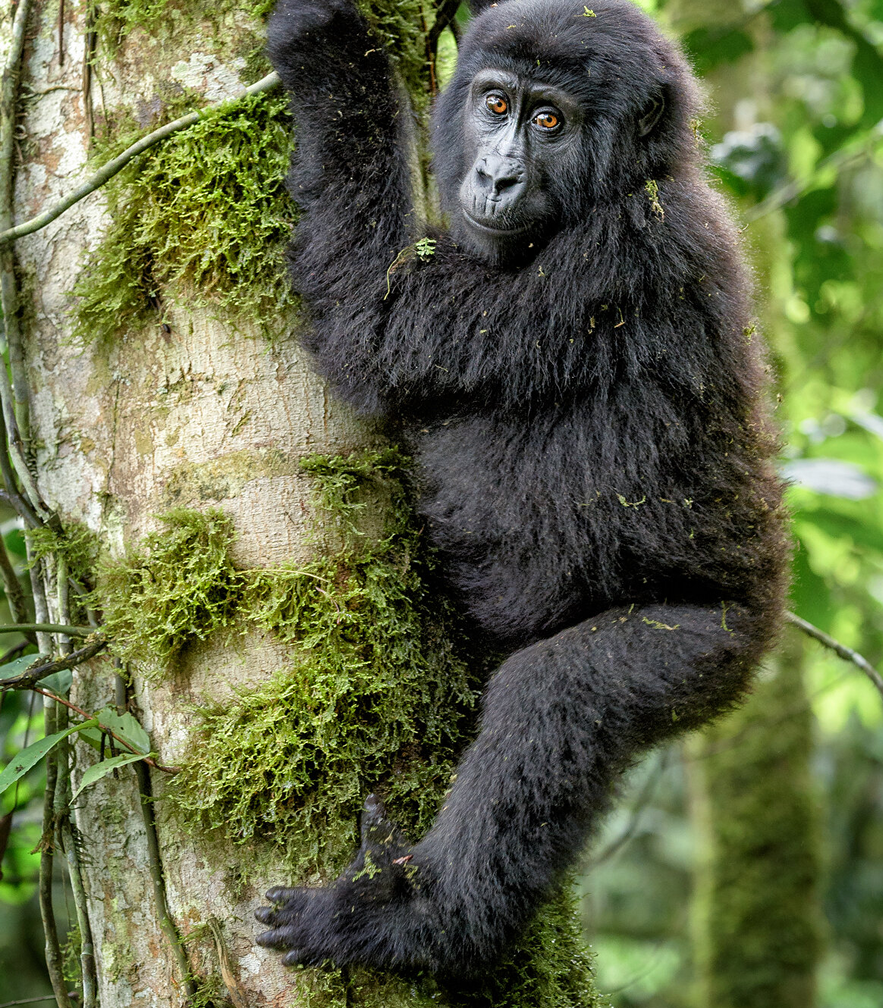
The Mountain Gorilla Population of the Virunga Massif and Bwindi Impenetrable Forest
The mountain gorilla is among the rarest great apes on the planet, found only in two forest ecosystems in East-Central Africa: the Virunga Massif, a volcanic mountain chain shared by Rwanda, Uganda and the Democratic Republic of Congo (DRC), and the Bwindi-Sarambwe ecosystem, anchored by Bwindi Impenetrable Forest in south-western Uganda and the neighboring Sarambwe Nature Reserve in the DRC. The two populations sit roughly 25–30 kilometres apart, separated by farmland and settlement. Early genetic research hinted that Bwindi’s gorillas might form a separate subspecies, but later analysis confirmed both groups are true mountain gorillas. Together they represent a landmark conservation success: a species pulled back from near-extinction through decades of protection, research, cross-border cooperation, and community involvement — the same story that now draws thousands of travelers each year to book Gorilla Trekking Rwanda experiences and Bwindi Gorilla Tours.
Population Status and Trends
By the early 1980s, the mountain gorilla teetered on the edge of extinction. Poaching, civil unrest, habitat destruction and disease had cut the Virunga population to somewhere between 240 and 254 individuals. Primatologist Dian Fossey, who founded the Karisoke Research Centre in Rwanda in 1967 and fought poaching until her murder in 1985, is widely credited with sparking the global conservation effort that followed.
Since then, numbers have climbed steadily, making the mountain gorilla the only wild great ape species confirmed to be growing rather than shrinking. The last complete Virunga census, in 2016, counted at least 604 gorillas across about 41 groups, up from 480 five years prior. In Bwindi-Sarambwe, a 2018 survey recorded 459 gorillas — 36 social groups plus 16 lone silverbacks — up from 400 previously. Combined, the worldwide mountain gorilla population now stands near 1,063, up from about 1,004 in 2018. This progress prompted the IUCN to reclassify the species in 2018 from “Critically Endangered” to “Endangered,” a meaningful, if still fragile, milestone.
A sixth transboundary census of Bwindi-Sarambwe began in May 2025, coordinated by the Greater Virunga Transboundary Collaboration (GVTC) and the International Gorilla Conservation Programme (IGCP) alongside Uganda Wildlife Authority and DRC’s Institut Congolais pour la Conservation de la Nature. For the first time, the survey also tracked the region’s chimpanzee population. Fieldwork wrapped up by late 2025, with full results due in 2026 and expected to refine current estimates. Despite the encouraging trend, conservationists warn the total population remains small and exposed to disease, climate change, habitat pressure, and — in parts of the DRC — ongoing conflict.
The Virunga Massif
The Virunga Massif comprises eight volcanoes — five dormant, three still active — straddling Rwanda, Uganda and the DRC. It is politically split into three protected areas: Volcanoes National Park in north-western Rwanda, Mgahinga Gorilla National Park in south-western Uganda, and Virunga National Park in eastern DRC. Ecologically, though, it functions as one continuous forest, and gorillas move freely across all three borders — making transboundary cooperation essential to the region’s conservation model.
Volcanoes National Park, Africa’s oldest national park (established in 1925 as Albert National Park), spans about 160 square kilometres across five volcanic peaks: Karisimbi, Bisoke, Sabyinyo, Gahinga and Muhabura. It’s Rwanda’s premier tourist destination and home to the historic Karisoke Research Centre, making it the natural starting point for any Adventure Rwanda Safaris itinerary built around gorilla encounters.
Mgahinga Gorilla National Park, Uganda’s smallest park at just 34 square kilometres, sits where Uganda, Rwanda and the DRC meet, beneath the volcanic peaks of Muhabura, Gahinga and Sabyinyo. It shares its ecosystem directly with Volcanoes National Park, and its resident gorilla family regularly crosses into both neighboring countries.
Virunga National Park in the DRC is the largest of the three and Africa’s oldest UNESCO World Heritage-listed park, but prolonged armed conflict and instability in eastern DRC have made large sections difficult and often unsafe to access, sharply limiting organized tourism compared with its Rwandan and Ugandan counterparts.
Bwindi Impenetrable Forest
Bwindi Impenetrable National Park, a UNESCO World Heritage Site in south-western Uganda, ranks among the continent’s oldest and most biodiverse rainforests, thought to have remained largely unchanged for more than 25,000 years. Spread across roughly 331 square kilometres, it shelters over half of the world’s mountain gorillas along with remarkable biodiversity: around 120 mammal species, 340-plus bird species, 11 primate species, and more than 1,000 flowering plant varieties. Bwindi connects with the smaller Sarambwe Nature Reserve just across the DRC border, together forming the Bwindi-Sarambwe ecosystem. Unlike the volcanic slopes and bamboo zones of Virunga, Bwindi’s gorillas live in dense, steep, mid-altitude tropical rainforest — terrain that gives the park its name, meaning “a place of darkness,” and makes any of the region’s Bwindi Gorilla Tours notably more physically demanding than trekking in Rwanda.
Gorilla Families Available for Tracking
Tracking is only possible with gorilla families that have been “habituated” — a roughly two-year process in which researchers gradually accustom a wild group to human presence without changing its natural behavior. Only habituated families welcome tourists; the rest remain reserved for research or left undisturbed. Across the three most-visited parks, the approximate numbers of trackable families are:
Volcanoes National Park (Rwanda): around 12 habituated families are open daily out of roughly 18–20 total groups, with the remainder reserved for ongoing research by Karisoke. Popular groups for anyone planning Gorilla Trekking Rwanda include Susa, Sabyinyo, Amahoro, Umubano, Kwitonda, Agashya, Hirwa, Bwenge, Karisimbi, Ugenda, Kwisanga and Muhoza. A strict cap of eight visitors per family per day caps total daily permits at around 96, priced at US$1,500 per person.
Mgahinga Gorilla National Park (Uganda): only one habituated family, Nyakagezi, is currently trackable — making Mgahinga the most exclusive but least predictable of the three parks, since the group periodically wanders into Rwanda or the DRC. When present, it offers about eight permits daily at US$800 per person.
Bwindi Impenetrable National Park (Uganda): by far the largest number, with roughly 19–22 habituated families spread across four sectors — Buhoma, Ruhija, Rushaga and Nkuringo. Buhoma and Ruhija each host several groups (including Mubare, Habinyanja, Rushegura, Bitukura, Oruzogo and Kyaguliro), Rushaga is the largest sector with families like Nshongi, Mishaya, Busingye, Kahungye and Bweza, and Nkuringo has its own smaller cluster. This scale makes Bwindi Africa’s premier gorilla-tracking destination and the only park offering a second trek in a different sector on consecutive days — a major draw for operators building multi-day Adventure Gorilla Tours packages.
(Virunga National Park in the DRC also maintains several habituated families — historically around eight — but access has fluctuated due to insecurity, so it isn’t typically counted among the three most consistently accessible tracking parks.)
Conservation Measures
Volcanoes National Park, Rwanda. Rwanda runs one of the world’s most tightly managed gorilla conservation and tourism systems. The Rwanda Development Board deploys armed ranger patrols and trackers who monitor every habituated family daily, deterring poaching and snaring and catching injury or illness early. High-value, low-volume tourism — permits capped at eight visitors per family and deliberately priced high — limits stress on the animals while generating substantial revenue, a share of which by law flows back to neighboring communities through revenue-sharing schemes funding schools, clinics and infrastructure. Former poachers have been formally brought into tourism and conservation roles, including through the Iby’Iwacu Cultural Village. The NGO Gorilla Doctors provides regular veterinary checks and emergency care, and Rwanda hosts the annual Kwita Izina gorilla-naming ceremony, reinforcing political commitment and international visibility. This robust framework is a big part of why Adventure Rwanda Safaris built around gorilla trekking have become so popular with responsible travelers.
Mgahinga Gorilla National Park, Uganda. The Uganda Wildlife Authority (UWA) manages conservation here through ranger-based anti-poaching patrols, boundary monitoring, and close coordination with Rwandan and Congolese authorities, since the park’s single resident family ranges across all three countries. Protection depends heavily on the Greater Virunga Transboundary Collaboration (GVTC), a treaty signed by Rwanda, Uganda and the DRC in 2015 that coordinates joint patrols, shared law enforcement, disease surveillance and information exchange across the whole ecosystem. Golden monkey tracking and volcano hikes supplement gorilla permit revenue, funding community projects and easing pressure on the forest.
Bwindi Impenetrable National Park, Uganda. Bwindi’s strategy similarly rests on UWA ranger patrols against poaching, snaring and illegal logging, backed by community conservation rangers and local scouts. The Institute of Tropical Forest Conservation conducts long-term ecological and health research, while Gorilla Doctors and Conservation Through Public Health work to limit disease transmission between humans and gorillas — a serious concern given how genetically close the two species are and how densely populated the surrounding area is. The Bwindi Mgahinga Conservation Trust channels tourism revenue and donor funding into community development, education and alternative livelihoods for the roughly half a million people living around the park. Strict visitor rules — minimum viewing distance, mask requirements during respiratory outbreaks, group size limits and a one-hour viewing cap — protect both gorillas and guests on every trek. Bwindi also takes part in the GVTC/IGCP transboundary census and collaborates with Sarambwe Nature Reserve authorities to manage the shared ecosystem as one unit.
Conclusion
The mountain gorilla’s recovery — from fewer than 300 individuals in the 1980s to over 1,000 today — stands as one of conservation’s great achievements, built on ranger protection, veterinary care, scientific monitoring, regulated high-value tourism, and transboundary cooperation between Rwanda, Uganda and the DRC. Yet the species remains Endangered, confined to two small forest islands surrounded by some of Africa’s densest human populations. Continued vigilance against poaching, disease, habitat loss, climate change and conflict will decide whether this fragile recovery holds — and whether the next generation of travelers booking Adventure Gorilla Tours, Gorilla Trekking Rwanda, Bwindi Gorilla Tours, or Adventure Rwanda Safaris will still get to look a mountain gorilla in the eye.
Short Duration Packages
1-Day Gorilla Safari from Kigali The shortest option includes departing Kigali very early in the morning and getting to Volcanoes National Park. This is ideal for those with very limited time.
2-3 Day Gorilla Trekking Safari A 3-day gorilla trekking safari is a short but effective option where you arrive in Kigali, go to Volcanoes National Park, do trekking, and return. The cheapest 2-day, 1-night gorilla trekking safaris out of the Rwandan capital Kigali start at around US$2,000 per person, usually inclusive of transport from Kigali, a transfer to the trailhead, accommodations, meals and the US$1,500 trekking permit.
Medium Duration Packages
3-Day Gorilla and Golden Monkey Trekking Safari This package gives you a chance to track mountain gorillas and golden monkeys in their natural habitats.
3-Day Gorilla Trek and Dian Fossey Hike An affordable option that includes trekking the endangered mountain gorillas in Volcanoes National Park as well as hiking the Dian Fossey grave.
5-Day Rwanda Safari A 5-day Rwanda safari includes gorilla trekking, golden monkeys, and city tour.
Low Season 4-Day Package Rwanda Safari & Akagera Safari offers a Low Season 4-Day Safari & Gorilla Trekking package which includes low season discounts on accommodation and park permits, with travelers spending a minimum of two nights in Akagera or Nyungwe National Park before trekking to see mountain gorillas.
Longer/Luxury Packages
6-Night Luxury safari holiday; A 6-night luxury journey through Rwanda combines a private Akagera safari with a stay in the Volcanoes region for mountain gorilla and golden monkey trekking.
8-Day Volcanoes and Nyungwe Park Safari This safari offers the opportunity to see primates and gorillas in Volcanoes National Park as well as combine visits to Nyungwe Park.
Key Activities Included
Beyond gorilla trekking, Volcanoes National Park offers diverse adventures including golden monkey tracking through bamboo forests, volcano hiking to Mount Bisoke’s crater lake at 3,711m, and Mount Karisimbi at 4,507m.
Most packages operate year-round, though between November and May, visitors can receive a 30% discount on Rwanda gorilla trekking permits from the Rwanda Development Board.