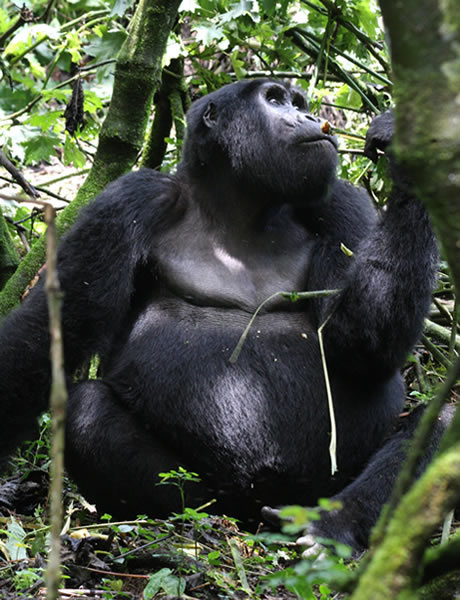
The Grey Silverback Mountain Gorilla: Patriarch of the Family
In the misty volcanic highlands that straddle Rwanda, Uganda, and the Democratic Republic of Congo, the mountain gorilla lives out one of the animal kingdom’s most compelling family dramas. At the center of this drama stands the silverback, the mature male whose name comes from the distinctive swath of grey or silver hair that spreads across his back and hips as he ages, a visible badge of seniority that marks him as leader, protector, and patriarch of his troop.
The Making of a Silverback
A male mountain gorilla is not born silver. He arrives dark-coated, much like every other infant in the group, and remains so through infancy and the boisterous years of juvenility. Around the age of eight, as he transitions into what primatologists call the blackback stage, his body begins to fill out with the early signs of the muscular bulk that will eventually define him. It is not until he reaches twelve to fifteen years of age that the telltale saddle of grey hair emerges across his back, signaling full sexual and social maturity. By this point, a silverback may weigh between 300 and 430 pounds and stand roughly five to six feet tall when upright, with an arm span that can exceed eight feet. His canine teeth lengthen, his sagittal crest (the bony ridge atop his skull that anchors his powerful jaw muscles) becomes more pronounced, and his overall presence shifts from adolescent gangliness to commanding bulk. This physical transformation is not merely cosmetic. It is the silverback’s entire toolkit for the role he is about to assume.
Structure of the Troop
Mountain gorilla society is built around small, tightly knit family groups, typically numbering somewhere between five and thirty individuals, though groups of ten to twenty are most common. At the head of nearly every group sits a single dominant silverback, though some troops, particularly larger ones, may contain a second, subordinate silverback who is often a son or younger brother of the leader, tolerated as a kind of understudy or eventual successor. Beneath the silverback in the social hierarchy are several adult females, their dependent offspring, and sometimes a blackback or two nearing maturity. Unlike many primate societies, mountain gorilla groups are not matrilineal strongholds; rather, the silverback is the gravitational center around which the entire group’s movements, decisions, and safety revolve.
This is, in essence, a harem structure, though one tempered by genuine social bonds rather than pure dominance. Females are not born into the group they eventually join. Instead, when they reach sexual maturity at around eight years old, they leave their natal group, sometimes transferring directly to an established troop, sometimes joining a lone silverback who is striking out to build a group of his own. This female dispersal is a crucial feature of gorilla society, since it prevents inbreeding and gives females some degree of choice in selecting which male’s protection and genetic legacy they will accept.
The Silverback’s Daily Work
The silverback’s responsibilities are constant and varied. He determines where the group forages, rests, and nests each night, since mountain gorillas build fresh sleeping nests from vegetation every evening, rarely using the same spot twice. He mediates disputes among group members, intervening when squabbles break out between females or when juveniles roughhouse too aggressively. He is the primary defender against external threats, whether those threats come from predators (rare at this altitude, since adult gorillas have few natural enemies) or, far more commonly, from rival silverbacks attempting to lure away females or, in the most dangerous encounters, from poachers’ snares.
When confronted, a silverback’s defensive display is one of the most dramatic spectacles in the natural world. He may stand upright, beat his chest with cupped hands producing a hollow, resonant drumming, tear at vegetation, charge forward on all fours, and bark out a series of escalating vocalizations. This display is largely theater, an attempt to resolve conflict through intimidation rather than actual combat, since silverbacks understand instinctively that physical fights carry real risk of injury to himself and, by extension, vulnerability for the family he protects. Genuine fights, when they do occur, between rival males vying for females or territory, can be brutal and occasionally fatal, but the vast majority of confrontations are settled through these dramatic, mostly bloodless shows of force.
Bonds Beyond Dominance
What distinguishes mountain gorilla society from a simple dominance hierarchy is the depth of affection and grooming behavior that runs through the group. Silverbacks are notably gentle with infants, often allowing the youngest members of the troop to climb on them, play in their laps, or sleep nested against their massive frames. Researchers who have spent decades observing these gorillas, following the pioneering fieldwork of Dian Fossey in the Virunga Mountains, have documented silverbacks adopting orphaned infants after a mother’s death, carrying them, sharing nests with them, and integrating them fully into the group’s protective embrace. This nurturing dimension complicates any simple reading of the silverback as merely an authoritarian figure; he is as much caregiver as he is enforcer.
Females, for their part, maintain close relationships with their own offspring for years. A mother gorilla nurses her infant for roughly three years and carries it constantly in the early months, the bond between them remaining visible long after weaning as juveniles continue to forage and rest near their mothers. Siblings, half-siblings, and unrelated juveniles within the same troop often form playful associations, wrestling, chasing, and exploring together under the loose supervision of the adults, behavior that builds the social skills they will need later in life.
Succession and Change
A group’s stability hinges almost entirely on the health and authority of its lead silverback. When a dominant male dies or is overthrown, the consequences ripple through the entire troop. Females may disperse to join other groups, infants are sometimes at risk from incoming males who, in a behavior documented though distressing, may kill unrelated infants to bring females back into reproductive readiness more quickly. A subordinate silverback, if present, may step into the leadership role and the group continues largely intact; otherwise, the troop can fragment entirely, with females scattering to seek protection elsewhere. This vulnerability at moments of transition underscores just how central the silverback truly is. He is not merely a figurehead but the structural keystone holding the family together.
A Fragile Legacy
Mountain gorillas remain endangered, though decades of conservation work, anti-poaching patrols, habituated tourism, and veterinary intervention have helped their numbers climb from a low of a few hundred individuals in the 1980s to just over a thousand today, a rare conservation success story among great apes. Each surviving family group, with its silverback patriarch at the center, represents not just a biological unit but a living continuation of social traditions that have been observed, named, and followed by researchers for generations. To watch a silverback gently cradle an infant moments after delivering a thunderous chest-beating display is to witness the full range of what makes mountain gorilla society so remarkable: an intricate balance of strength and tenderness, hierarchy and bond, that has allowed this most magnificent of apes to endure against considerable odds.
Mountain gorillas (Gorilla beringei beringei) are one of the most extraordinary wildlife encounters on Earth, and gorilla trekking has become a signature safari experience in East Africa for good reason.
Where They Live
Mountain gorillas exist in only two isolated populations, found nowhere else on the planet:
- The Virunga Massif — spanning the borders of Uganda, Rwanda, and the Democratic Republic of Congo, including Volcanoes National Park (Rwanda), Mgahinga Gorilla National Park (Uganda), and Virunga National Park (DRC)
- Bwindi Impenetrable Forest — a dense, ancient rainforest in southwestern Uganda
They live at high altitude, typically between 2,200 and 4,300 meters, in cool, misty mountain forests thick with bamboo and vegetation.
A Conservation Success Story
Mountain gorillas were once considered critically endangered, with numbers dropping below 700 individuals in the late 1980s. Thanks to decades of dedicated conservation work, anti-poaching efforts, and community-based tourism, the population has slowly recovered to just over 1,000 individuals today — one of the only great ape populations in the world that is actually increasing. This recovery is largely credited to the revenue and protection that gorilla trekking tourism generates.
Why It’s Such a Popular Safari Activity
1. Rarity and exclusivity. With only around 1,000 gorillas left and permits deliberately limited (a handful of groups per day, per park), trekking offers an experience very few people on Earth get to have. That scarcity — plus permit costs running from a few hundred to $1,500+ depending on the country — adds to its appeal as a bucket-list activity.
2. Profound closeness with a wild great ape. Habituated gorilla families allow visitors to sit within a few meters of them for a full hour, watching silverbacks, mothers, and playful youngsters go about their day. The eye contact and clear intelligence in their gaze often leaves people deeply moved — many describe it as the most emotional wildlife encounter of their lives.
3. The adventure of the trek itself. Reaching the gorillas isn’t passive — it involves hiking through dense, muddy, high-altitude rainforest, sometimes for a couple of hours, sometimes much longer. The physical effort and unpredictability make the eventual encounter feel earned.
4. Direct conservation impact. Because permit fees fund park protection and local communities, visitors know their trip is directly supporting the survival of an endangered species — a rare case where tourism dollars visibly translate into conservation outcomes.
5. Combines well with other iconic experiences. Uganda and Rwanda pair gorilla trekking with chimpanzee tracking, savanna game drives, and volcano hikes, letting travelers build a broader East African itinerary around it.
If you’re considering it, permits typically need to be booked well in advance (especially in Rwanda, where demand is highest), and July is actually within one of the better trekking windows since the dry season runs roughly June through September.