About
Karisoke Research Centre: Dian Fossey’s Legacy in Volcanoes National Park
High in the saddle between two of the Virunga volcanoes, Mount Bisoke and Mount Karisimbi, lies a clearing that once held one of the most important field research stations in the history of primatology. This is Karisoke — a name formed by combining “Kari” from Karisimbi and “soke” from Visoke (the local name for Bisoke) — and it is where the American primatologist Dian Fossey built her life’s work studying and protecting the mountain gorillas of Rwanda.
The Origins of Karisoke
In 1967, Dian Fossey left the forests of the Democratic Republic of Congo because of growing insecurity there and established her research base between the Bisoke and Karisimbi volcanoes, a site that became known as the Karisoke Research Centre. She had originally been trained and encouraged by the paleoanthropologist Louis Leakey, who saw in her the same potential he had recognized in Jane Goodall and Biruté Galdikas. At Karisoke, Fossey pioneered techniques for habituating wild gorillas to human presence, painstakingly building trust with individual gorilla families over years of daily observation.
Her research fundamentally changed how the world understood mountain gorillas — dispelling the “King Kong” myth of a violent, dangerous beast and revealing instead a species with complex social bonds, gentle temperaments, and close family structures. But Fossey’s work was inseparable from activism. She became a driving force behind gorilla conservation, mobilizing efforts to protect the animals from poaching and hunting. Her methods were often confrontational — she was known for destroying poachers’ snares, publicly shaming hunters, and clashing with local authorities and even fellow conservationists over her aggressive approach.
That confrontation ultimately cost her life. Fossey was murdered in 1985, and she was buried at the research centre beside the grave of Digit, a gorilla who had been one of her favourites and who was himself killed by poachers years earlier. Her murder was never conclusively solved, and it remains one of the more haunting mysteries in the history of conservation. Today, her gravesite sits within a small gorilla graveyard at the former research camp, where Digit and several other gorillas she studied and lost are also buried — a quiet, moving place that visitors describe as more of a pilgrimage than a tourist stop.
The original research buildings no longer stand in any substantial form; the site was largely destroyed and looted during the early 1990s, when Volcanoes National Park became a battleground in Rwanda’s civil war, a period that halted tourism in the park entirely until 1999. What remains today are building foundations, overgrown clearings, and the graves themselves — remnants that speak more to the site’s history than to any physical grandeur. The Dian Fossey Gorilla Fund, the organization she founded, continues her research and conservation mission and still operates in the region, now supporting the protection of several of Rwanda’s habituated gorilla families as part of its broader work.
Where Karisoke Sits
Volcanoes National Park itself occupies the Rwandan portion of the Virunga Massif, a chain of volcanoes in the country’s northwest that it shares a border with along the Democratic Republic of Congo and Uganda. The park is roughly two hours by road from Kigali, along well-paved routes through Rwanda’s characteristic terraced hillsides, making it an easily accessible day trip from the capital, though most visitors base themselves in the nearby town of Musanze (formerly Ruhengeri) or in one of the lodges near the park headquarters at Kinigi.
Karisoke’s original site lies in the saddle area between Bisoke and Karisimbi — hence its name — at high altitude within dense montane forest. It is not a peak in itself but rather a historical and memorial site nestled within the mountain landscape, which is part of why the hike to reach it is often described more as a reflective walk into history than a mountaineering challenge.
The Hike to Karisoke
Like all activities in Volcanoes National Park, the day begins early. Visitors are required to gather at the park headquarters in Kinigi by around 7:00 a.m., where a briefing takes place before transport to the trailhead. From the headquarters, it is roughly a thirty-minute drive to the start of the trail, followed by a ten-minute walk to the edge of the park boundary, at which point the ascent through the forest begins.
The climb through the woodland to reach the former research camp and Fossey’s grave typically takes somewhere between two and four hours, depending on a hiker’s fitness level and how much time they spend along the way. This makes it a moderate hike rather than an extreme one — considerably less demanding than summiting Karisimbi (Rwanda’s highest peak, at over 4,500 metres) but more sustained than a casual stroll, since the trail gains real elevation through thick, often muddy montane forest. Sturdy hiking boots, waterproof clothing, and trekking poles are commonly recommended, as the trail can be slippery, particularly outside the dry season. Porters are available for hire at the park headquarters for those who want assistance carrying gear or navigating the steeper sections.
Once at the site, visitors are guided to the small clearing where the remnants of the research camp lie, and then to the graves of Fossey and the gorillas buried near her, including Digit. Guides typically offer context about Fossey’s life, her research methods, and the events surrounding her death, turning the visit into as much a history lesson as a physical hike. Given the round trip — including the ascent, time at the site, and the descent — the full excursion generally takes the better part of a day, often five to six hours total once travel to and from the trailhead is included.
Many travellers choose to combine the Karisoke hike with a golden monkey trek or schedule it the day before or after gorilla trekking, since both activities begin from the same park headquarters and share a similar early-morning structure. It is a popular way to add historical depth to a Rwanda gorilla safari without the cost or physical demands of a full volcano summit.
Costs
The park fee for the Dian Fossey Grave Hike to the Karisoke Research Camp currently stands at USD $75 per person, and this fee includes the cost of the guide. Some sources list this figure slightly differently — one puts the hiking permit at USD $75 per person as well, noting that part of the proceeds goes toward supporting gorilla conservation projects — so travellers should treat $75 as the reliable current benchmark, though it’s always worth confirming the exact figure with the Rwanda Development Board or a tour operator before booking, since park fees are periodically revised.
This $75 permit fee is separate from, and considerably less than, Rwanda’s standard gorilla trekking permit, which costs $1,500 per person for all foreign nationals — a price that reflects Rwanda’s positioning as a premium, low-volume gorilla tourism destination compared with Uganda’s $800 permit or the DRC’s $400 permit. It’s also worth noting that volcano hikes up Bisoke, Karisimbi, or Muhabura each require their own separate hiking permits, distinct again from the Karisoke/Dian Fossey permit — so visitors planning a fuller itinerary in the park should budget for each activity individually.
Beyond the permit itself, additional costs to factor in include:
- Transport to and from Kigali or Musanze to the park headquarters at Kinigi (often arranged through a tour operator or private driver)
- Tips for guides and porters, which are customary though not mandatory
- Porter hire, if desired, for carrying bags or providing support on the ascent
- Accommodation in Musanze or near Kinigi, ranging from budget guesthouses to luxury lodges such as Bisate Lodge or Sabyinyo Silverback Lodge
Because permits can sell out and are tied to specific dates, most visitors book through a licensed tour operator or directly via the Rwanda Development Board’s tourism reservation system well in advance of their planned visit.
A Journey Into Conservation History
What makes the hike to Karisoke distinctive within Volcanoes National Park’s roster of activities is that it is less about wildlife spectacle and more about legacy. Where gorilla trekking offers a direct, visceral encounter with the animals Fossey dedicated her life to protecting, the Karisoke hike offers something quieter: a walk into the physical and emotional landscape where that protection began, and where it ultimately cost its most famous champion her life. For many visitors, particularly those pairing it with gorilla trekking, it provides essential context — a reminder that the mountain gorillas surviving in Rwanda’s forests today exist in no small part because of the work that started in this clearing between two volcanoes nearly six decades ago.
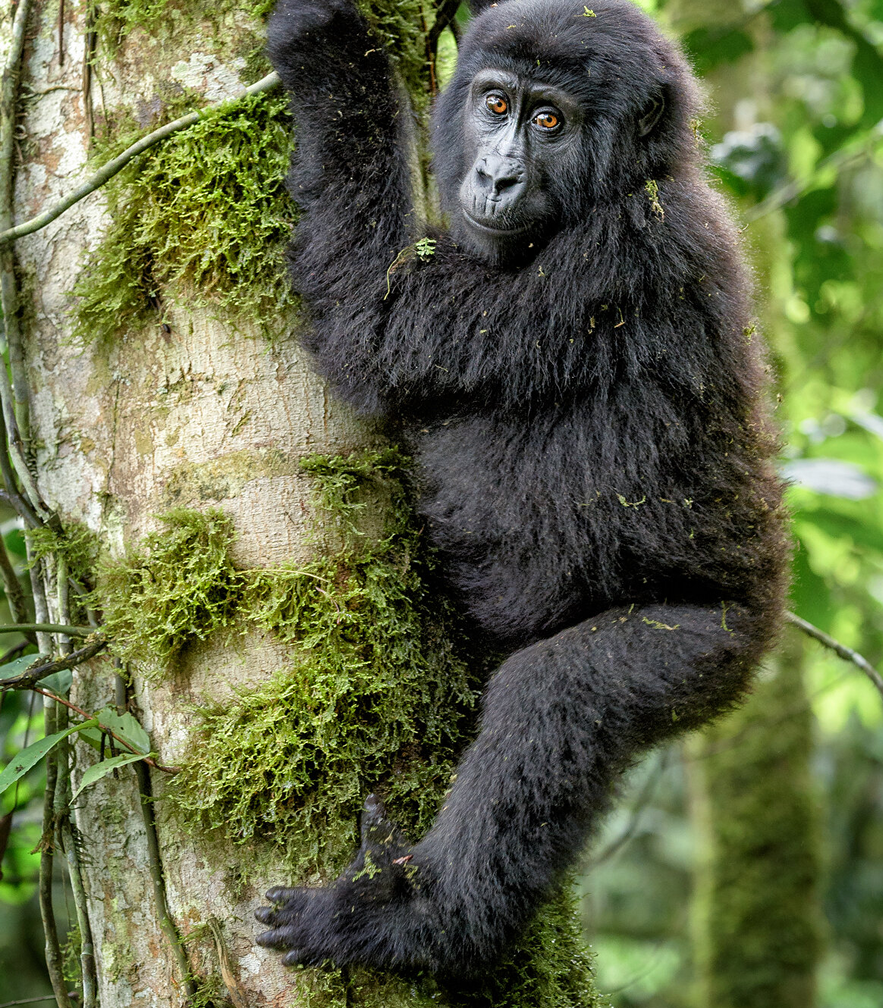
Mountain gorillas (Gorilla beringei beringei) are one of the most extraordinary wildlife encounters on Earth, and gorilla trekking has become a signature safari experience in East Africa for good reason.
Where They Live
Mountain gorillas exist in only two isolated populations, found nowhere else on the planet:
- The Virunga Massif — spanning the borders of Uganda, Rwanda, and the Democratic Republic of Congo, including Volcanoes National Park (Rwanda), Mgahinga Gorilla National Park (Uganda), and Virunga National Park (DRC)
- Bwindi Impenetrable Forest — a dense, ancient rainforest in southwestern Uganda
They live at high altitude, typically between 2,200 and 4,300 meters, in cool, misty mountain forests thick with bamboo and vegetation.
A Conservation Success Story
Mountain gorillas were once considered critically endangered, with numbers dropping below 700 individuals in the late 1980s. Thanks to decades of dedicated conservation work, anti-poaching efforts, and community-based tourism, the population has slowly recovered to just over 1,000 individuals today — one of the only great ape populations in the world that is actually increasing. This recovery is largely credited to the revenue and protection that gorilla trekking tourism generates.
Why It’s Such a Popular Safari Activity
1. Rarity and exclusivity. With only around 1,000 gorillas left and permits deliberately limited (a handful of groups per day, per park), trekking offers an experience very few people on Earth get to have. That scarcity — plus permit costs running from a few hundred to $1,500+ depending on the country — adds to its appeal as a bucket-list activity.
2. Profound closeness with a wild great ape. Habituated gorilla families allow visitors to sit within a few meters of them for a full hour, watching silverbacks, mothers, and playful youngsters go about their day. The eye contact and clear intelligence in their gaze often leaves people deeply moved — many describe it as the most emotional wildlife encounter of their lives.
3. The adventure of the trek itself. Reaching the gorillas isn’t passive — it involves hiking through dense, muddy, high-altitude rainforest, sometimes for a couple of hours, sometimes much longer. The physical effort and unpredictability make the eventual encounter feel earned.
4. Direct conservation impact. Because permit fees fund park protection and local communities, visitors know their trip is directly supporting the survival of an endangered species — a rare case where tourism dollars visibly translate into conservation outcomes.
5. Combines well with other iconic experiences. Uganda and Rwanda pair gorilla trekking with chimpanzee tracking, savanna game drives, and volcano hikes, letting travelers build a broader East African itinerary around it.
If you’re considering it, permits typically need to be booked well in advance (especially in Rwanda, where demand is highest), and July is actually within one of the better trekking windows since the dry season runs roughly June through September.