Congo Gorilla Safaris: Complete 2026 Guide to DRC & Odzala-Kokoua Trekking
What the Term Covers
“Congo Gorilla Safaris” means two related things. In the broadest sense, it describes the entire category of gorilla-trekking tourism centered on the Congo Basin — trips built around the only place on Earth where travelers can see all three living gorilla subspecies within a single country: the Democratic Republic of Congo (DRC), home to mountain gorillas and Eastern lowland (Grauer’s) gorillas, and the neighboring Republic of Congo (Congo-Brazzaville), home to Western lowland gorillas. In a narrower sense, it is also the actual trading name of several small tour operators — most visibly a Goma- and Bukavu-based outfit called Congo Gorilla Safaris, run under the umbrella of Primate Safari Experiences, which packages trekking permits, 4×4 transport, guiding, and accommodation into multi-day itineraries across DRC, Uganda, and Rwanda. This account covers both senses: the destinations themselves and what booking a trip through operators using this name actually involves in 2026.
Three Gorillas, Two Countries
The DRC’s claim to fame is holding two gorilla subspecies close together.
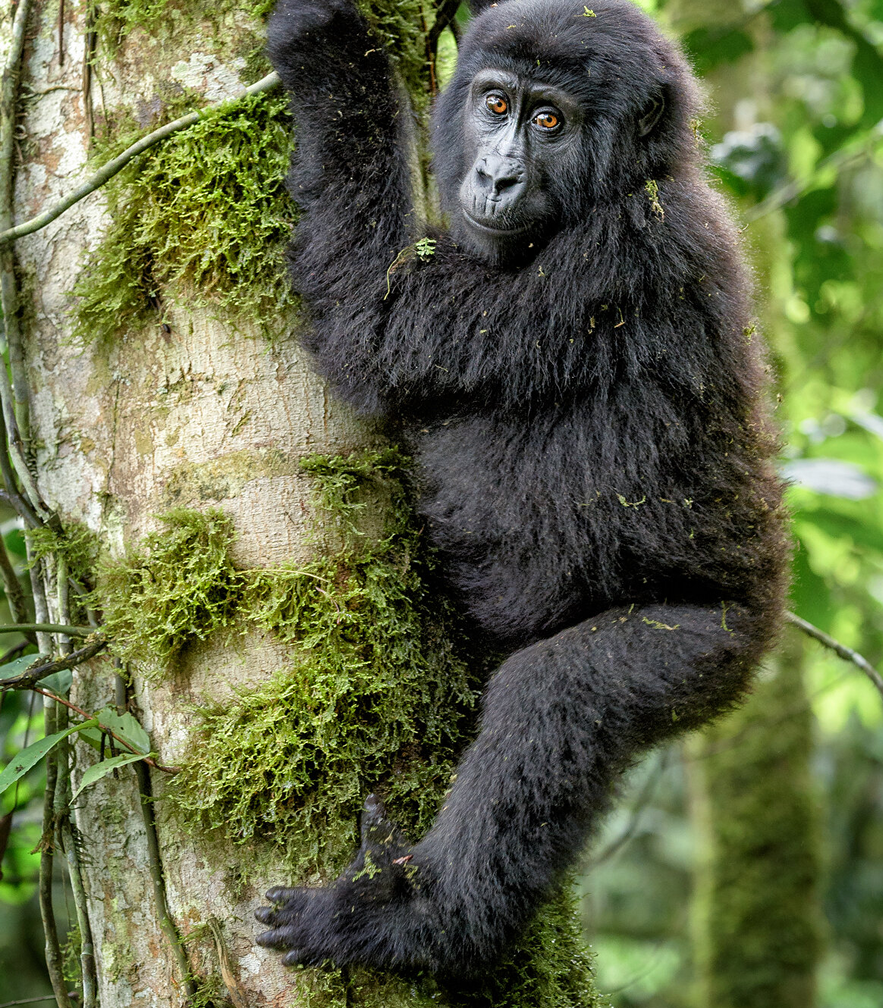
Congo’s mountain gorillas tend to be larger with a darker coat, while the Eastern lowland subspecies is somewhat smaller with lighter, greyish hair. Mountain gorillas live in Virunga National Park in North Kivu province, part of the volcanic Virunga Massif shared with Rwanda and Uganda. Eastern lowland gorillas — found nowhere else on Earth in trekkable form — live in Kahuzi-Biega National Park in South Kivu, near Bukavu on Lake Kivu’s western shore. Across the river in the Republic of Congo, Odzala-Kokoua National Park and the more remote Nouabalé-Ndoki protect Western lowland gorillas, a different and more numerous subspecies found across several Central African countries.
Virunga National Park
Virunga is Africa’s oldest national park, gazetted in 1925, a UNESCO World Heritage Site, and one of the most biodiverse protected areas on the continent. Spanning roughly 790,000 hectares, it ranges from swamps and steppes to the Rwenzori’s permanent snowfields above 5,000 meters, and from lava plains to volcanic savannahs, hosting mountain gorillas alongside some 20,000 hippos. It holds roughly 200 of the world’s remaining mountain gorillas across several habituated families, and its centrepiece volcano, Mount Nyiragongo, has historically drawn hikers to its lava lake.
The park’s tourism history, though, has been defined less by wildlife than by conflict. Repeated militia activity forced closures throughout the 2010s and 2020s.
The 2021 eruption of Mount Nyiragongo sent lava flows into chalets at its summit, and M23 rebel attacks in the same period damaged the gorilla-viewing sector, forcing further suspensions of eco-tourism; for a long stretch, only Tchegera Island on Lake Kivu remained consistently open, while the park’s central savanna zone and the northern Rwenzori sector stayed closed for security reasons. The situation deteriorated sharply from 2022 onward. Virunga has been closed since 2023, after the M23 rebel group’s rapid military campaign led to the takeover of Goma and Bukavu, and roughly 175 park staff have been killed by rebel elements and poachers over the past decade.
As of 2026, the picture is grim and current, not historical. Virunga remains on UNESCO’s List of World Heritage in Danger, with the World Heritage Committee citing armed groups as an ongoing, unresolved threat; kidnapping risk, armed ambush on roads, and active military clashes are documented and current. Both Virunga and Kahuzi-Biega sit inside North and South Kivu provinces, under a Level 4 “Do Not Travel” advisory from the U.S. State Department and the UK Foreign Office — the same rating applied to active war zones — with M23 occupying significant territory inside North Kivu, including parts of the park itself, park rangers killed in direct attacks, eco-guard posts abandoned, and the U.S. government stating it has extremely limited ability to provide emergency consular assistance in the Kivus.
Some operators with deep local security relationships continue to run tightly escorted trips when conditions briefly allow, but this is no longer a standard tourism product; several established agencies have publicly stopped selling Virunga and Kahuzi-Biega itineraries for exactly this reason. Anyone encountering marketing that presents Congo mountain-gorilla trekking as routine and low-risk should treat that framing with real scepticism and verify current conditions directly with the Congolese Institute for the Conservation of Nature (ICCN) and their home government’s travel advisory before booking.
Historically, when the park has been open, the appeal has been strong: eight or more habituated gorilla families (Rugendo, Kabirizi, Bageni, and others), a Senkwekwe orphanage for gorillas rescued from poaching, chimpanzee trekking and habituation experiences, guided rainforest walks, birding across more than 700 recorded species, and — when conditions allow — the Nyiragongo hike. Congo permits have also historically undercut regional prices, with mountain gorilla permits priced around $400 against roughly $800 in Uganda and $1,500 in Rwanda, though that cost advantage is irrelevant while the park itself is inaccessible to ordinary travellers.
Kahuzi-Biega National Park
Kahuzi-Biega, near Bukavu on Lake Kivu, was created specifically to protect Grauer’s (Eastern lowland) gorillas, the largest living gorilla subspecies, alongside chimpanzees, forest elephants, and dense montane rainforest. It has traditionally offered a gentler introduction to Congo gorilla trekking than Virunga, being logistically simpler to reach from Rwanda via Bukavu, and popular with travellers combining it with a Rwanda gorilla safari. It shares Virunga’s problem, however: it sits inside South Kivu, within the same Level 4 no-travel zone described above, and recent unrest around the park has repeatedly disrupted access.
Odzala-Kokoua: The Working Alternative
The safer and, in 2026, genuinely operational half of “Congo gorilla safaris” lies across the river, in the Republic of Congo (Congo-Brazzaville). Odzala-Kokoua National Park, established in 1935 and one of Africa’s oldest protected areas, sits in the Congo Basin — the world’s second-largest rainforest after the Amazon — and covers roughly 13,500 square kilometres of primary forest, swamp, and savanna-forest mosaic. It is managed by the conservation NGO African Parks on behalf of the Congolese government and protects an estimated 7,200 Western lowland gorillas alongside some 7,500 forest elephants, bongo antelope, forest buffalo, and over 440 bird species.
Trekking here is different in character from mountain gorilla trekking further east. Rather than climbing volcanic slopes, visitors move through dense lowland rainforest and use natural clearings called bais — mineral-rich openings where gorillas, elephants, and buffalo gather to feed and drink — as vantage points, along with river travel by boat and kayak. Treks depart in small groups of three or four guests with a guide and tracker, and habituated families can be watched for roughly an hour. Congo-Brazzaville itself is considered a safe, stable destination for tourists, and its tarred national road from the capital is in good condition, though the park remains remote: road transfers from Brazzaville take nine to ten hours, and most visitors instead fly a chartered two-hour route to Mboko airstrip before a further road transfer of two to three hours into the park’s lodges — Ngaga, Lango, and Mboko among them.
None of this is inexpensive. A single gorilla tracking permit runs approximately $750 in 2026, and full seven-to-eleven-day packages covering charter flights, luxury tented lodging, and guided tracking typically range from $11,000 to over $21,000 per person. That price reflects genuine exclusivity — small guest numbers, high logistics costs, and a research-driven, low-impact philosophy — rather than padding, and it stands in sharp contrast to the now largely theoretical bargain pricing once quoted for Virunga.
Booking, Permits, and Logistics in Practice
Operators trading as “Congo Gorilla Safaris” or similar names typically bundle permits, ground transport in dedicated safari vehicles, English-speaking guides, and lodging into set itineraries ranging from two-day gorilla-only trips to ten- or eleven-day combinations spanning mountain gorillas, Eastern lowland gorillas, Nyiragongo, and cross-border extensions into Rwanda’s Volcanoes National Park or Uganda’s Bwindi Impenetrable Forest. Visa handling for DRC entry runs through the country’s Department of Migration in Kinshasa, with tour operators typically acting only as facilitators; travelers flying directly into Goma are generally asked to notify their tour operator well ahead of departure so their details can be relayed to the airline. Yellow fever vaccination certificates, a valid passport, and correctly issued permits are standard requirements at any DRC land border. Accommodation options span budget guesthouses, mid-range hotels, and small luxury lodges such as Mikeno Lodge near Virunga’s Bukima sector, when operating.
Seasonally, both Congos see two wet and two dry periods rather than one annual cycle. In DRC, July to September and December to February are the driest, most heavily booked months; in Odzala-Kokoua, June to September and January to February offer the clearest trekking conditions, while the intervening rains from March to May and October to December bring lush scenery, dramatic light, and lighter crowds at the cost of muddier trails.
The Honest Summary
A trip marketed as a “Congo gorilla safari” today splits into two very different propositions. Trekking mountain or Eastern lowland gorillas in Virunga or Kahuzi-Biega remains, on paper, one of the most compelling wildlife experiences on the continent — two subspecies of the world’s largest primate, low permit costs relative to neighboring countries, and landscapes ranging from active volcanoes to bamboo forest. In practice, both parks sit inside a conflict zone under the highest travel-risk rating issued by Western governments, with credible kidnapping and combat risk that no marketing language should be allowed to soften. Odzala-Kokoua in the Republic of Congo, by contrast, offers a real, currently bookable Western lowland gorilla experience in a stable country, at a price point that reflects genuine remoteness and exclusivity rather than danger. Anyone drawn to the idea of a Congo gorilla safari in 2026 should treat these as two separate decisions — and weigh the eastern DRC option against current, verified security advisories rather than against the hopeful tone of any single tour operator’s website.
Mountain gorillas (Gorilla beringei beringei) are one of the most extraordinary wildlife encounters on Earth, and gorilla trekking has become a signature safari experience in East Africa for good reason.
Where They Live
Mountain gorillas exist in only two isolated populations, found nowhere else on the planet:
- The Virunga Massif — spanning the borders of Uganda, Rwanda, and the Democratic Republic of Congo, including Volcanoes National Park (Rwanda), Mgahinga Gorilla National Park (Uganda), and Virunga National Park (DRC)
- Bwindi Impenetrable Forest — a dense, ancient rainforest in southwestern Uganda
They live at high altitude, typically between 2,200 and 4,300 meters, in cool, misty mountain forests thick with bamboo and vegetation.
A Conservation Success Story
Mountain gorillas were once considered critically endangered, with numbers dropping below 700 individuals in the late 1980s. Thanks to decades of dedicated conservation work, anti-poaching efforts, and community-based tourism, the population has slowly recovered to just over 1,000 individuals today — one of the only great ape populations in the world that is actually increasing. This recovery is largely credited to the revenue and protection that gorilla trekking tourism generates.
Why It’s Such a Popular Safari Activity
1. Rarity and exclusivity. With only around 1,000 gorillas left and permits deliberately limited (a handful of groups per day, per park), trekking offers an experience very few people on Earth get to have. That scarcity — plus permit costs running from a few hundred to $1,500+ depending on the country — adds to its appeal as a bucket-list activity.
2. Profound closeness with a wild great ape. Habituated gorilla families allow visitors to sit within a few meters of them for a full hour, watching silverbacks, mothers, and playful youngsters go about their day. The eye contact and clear intelligence in their gaze often leaves people deeply moved — many describe it as the most emotional wildlife encounter of their lives.
3. The adventure of the trek itself. Reaching the gorillas isn’t passive — it involves hiking through dense, muddy, high-altitude rainforest, sometimes for a couple of hours, sometimes much longer. The physical effort and unpredictability make the eventual encounter feel earned.
4. Direct conservation impact. Because permit fees fund park protection and local communities, visitors know their trip is directly supporting the survival of an endangered species — a rare case where tourism dollars visibly translate into conservation outcomes.
5. Combines well with other iconic experiences. Uganda and Rwanda pair gorilla trekking with chimpanzee tracking, savanna game drives, and volcano hikes, letting travelers build a broader East African itinerary around it.
If you’re considering it, permits typically need to be booked well in advance (especially in Rwanda, where demand is highest), and July is actually within one of the better trekking windows since the dry season runs roughly June through September.