- admin
- September 13, 2026
- Mountain Gorilla Trekking
Buhoma, Ruhija, Rushaga & Nkuringo
Gorilla Trekking Rwanda vs Gorilla Safaris Uganda: Which Should You Choose?
Rwanda and Uganda both offer world-class mountain gorilla trekking, and the animals themselves — habituated family groups tracked with rangers in dense montane forest — are essentially the same experience in either country. Whether you’re drawn to Gorilla Trekking Rwanda for its polished logistics or Gorilla Safaris Uganda for their value, the differences that actually matter come down to cost, terrain, logistics, and the broader trip you’re building around it.
The Permit Price Gap Is the Biggest Factor for Budget Gorilla Tours
The Uganda gorilla permit is USD 800 per person for foreign non-residents in 2026, roughly half of Rwanda’s USD 1,500. Rwanda’s standard permit costs USD $1,500 for international tourists, and Rwanda issues just 112 permits a day across 14 habituated families of 8 people each. There are some ways to trim the Rwanda price: a combo discount lets travelers who pair their trek with two or more nights in Nyungwe or Akagera National Park access a reduced rate around $1,050, and East African residents and citizens qualify for much lower rates, but the standard $1,500 rate applies to all categories, including discounted ones, during the high season from June to October. For anyone specifically searching for Budget Gorilla Tours, this permit gap alone often decides the question — a typical foreign visitor traveling in peak season pays almost double for Rwanda compared to Uganda.
That said, the permit is only one line item. A short Rwanda trip runs roughly US$2,000–US$3,000 per person once you add a US$1,500 permit to modest lodging, transport, and services, with mid-range lodges costing US$300–US$600 a night and luxury lodges reaching US$1,200–US$3,500 or more. Uganda’s overall trip cost is lower across the board too — not just the permit, but lodges, park fees, and internal transport, since Uganda’s tourism infrastructure is generally less premium-positioned than Rwanda’s. This is exactly why Uganda dominates the conversation when travelers search for Budget Gorilla Tours that still deliver a genuine wilderness encounter.
Terrain and Trekking Difficulty Differ Meaningfully
This is where the two countries diverge in the actual on-the-ground experience, not just price. Rwanda’s gorilla families live in Volcanoes National Park, in the Virunga range, where the terrain is largely volcanic slopes and relatively open bamboo and moorland vegetation at altitude (often 2,500–3,000+ meters). Treks can be strenuous because of altitude and steep slopes, but visibility in the forest is often better, and many operators market Gorilla Trekking Rwanda as more manageable underfoot despite the elevation gain.
Uganda’s gorillas are mostly in Bwindi Impenetrable National Park (with a smaller population in Mgahinga, part of the same Virunga massif as Rwanda and DR Congo). Bwindi lives up to its name: it’s a true montane rainforest with dense undergrowth, tangled vines, muddy and slippery slopes, and unpredictable trek lengths, since gorilla families move daily and there’s no way to know in advance whether your trek will be 30 minutes or 6+ hours of hiking. Gorilla Safaris Uganda are physically tougher and muddier than Rwanda’s treks in most trip reports, but Bwindi is also considered one of the most beautiful and biodiverse rainforests in Africa, home to over 400 plant species and a huge range of birds and other primates alongside the gorillas.
Accessibility and Logistics Favor Rwanda
Volcanoes National Park sits just 2.5–3 hours’ drive from Kigali International Airport, making it the most accessible gorilla trekking park on the continent. That’s a significant practical advantage: you can fly into Kigali, drive to Musanze the same day, trek the next morning, and be back at the airport within a tight 3-day window. Uganda’s Bwindi, by contrast, is a long haul from Entebbe/Kampala — typically a full day’s drive (8-10 hours) or a costly domestic flight to reach the park, which adds real time and expense to a Uganda-only trip. Many travelers offset this by combining Bwindi with other Ugandan attractions (Queen Elizabeth NP, chimp trekking in Kibale) to make the longer transit worthwhile, since Uganda is a genuine multi-primate, multi-park safari destination in a way Rwanda’s single-park gorilla model isn’t.
Wildlife Quality: Comparable, With Small Nuances
In terms of the actual gorilla encounter, both countries are excellent and roughly equivalent — habituated families, expert trackers, similar group sizes, and the same one-hour limit with the gorillas once found. Rwanda’s population is concentrated in fewer, often larger and more “showy” family groups in the Virunga volcanoes, and its open terrain can make for better photography since there’s more light and less understory blocking the view. Uganda has more habituated families spread across a larger park, which spreads out trekking groups and can mean smaller crowds at any single location, plus the bonus of Uganda hosting nearly half the world’s mountain gorilla population when you count Bwindi and Mgahinga together. Neither country offers a meaningfully “better” gorilla — you’re seeing the same species, often literally the same family lineages that cross the unmarked borders between the three Virunga countries (Rwanda, Uganda, DRC).
Value: It Depends What You’re Optimizing For
If pure value-for-money on the permit is what matters, Uganda wins clearly — roughly half the price for a comparable wildlife experience, plus the option to combine it with chimpanzee trekking and other primates in the same trip, making it the natural home of Budget Gorilla Tours. If you’re optimizing for convenience, luxury infrastructure, and minimizing total travel time, Rwanda wins — you pay a premium, but you get shorter transfers, more polished lodges, and a more streamlined, less physically grueling trek.
Rwanda has positioned itself deliberately as the most exclusive gorilla trekking destination in Africa, appealing to travelers who value comfort, access, and impact over budget alone. Uganda is the opposite positioning: rougher, cheaper, and arguably richer in overall biodiversity and itinerary options if you have the extra days to spend on longer drives.
Why Not Both? Uganda and Rwanda Combined Safaris
For travelers who can’t decide, Uganda and Rwanda Combined Safaris are an increasingly popular option — and they open the door to Double Gorilla Trekking, where you trek habituated families in both Volcanoes National Park and Bwindi Impenetrable National Park on the same trip. Double Gorilla Trekking gives you the chance to compare the volcanic, open terrain of Rwanda against the dense, muddy rainforest of Uganda in a single itinerary, along with two very different permit price points and two distinct wildlife ecosystems. Because Kigali and Kampala/Entebbe are a manageable overland or short-flight connection apart, Uganda and Rwanda Combined Safaris are logistically realistic for travelers with 7-10 days to spare, and many operators now package Double Gorilla Trekking alongside chimp trekking, classic savannah game drives, or lake excursions to round out the trip.
A Reasonable Way to Decide
- Choose Rwanda if: you have limited time (a long weekend can genuinely work), you want the most comfortable logistics and lodges, cost is secondary to convenience, or you’re combining it with Rwanda’s other parks (Akagera for classic safari game drives, Nyungwe for chimps and canopy walks) for the permit discount.
- Choose Uganda if: budget matters, you have more time to spend on the ground, you want to pair gorillas with chimpanzee trekking and a fuller primate-and-safari circuit, and you don’t mind a muddier, more physically demanding trek in exchange for roughly half the permit cost.
- Choose Double Gorilla Trekking via Uganda and Rwanda Combined Safaris if: you want both experiences on one trip, have the extra days and budget for two permits, and want the fullest possible picture of mountain gorilla trekking across the Virunga region.
Both are outstanding, well-managed conservation programs — permit revenue in each country is the backbone of mountain gorilla protection and community development around the parks, and gorilla numbers in the Virunga/Bwindi ecosystem have been rising for years thanks largely to that funding model. There’s no wrong choice here in terms of animal welfare or trip quality; it’s really a question of how much you want to pay for convenience versus how much extra effort and lower cost you’re willing to accept.
Mountain gorillas (Gorilla beringei beringei) are one of the most extraordinary wildlife encounters on Earth, and gorilla trekking has become a signature safari experience in East Africa for good reason.
Where They Live
Mountain gorillas exist in only two isolated populations, found nowhere else on the planet:
- The Virunga Massif — spanning the borders of Uganda, Rwanda, and the Democratic Republic of Congo, including Volcanoes National Park (Rwanda), Mgahinga Gorilla National Park (Uganda), and Virunga National Park (DRC)
- Bwindi Impenetrable Forest — a dense, ancient rainforest in southwestern Uganda
They live at high altitude, typically between 2,200 and 4,300 meters, in cool, misty mountain forests thick with bamboo and vegetation.
A Conservation Success Story
Mountain gorillas were once considered critically endangered, with numbers dropping below 700 individuals in the late 1980s. Thanks to decades of dedicated conservation work, anti-poaching efforts, and community-based tourism, the population has slowly recovered to just over 1,000 individuals today — one of the only great ape populations in the world that is actually increasing. This recovery is largely credited to the revenue and protection that gorilla trekking tourism generates.
Why It’s Such a Popular Safari Activity
1. Rarity and exclusivity. With only around 1,000 gorillas left and permits deliberately limited (a handful of groups per day, per park), trekking offers an experience very few people on Earth get to have. That scarcity — plus permit costs running from a few hundred to $1,500+ depending on the country — adds to its appeal as a bucket-list activity.
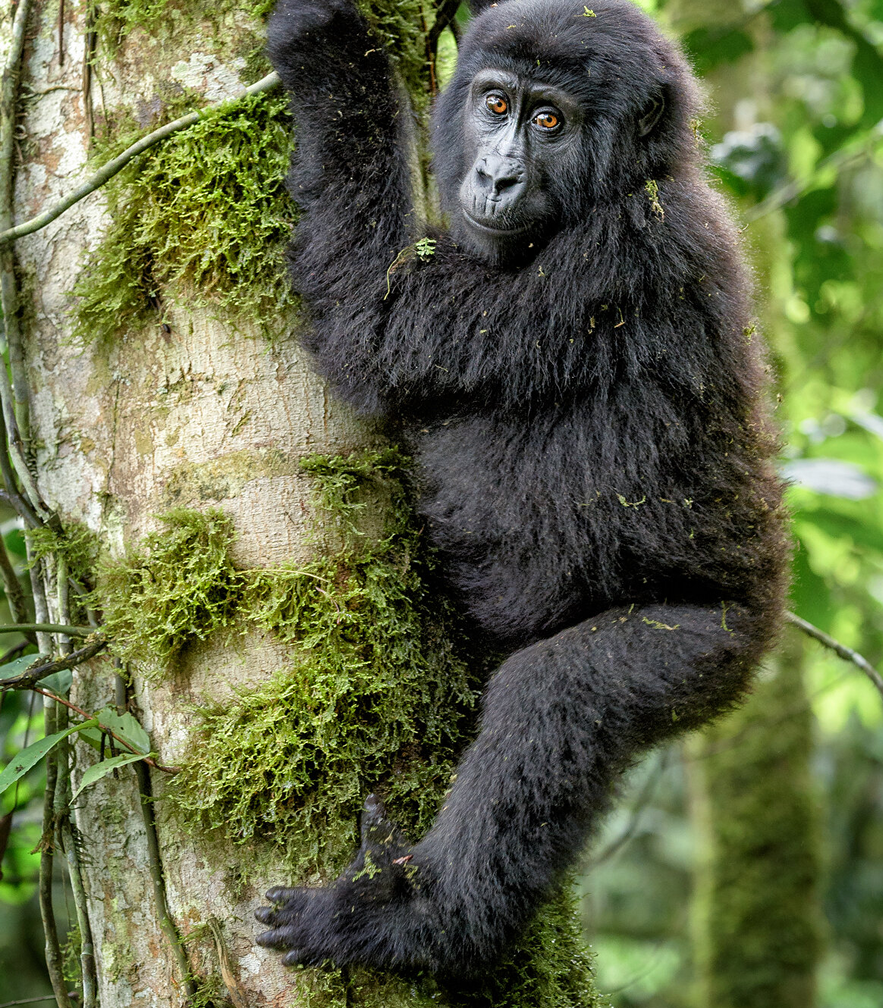
2. Profound closeness with a wild great ape. Habituated gorilla families allow visitors to sit within a few meters of them for a full hour, watching silverbacks, mothers, and playful youngsters go about their day. The eye contact and clear intelligence in their gaze often leaves people deeply moved — many describe it as the most emotional wildlife encounter of their lives.
3. The adventure of the trek itself. Reaching the gorillas isn’t passive — it involves hiking through dense, muddy, high-altitude rainforest, sometimes for a couple of hours, sometimes much longer. The physical effort and unpredictability make the eventual encounter feel earned.
4. Direct conservation impact. Because permit fees fund park protection and local communities, visitors know their trip is directly supporting the survival of an endangered species — a rare case where tourism dollars visibly translate into conservation outcomes.
5. Combines well with other iconic experiences. Uganda and Rwanda pair gorilla trekking with chimpanzee tracking, savanna game drives, and volcano hikes, letting travelers build a broader East African itinerary around it.
If you’re considering it, permits typically need to be booked well in advance (especially in Rwanda, where demand is highest), and July is actually within one of the better trekking windows since the dry season runs roughly June through September.