- admin
- July 7, 2026
- Gorilla Habituation
Buhoma, Ruhija, Rushaga & Nkuringo
Double Gorilla Trekking in Rwanda and Uganda: The Complete Guide
What “Double Gorilla Trekking” Actually Means
Double gorilla trekking is a safari format that combines mountain gorilla treks in two countries — Rwanda and Uganda — within a single trip, rather than visiting just one national park. Instead of choosing between Rwanda’s Volcanoes National Park or Uganda’s Bwindi Impenetrable National Park, travellers cross the border between the two countries and track a different habituated gorilla family in each location. The two parks sit close enough together, on opposite sides of the Virunga volcanic range, that the crossing is straightforward by road, usually through the Cyanika or Katuna border posts. Many operators build these trips around Double Gorilla safaris in Rwanda and Uganda as a single combined itinerary, and it has become one of the signature ways for Gorilla Adventure Safaris enthusiasts to experience gorilla tourism in East Africa.
The appeal is simple: mountain gorillas exist in only three countries on Earth — Rwanda, Uganda, and the Democratic Republic of Congo — and fewer than 800 individuals survive in the wild. Doing two separate treks in two different ecosystems, with different terrain, different gorilla families, and different supporting wildlife, gives travellers two distinct wildlife encounters instead of one, while also letting them experience two contrasting countries, cultures, and landscapes on a single itinerary.
The Two Destinations
Rwanda’s Volcanoes National Park is home to the country’s entire population of trekkable mountain gorillas, spread across roughly a dozen habituated families on the lower slopes of the Virunga volcanoes. Rwanda has built its reputation on accessibility and polish: Kigali International Airport sits under three hours by road from the park, the road infrastructure is excellent, and the lodge scene around the park entrance — including well-known properties near Kinigi — ranges from comfortable mid-range options to some of the most exclusive lodges in Africa. Rwanda deliberately positions its Gorilla Tours Rwanda itineraries as a premium, low-volume, high-value experience, and the pricing of its permits reflects that strategy.
Uganda’s gorilla trekking areas are split between Bwindi Impenetrable National Park, which holds the great majority of the country’s habituated gorilla families, and the smaller Mgahinga Gorilla National Park on the Virunga slopes near the Rwandan and Congolese borders. Bwindi’s terrain is different in character from Rwanda’s volcanic foothills — a dense, ancient rainforest with steep, tangled trails that gave the park its name. This is where most Gorilla trekking Uganda itineraries are centred, and Uganda also offers something Rwanda does not: the gorilla habituation experience, a full-day activity in Bwindi that allows small groups of up to four visitors to spend several hours with a gorilla family that is still in the process of being habituated to human presence, rather than the standard one-hour viewing window.
Why These Safaris Are Considered by Most Travellers
Several practical and experiential factors explain why travellers gravitate toward the double-country format rather than picking a single park.
Cost efficiency and value balancing. Permit pricing is the clearest driver. A Ugandan gorilla permit costs roughly $800 per person for foreign non-residents (with a discounted rate of around $600 in the low-season months of April, May, and November), while a Rwandan permit costs $1,500 per person year-round. By combining both countries, travellers can offset Rwanda’s premium cost with Uganda’s comparatively lower one, building a trip that includes the exclusivity of Rwanda alongside a more affordable second trek in Uganda. This blended approach lets budget-conscious travellers still access Rwanda’s polished infrastructure without paying for two full-price Rwandan permits — a major reason Double Gorilla safaris in Rwanda and Uganda have grown so popular among value-focused adventure travellers.
Two ecosystems, two experiences. Rwanda’s volcanic slopes and Uganda’s rainforest interior are visually and physically distinct. Trekking in both means experiencing gorillas against two different backdrops — open, sloped, high-altitude terrain in Rwanda versus dense, humid, biodiverse jungle in Uganda — rather than repeating the same setting twice. Bwindi, in particular, rewards trekkers with additional wildlife: it supports around 90 mammal species and 11 primate species, including the black-and-white colobus monkey, giving the Ugandan leg of the trip a broader safari feel beyond gorillas alone.
Logistical convenience. Because the two parks border each other across the Virunga massif, the crossing does not require a long detour or a separate flight. Travellers already in the region for gorilla trekking can add a second country’s experience with a manageable road transfer rather than restructuring an entire itinerary. The East African Tourist Visa reinforces this convenience, since a single visa covers multiple entries across Uganda, Rwanda, and Kenya, removing the need for separate visa applications when crossing borders mid-trip.
Bragging rights and rarity. Gorilla trekking itself is already considered one of the rarest and most sought-after wildlife experiences in the world, in part because only a limited number of permits are issued each day — Rwanda allocates permits across roughly a dozen families with eight trekkers per family, and Uganda similarly caps group sizes at eight per family across its 17-plus habituated groups in Bwindi. Doing this twice, in two countries, elevates the experience further for travellers who want the fullest possible version of the “once in a lifetime” claim that dominates gorilla tourism marketing, and it’s why so many Gorilla Adventure Safaris operators now market the combined route as their flagship product.
Complementary strengths. Rwanda is generally regarded as the more accessible, luxury-oriented destination with shorter transfer times and higher-end lodges, while Uganda is seen as the more affordable, rugged, and immersive option with a wider variety of gorilla families and additional trekking formats like habituation experiences. Combining both means travellers are not forced to sacrifice one strength for the other.
The Experience Delivered
A double gorilla trekking safari typically unfolds as a multi-day itinerary bookending two separate treks, usually with a few days of buffer for travel, acclimatisation, and other activities in between.
Each trek follows a broadly similar structure regardless of country. Trekkers gather early in the morning at park headquarters for a briefing covering rules, safety expectations, and group assignments — groups are limited to eight visitors per gorilla family, accompanied by an experienced guide and, in Rwanda, two armed rangers for security. From there, the hike into the forest can take anywhere from two to seven hours, depending on where the gorilla family has moved to that day, since the animals range in search of food rather than staying in fixed locations. Once the group locates the gorillas, visitors are permitted a strictly enforced one-hour window to observe, photograph, and simply be near the family in its natural habitat — watching interactions between silverbacks, mothers, and juveniles at close range.
Doing this in two different countries means experiencing that hour twice, with two different families, two different guiding teams, and two different physical challenges. Rwanda’s volcanic slopes tend to involve steep but relatively open terrain at higher altitude, while Uganda’s Bwindi forest is denser, more tangled, and can involve scrambling through thick undergrowth — travellers often describe the Ugandan trek as physically tougher but the surrounding forest as more visually and biologically rich, which is part of what makes Gorilla trekking in Uganda such a distinct complement to a Rwandan trek.
Beyond the gorillas themselves, the broader experience includes cultural encounters with communities living around the parks (a portion of every permit fee is directed toward local community development), immersion in some of Africa’s most biodiverse remaining forest habitat, and a strong conservation narrative — trekkers are directly funding anti-poaching patrols, ranger salaries, and research that has helped mountain gorilla populations grow from a few hundred individuals decades ago to nearly 800 today, a rare conservation success story in an era of biodiversity loss.
Planning Considerations
Permits for both countries sell out months in advance, particularly during the peak seasons of June through September and December through February, so operators generally recommend booking three to six months ahead. A minimum age of 15 is strictly enforced in both countries, since gorillas are highly susceptible to human respiratory illnesses. Because trekking involves genuine physical exertion — sometimes at altitude, sometimes through dense terrain for several hours before the gorillas are even located — a reasonable level of fitness is expected, though no technical climbing skill is required. Total trip costs vary widely depending on lodge tier, transport choices (fly-in versus road transfer), and season, but travellers should budget for the permits as the single largest fixed cost, with accommodation, meals, transport, and guide or porter tips forming the remainder of the total investment.
Ultimately, double gorilla trekking appeals to travellers who want more than a single encounter. Whether booked through specialists in Gorilla tours Rwanda, operators focused on Gorilla trekking Uganda, or full-service Gorilla Adventure Safaris covering both parks, this format delivers two distinct wildlife experiences, two national parks, two ecosystems, and a fuller sense of the Virunga region’s shared conservation story, all within one carefully planned safari.
Mountain gorillas (Gorilla beringei beringei) are one of the most extraordinary wildlife encounters on Earth, and gorilla trekking has become a signature safari experience in East Africa for good reason.
Where They Live
Mountain gorillas exist in only two isolated populations, found nowhere else on the planet:
- The Virunga Massif — spanning the borders of Uganda, Rwanda, and the Democratic Republic of Congo, including Volcanoes National Park (Rwanda), Mgahinga Gorilla National Park (Uganda), and Virunga National Park (DRC)
- Bwindi Impenetrable Forest — a dense, ancient rainforest in southwestern Uganda
They live at high altitude, typically between 2,200 and 4,300 meters, in cool, misty mountain forests thick with bamboo and vegetation.
A Conservation Success Story
Mountain gorillas were once considered critically endangered, with numbers dropping below 700 individuals in the late 1980s. Thanks to decades of dedicated conservation work, anti-poaching efforts, and community-based tourism, the population has slowly recovered to just over 1,000 individuals today — one of the only great ape populations in the world that is actually increasing. This recovery is largely credited to the revenue and protection that gorilla trekking tourism generates.
Why It’s Such a Popular Safari Activity
1. Rarity and exclusivity. With only around 1,000 gorillas left and permits deliberately limited (a handful of groups per day, per park), trekking offers an experience very few people on Earth get to have. That scarcity — plus permit costs running from a few hundred to $1,500+ depending on the country — adds to its appeal as a bucket-list activity.
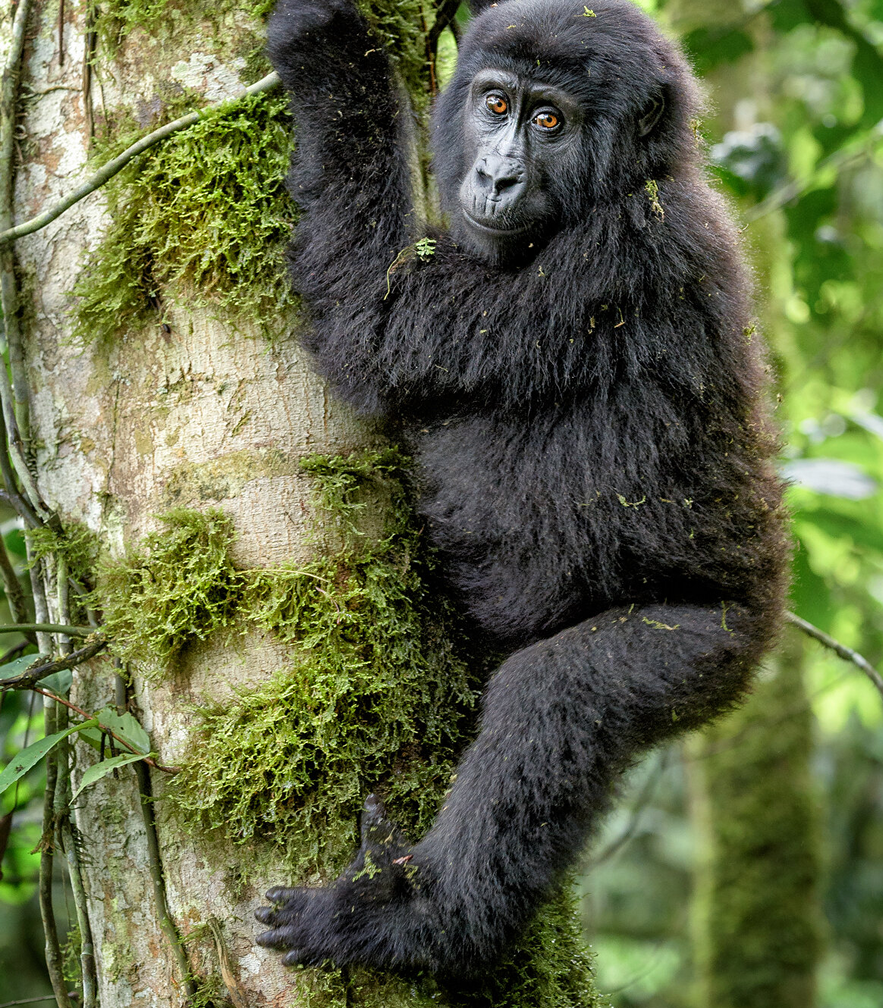
2. Profound closeness with a wild great ape. Habituated gorilla families allow visitors to sit within a few meters of them for a full hour, watching silverbacks, mothers, and playful youngsters go about their day. The eye contact and clear intelligence in their gaze often leaves people deeply moved — many describe it as the most emotional wildlife encounter of their lives.
3. The adventure of the trek itself. Reaching the gorillas isn’t passive — it involves hiking through dense, muddy, high-altitude rainforest, sometimes for a couple of hours, sometimes much longer. The physical effort and unpredictability make the eventual encounter feel earned.
4. Direct conservation impact. Because permit fees fund park protection and local communities, visitors know their trip is directly supporting the survival of an endangered species — a rare case where tourism dollars visibly translate into conservation outcomes.
5. Combines well with other iconic experiences. Uganda and Rwanda pair gorilla trekking with chimpanzee tracking, savanna game drives, and volcano hikes, letting travelers build a broader East African itinerary around it.
If you’re considering it, permits typically need to be booked well in advance (especially in Rwanda, where demand is highest), and July is actually within one of the better trekking windows since the dry season runs roughly June through September.