- admin
- July 8, 2026
- Gorilla Habituation
Buhoma, Ruhija, Rushaga & Nkuringo
Combining Gorilla Trekking with Uganda’s Big Game: Murchison Falls, Kibale, and Beyond
Uganda holds a rare distinction in African travel: it is one of the only countries on earth where a single itinerary can deliver both a face-to-face encounter with a mountain gorilla family and a classic Big Five-style savanna safari, all within a matter of days and without ever leaving national borders. While Rwanda has built its tourism brand almost entirely around gorilla trekking in Volcanoes National Park, and Kenya and Tanzania dominate the popular imagination of “safari,” Uganda quietly offers something neither can match on its own — a genuine combination itinerary that pairs primates with plains game, rainforest with savanna, and the Nile’s thundering falls with the misty slopes of the Albertine Rift.
For travelers weighing where to spend their limited safari days, understanding how to link Uganda’s flagship destinations — Bwindi Impenetrable Forest, Kibale Forest, and Murchison Falls National Park — into one coherent, well-paced journey is the difference between a good trip and an exceptional one.
Why Uganda Works as a Combination Destination
Uganda’s geography is the reason this works. The country sits at the meeting point of East Africa’s savanna ecosystems and the dense, ancient rainforests of the Congo Basin. Within a few hours’ drive or a short domestic flight, travellers can move from equatorial forest thick with primates to open grassland dotted with elephants, lions, and giraffes. Few countries offer that kind of ecological range in such compact geography.
This compactness matters practically. A gorilla trek in Bwindi and a game drive in Murchison Falls might sound like two entirely different trips, but in Uganda they can be stitched together into a single 8–12 day circuit without excessive backtracking, provided the itinerary is planned with an understanding of the country’s road network and the flight options connecting its major parks.
Bwindi Impenetrable Forest: The Anchor Experience
Any combination itinerary begins with the gorillas, and in Uganda, that means Bwindi Impenetrable National Park, home to roughly half of the world’s remaining mountain gorilla population. Trekking permits, currently priced at 800 USD for foreign non-residents, grant access to one of several habituated gorilla families spread across Bwindi’s four trekking sectors — Buhoma, Ruhija, Rushaga, and Nkuringo.
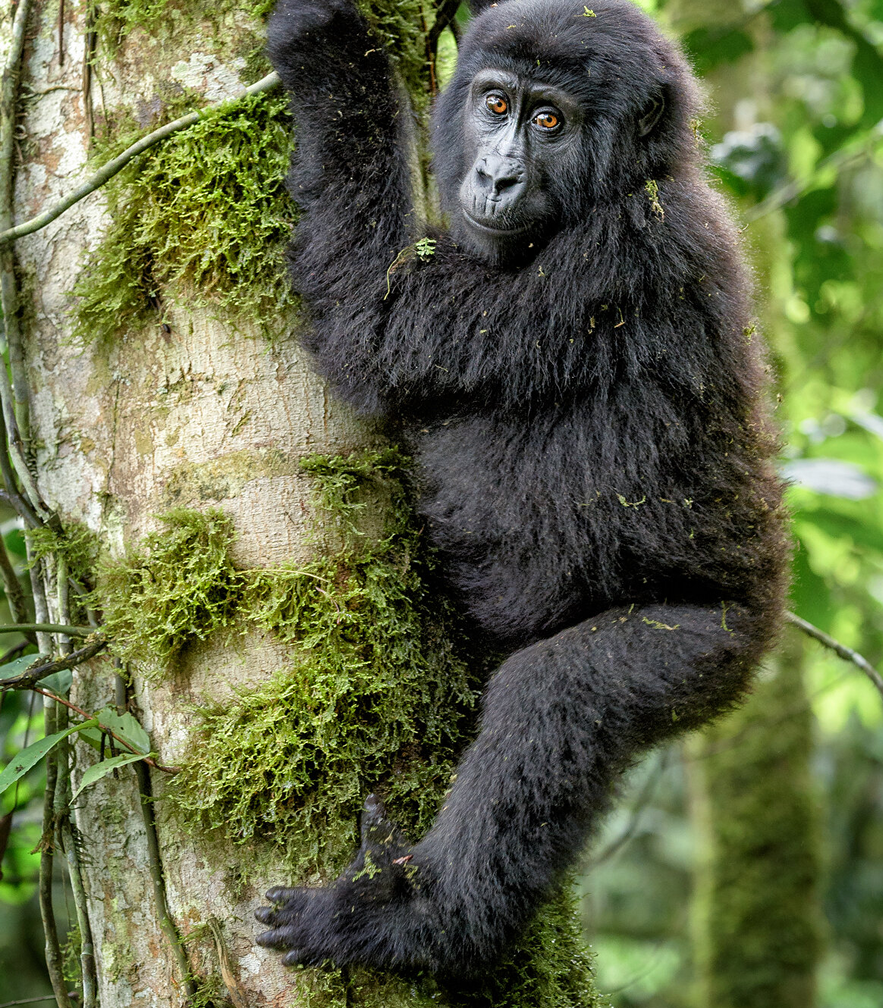
The trek itself is unpredictable by design. Some encounters take place after a gentle 45-minute walk; others require three or four hours of climbing through dense, humid forest on steep, often muddy terrain. What travellers receive in exchange is a single hour in the presence of a wild gorilla family — watching silverbacks assert quiet dominance, juveniles wrestle in the undergrowth, and mothers tend to infants with unmistakably familiar tenderness. It is widely described as one of the most profound wildlife experiences available anywhere on the planet, and it justifies its position as the anchor of any Uganda itinerary.
Bwindi also rewards travellers who stay an extra day. Community walks around Buhoma, visits to the Batwa cultural experience, and birdwatching in the forest’s understory (Bwindi hosts over 350 recorded bird species, including several Albertine Rift endemics) round out what could otherwise be a single-purpose stop.
Kibale Forest: Primates Beyond the Gorillas
Roughly a four-to-five-hour drive north of Bwindi lies Kibale Forest National Park, often described as the primate capital of East Africa. Where Bwindi delivers one extraordinary encounter, Kibale delivers volume and variety — thirteen primate species inhabit its forest canopy, most famously habituated chimpanzee communities that can be tracked much like gorillas, though on considerably gentler terrain.
Chimpanzee tracking in Kibale typically takes place over flatter, more accessible trails than Bwindi’s slopes, making it a natural complement rather than a repeat of the same physical demand. Sightings often include large troops of red colobus monkeys, L’Hoest’s monkeys, grey-cheeked mangabeys, and the occasional glimpse of the elusive, and now rarer, olive baboon interactions along forest edges. For travelers who want to go further, the Chimpanzee Habituation Experience allows a full morning with researchers as they follow a community not yet fully accustomed to tourist groups — a slower, more immersive alternative to the standard one-hour tracking permit.
Adjacent to Kibale, Bigodi Wetland Sanctuary and the crater lakes region around Fort Portal add an easy half-day of birding and scenic wandering, useful for travellers pacing themselves between more demanding trekking days.
Murchison Falls: Uganda’s Big Game Centrepiece
From Kibale, the itinerary shifts dramatically in character. Murchison Falls National Park, Uganda’s largest protected area, sits roughly four to five hours north by road (or a short 45-minute flight from Kasese or Kihihi, connecting most conveniently via Entebbe), and it is here that the trip becomes a conventional savanna safari.
The park takes its name from the point where the Nile River is forced through a gap barely seven meters wide before plunging 43 meters into the gorge below — one of the most powerful natural spectacles in East Africa, best appreciated first from the top viewpoint and then again from a boat launch cruising the river below.
Game drives across Murchison’s northern savanna sectors regularly produce sightings of elephants, Rothschild’s giraffes, Cape buffalo, and Uganda kob in substantial numbers, along with healthy lion prides that have made the park’s grasslands one of the more reliable big cat destinations in the country. Leopards are present but, as is typical across most of Africa, are sighted less predictably. The Nile boat cruise toward the base of the falls is arguably as compelling as the game drives themselves, offering close encounters with hippo pods, basking Nile crocodiles, and dense concentrations of waterbirds, including the prehistoric-looking shoebill stork in the delta’s papyrus swamps for travellers willing to add a specialised side excursion.
Murchison completes the ecological picture that Bwindi and Kibale cannot: open horizons, large herbivores, predator sightings, and the unmistakable sense of classic African safari that many travelers specifically seek out alongside their primate encounters.
Structuring the Itinerary: A Practical Framework
A well-paced combination trip typically runs 9 to 12 days, though it can be compressed to 7 with careful routing or extended to two weeks for travellers who want more time at each stop. A representative structure looks like this:
Days 1–2: Entebbe to Bwindi. Most itineraries begin with a flight into Entebbe, followed by either a long road transfer (roughly 8–10 hours, often broken up with a stop at Lake Mburo National Park) or a domestic flight to one of the airstrips near Bwindi.
Day 3: Gorilla trekking. A full day dedicated to the trek itself, with permits arranged well in advance — often six months to a year ahead during peak July–September and December–February seasons.
Day 4: Transfer to Kibale. The drive between Bwindi and Kibale, while long, passes through the scenic Ishasha sector of Queen Elizabeth National Park, known for its tree-climbing lions — a worthwhile detour that effectively adds a fourth ecosystem to the itinerary at minimal extra cost in time.
Day 5: Chimpanzee tracking in Kibale, followed by an afternoon at Bigodi Wetland Sanctuary.
Days 6–7: Transfer and arrival in Murchison Falls, typically via road through Fort Portal and Hoima, or by charter flight for travellers prioritising time over budget.
Days 8–9: Murchison Falls game drives and Nile boat cruise, with an optional shoebill stork excursion in the delta.
Day 10: Return to Entebbe for departure, either by road (roughly 5–6 hours) or by a short scheduled flight.
Travellers with additional time often extend the itinerary with a stop at Queen Elizabeth National Park proper (rather than just the Ishasha sector), which adds crater lake scenery, the Kazinga Channel boat cruise, and further predator sightings to the mix.
Cross-Border Extensions
For travellers who want to layer in Rwanda, the logistics are straightforward. The Cyanika and Katuna/Gatuna border crossings connect southwestern Uganda directly to Rwanda’s Volcanoes National Park region, typically a 2–4-hour drive from Bwindi depending on the specific crossing and road conditions. This opens the possibility of tracking golden monkeys in Rwanda in addition to gorillas and chimpanzees in Uganda, or simply flying out of Kigali instead of backtracking to Entebbe — a routing choice that can save a full day of travel for itineraries under time pressure.
Budgeting and Timing Considerations
Cost is often the first question travellers raise, and it deserves a direct answer. Gorilla permits (800 USD in Uganda, compared to 1,500 USD in Rwanda) and chimpanzee permits (roughly 200 USD) represent fixed costs regardless of season. Beyond permits, the largest variable is transport — whether an itinerary relies on road transfers or domestic flights between parks meaningfully changes both the cost and the total number of usable safari days, since Uganda’s road network, while improving, still involves long transfer days on unpaved sections in more remote areas.
Uganda’s dry seasons (June–September and December–February) offer the most reliable trekking conditions and the easiest driving. However, gorilla trekking happens year-round since permits are capped daily regardless of weather. The wetter months (March–May and October–November) bring lower rates at many lodges and thinner crowds, at the cost of muddier forest trails.
What Makes the Combination Worth It
The case for combining gorilla trekking with Uganda’s big game destinations ultimately comes down to contrast. A trip built around gorillas alone, however profound, is a single extraordinary morning surrounded by travel days. Layering in Kibale’s chimpanzee tracking and Murchison Falls’ classic savanna safari transforms the trip into a fuller picture of what East Africa’s wildlife has to offer — rainforest primates, open-plains megafauna, and one of the continent’s great river spectacles, all accessible within a single country’s borders and a single, well-designed itinerary.
For travellers deciding between a narrowly focused gorilla trip and a broader circuit, the honest answer is that Uganda rewards those willing to commit a few extra days. Few other places on earth let you track a chimpanzee community in the morning and watch elephants cross the Nile floodplain three days later — and that range, more than any single sighting, is what makes Uganda’s combination safari genuinely distinctive.
Mountain gorillas (Gorilla beringei beringei) are one of the most extraordinary wildlife encounters on Earth, and gorilla trekking has become a signature safari experience in East Africa for good reason.
Where They Live
Mountain gorillas exist in only two isolated populations, found nowhere else on the planet:
- The Virunga Massif — spanning the borders of Uganda, Rwanda, and the Democratic Republic of Congo, including Volcanoes National Park (Rwanda), Mgahinga Gorilla National Park (Uganda), and Virunga National Park (DRC)
- Bwindi Impenetrable Forest — a dense, ancient rainforest in southwestern Uganda
They live at high altitude, typically between 2,200 and 4,300 meters, in cool, misty mountain forests thick with bamboo and vegetation.
A Conservation Success Story
Mountain gorillas were once considered critically endangered, with numbers dropping below 700 individuals in the late 1980s. Thanks to decades of dedicated conservation work, anti-poaching efforts, and community-based tourism, the population has slowly recovered to just over 1,000 individuals today — one of the only great ape populations in the world that is actually increasing. This recovery is largely credited to the revenue and protection that gorilla trekking tourism generates.
Why It’s Such a Popular Safari Activity
1. Rarity and exclusivity. With only around 1,000 gorillas left and permits deliberately limited (a handful of groups per day, per park), trekking offers an experience very few people on Earth get to have. That scarcity — plus permit costs running from a few hundred to $1,500+ depending on the country — adds to its appeal as a bucket-list activity.
2. Profound closeness with a wild great ape. Habituated gorilla families allow visitors to sit within a few meters of them for a full hour, watching silverbacks, mothers, and playful youngsters go about their day. The eye contact and clear intelligence in their gaze often leaves people deeply moved — many describe it as the most emotional wildlife encounter of their lives.
3. The adventure of the trek itself. Reaching the gorillas isn’t passive — it involves hiking through dense, muddy, high-altitude rainforest, sometimes for a couple of hours, sometimes much longer. The physical effort and unpredictability make the eventual encounter feel earned.
4. Direct conservation impact. Because permit fees fund park protection and local communities, visitors know their trip is directly supporting the survival of an endangered species — a rare case where tourism dollars visibly translate into conservation outcomes.
5. Combines well with other iconic experiences. Uganda and Rwanda pair gorilla trekking with chimpanzee tracking, savanna game drives, and volcano hikes, letting travelers build a broader East African itinerary around it.
If you’re considering it, permits typically need to be booked well in advance (especially in Rwanda, where demand is highest), and July is actually within one of the better trekking windows since the dry season runs roughly June through September.