
Sipi Falls, Three Waterfalls, Coffee Trails & Mount Elgon Hikes
If you’re touring eastern Uganda, Sipi Falls is hard to miss — and honestly, hard to top. Tucked into the foothills of Mount Elgon near Kapchorwa, just north of Mbale and a stone’s throw from the Kenyan border, it’s become one of the most photographed spots in the country. Sitting at about 1,775 meters, the air here is cooler and mistier than what you’d get in Kampala or the savannah parks up north, and that alone makes it feel like a different country.
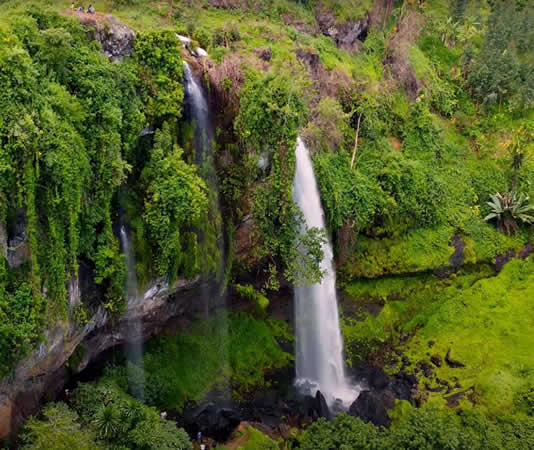
Where the name comes from, and what you’re actually looking at
“Sipi” isn’t one waterfall — it’s three. The name comes from “Sep,” a wild banana-like plant that grows along the riverbanks and that locals have long used to treat fevers and measles. Of the three falls, the main one steals the show: it plunges around 100 meters and dwarfs its two siblings, which is why most people treat it as the centerpiece of a visit. But don’t skip the other two — they’re framed by terraced hills, coffee gardens, and thick greenery that make the whole area feel more like a mountain retreat than a single roadside attraction.
Getting up there
Plan on 5 to 6 hours from Kampala to cover the roughly 270–280 km, heading out through Jinja and Mbale before the road climbs into Elgon’s foothills. It’s a drive worth savoring rather than rushing — you’ll pass Mabira Forest, cross the Nile at Jinja, and watch the landscape shift from lowland to highland as you go.
What to actually do once you’re there
Sipi is not a “look at the waterfall and leave” kind of place. The classic move is a guided hike linking all three falls — anywhere from a quick one-hour walk to a fuller four-hour route — winding through coffee farms and small homesteads, where you can watch (and taste) the Arabica coffee grown on these slopes.
If you want more adrenaline, Sipi has built a name for itself as an abseiling spot — yes, people rappel straight down the face of the main falls — alongside rock climbing and zip-lining, all run by local outfitters. There’s also trout fishing on the cold, clear Sipi River, run catch-and-release, similar to the Nile perch fishing you’d find at Murchison Falls. And for birders, this is genuinely special ground: Mount Elgon’s checklist runs past 300 species, some found nowhere else in Uganda, and a good number of them turn up right around the falls.
Beyond the adventure sports, there’s real cultural depth here too — village walks with the Sabiny people, a look at traditional farming, banana beer brewing, and coffee processing from bean to cup.
The launchpad for Mount Elgon itself
Sipi isn’t just a destination — it’s basically base camp for anyone climbing Mount Elgon. Most expeditions start here, and the Sasa Trail (the shortest but toughest route) is a four-day round trip with about 1,250 meters of elevation gain, including a brutal 1,600-meter climb on day one alone. Push further into the park and you’ll find hot springs inside the crater, ancient rock paintings, and wildlife ranging from monkeys and small antelope to the occasional elephant or buffalo sighting.
When to go
Uganda works year-round, but the dry seasons make hiking easier and tend to bring animals closer to water sources, which helps sightings. That said, at this altitude, a bit of mist or a quick shower even in the “dry” months is just part of the deal — ask any local and they’ll tell you it’s part of the charm, not a flaw.
How Trips to Sipi Usually Get Packaged
We build Sipi trips around a handful of formats:
- Day trip from Mbale or Jinja — quick hit for people already nearby: the waterfall hike, a coffee farm stop, lunch with a view. Good if time’s tight.
- 2–3 day Sipi getaway from Kampala — the most popular option: the drive, a night or two at a lodge overlooking the falls, the full three-waterfall hike, a coffee tour, and abseiling or village walks if you want them.
- Adventure-heavy trips — built around abseiling, climbing, and zip-lining, sometimes with a short Elgon day hike tacked on for people chasing adrenaline over wildlife.
- Multi-day Mount Elgon treks — for the serious hikers, using Sipi as the trailhead for a summit attempt via the Sasa or the gentler Sipi Trail, usually four-plus days with camping or basic huts.
- Cultural-and-nature blends — pairing the hikes with deeper community time: coffee demos, traditional dance, homestays, farm visits — a slower pace for people who’d rather soak it in than rush through it.
Most of this is flexible — stretch the stay, bolt on a summit attempt, or swap the tougher hikes for gentler walks and birding.
What Sipi Pairs Well With
Given where it sits, near the Kenyan border in eastern Uganda, Sipi naturally slots into a few bigger itineraries:
- Kidepo Valley National Park — often used as a stopover en route to Kidepo, Uganda’s wild, remote northeastern park, known for cheetahs and huge buffalo herds you won’t easily see elsewhere in the country.
- Murchison Falls National Park — a popular combo for travelers wanting both a highland hiking fix and a classic savannah-and-boat-safari experience.
- Jinja and the source of the Nile — since you’re driving right through it anyway, plenty of people tack on white-water rafting, kayaking, or bungee jumping.
- Cross-border trips into Kenya — Sipi and Elgon connect naturally to further hiking on Kenya’s side of the mountain, or a broader Kenyan safari.
- Mbale and other Elgon trailheads — shorter add-ons for exploring the town’s markets or other park access points, without much extra driving.
All told, Sipi works whether you want it as a standalone highland break or as a link between bigger, wilder stops on a longer Ugandan itinerary — adventure, mountain trekking, birding, or just a scenic breather between parks.
About our Company
Adventure Gorilla Safaris is a passion-driven safari company founded in 2019, operating as a Destination Management Company (DMC) and luxury safari operator. Based in Kigali, Rwanda, the team has built its reputation on delivering meticulously curated, eco-conscious journeys through Uganda and Rwanda, with seamless extensions into Kenya and Tanzania. Their founding purpose was straightforward: to make gorilla trekking holidays both luxurious and genuinely cost-worthy, rather than treating those two goals as mutually exclusive.
Most Recent Posts
- All Post
- Gorilla Habituation
- Mountain Gorilla Trekking
- Primate-tracking opportunities
- safari destinations
- Tailor-made Safaris
- Wildlife Tours
Explore Our Services
Lorem Ipsum is simply dumy text of the printing typesetting industry.