- admin
- July 5, 2026
- Mountain Gorilla Trekking
Buhoma, Ruhija, Rushaga & Nkuringo
A Day in the Life of a Habituated Gorilla Family: Behaviour, Leadership & Adaptation
Dawn: The Silverback’s Authority Emerges
As mist clings to the volcanic slopes of Rwanda’s Volcanoes National Park, a deep, resonant vocalisation echoes through the forest canopy. Kubufu, a 12-year-old silverback weighing nearly 400 pounds, is waking his family. His powerful chest heaves with the effort of the low-frequency rumble that can travel distances of over a mile through dense forest. This vocalisation is far more than a mere alarm clock—it is an assertion of authority, a reassurance of security, and the first decision of the day made by the family’s most crucial member.
Kubufu’s role extends infinitely beyond reproduction. As the family’s sole silverback, he embodies the position of ultimate responsibility and decision-making power that defines gorilla social structure. His family consists of three females, four juvenile males, and two infants, each depending entirely upon his judgment for survival. This morning, as his family begins to stir in their night nests constructed from branches and vegetation, Kubufu performs his first duty: assessing the day’s conditions and determining the family’s trajectory.
The role of the silverback as protector and social anchor cannot be overstated. During nighttime, the silverback positions himself strategically within or near the night nest cluster, prepared to defend against potential threats—whether leopards, other gorilla groups, or occasional human poachers that persist despite anti-poaching efforts. His very presence grants the family’s younger members the psychological security necessary for adequate rest. Throughout the day, his position within the group’s movement determines spacing and pace. His selection of feeding sites reflects accumulated knowledge about seasonal food availability, water sources, and territorial boundaries that have taken years to develop.
Mid-Morning: The Architecture of Learning
By 9 AM, the family has begun their descent toward prime feeding grounds rich in wild celery, various fig species, and bamboo shoots. It is here that the intricate process of knowledge transfer becomes visible to habituated researchers who’ve earned the trust of these families through months of patient, non-intrusive observation.
Tamu, a three-year-old juvenile, stays remarkably close to his mother, Zuri. Rather than wandering independently, he observes her feeding technique with intensity that would humble human students. When Zuri strips bamboo shoots with practised precision, Tamu watches the angle of her hands, the pressure she applies, and the specific shoots she selects versus rejects. He doesn’t yet understand why some plants are palatable and others potentially toxic, but he is encoding this information through observation. This learning pattern characterises gorilla juvenile development—knowledge transfer occurs not through explicit teaching but through constant, patient observation.
The sophistication of this learning system becomes apparent when observing multi-generational knowledge. Elderly females, particularly those who have survived years of challenges, demonstrate optimal foraging techniques to younger animals in the family. The acquisition of “ecological knowledge”—understanding which fruits ripen in which months, where water is most pure during dry seasons, and which vegetation provides superior nutrition during different times of year—represents accumulated intelligence that took the matriarch years to master. When a young female eventually establishes her own family, she carries this knowledge with her, preventing years of trial-and-error learning that might otherwise prove fatal.
Kubufu’s role as decision-maker extends to protecting these learning opportunities. When he settles at a particular feeding site, younger animals have extended time to practice foraging techniques rather than constantly moving. His calm demeanour during routine feeding communicates that this environment is safe for experimentation and learning. Conversely, his alert posture and subtle vocalisations—a guttural grunt or change in body tension—instantly redirect juvenile attention toward environmental threats, teaching threat awareness through direct social communication.
Midday: The Social Fabric
By noon, the family had found an excellent feeding area dense with Lobelia and wild apricot trees. The structured hierarchies that characterise gorilla society become apparent during these abundant feeding times. Adult females maintain clear dominance rankings, determined partly by age, partly by tenure in the group, and partly by personality and alliance-building. Zuri, the eldest female, feeds with a confidence that younger females respect; they maintain an appropriate distance and yield prime feeding locations to her without obvious conflict.
These dominance hierarchies exist without the aggression common in other primate groups. Instead, they rely upon subtle body language, positioning, and the occasional measured display of authority. A direct stare, a deliberate movement toward another animal, or a specific vocalisation can communicate social rank without physical contact. This intricate system maintains group cohesion while preventing the constant conflicts that would exhaust everyone’s energy.
Perhaps most remarkable are the grooming behaviours that punctuate the day. In mid-afternoon, as feeding intensity decreases, adult females engage in prolonged grooming sessions. These are not merely hygienic activities; they represent the emotional scaffolding of gorilla society. Through grooming, individuals reinforce bonds, resolve subtle tensions, and communicate trust. When an older female grooms a younger one, she is explicitly affirming the younger individual’s place in the social hierarchy. These behaviours appear to have a calming, almost meditative quality, lowering stress levels and promoting group stability.
Infants represent the emotional centre of the group. Young Mbasa, only two years old, is permitted remarkable freedom to play with juveniles in ways that would never be tolerated without the presence of the group’s protectors. Older individuals engage in gentle play with infants, exhibiting patience that seems almost parental despite non-biological relationships. This tolerance facilitates the infant’s developing motor skills and social understanding.
Afternoon: Environmental Navigation and Adaptation
The differences between habitats become starkly apparent when comparing families from Rwanda’s Volcanoes National Park with those habituated in Uganda’s Bwindi Impenetrable Forest. While the two regions are geographically closer than many assume—separated by approximately 30 kilometers—their environmental characteristics demand different adaptive strategies.
Volcanoes National Park, dominated by volcanic soils and specific vegetation patterns, offers rich herbaceous vegetation but presents constant altitude challenges. The park ranges from 2,500 to 4,500 meters elevation, and gorilla groups regularly navigate steep volcanic slopes. The ash-enriched soil produces distinct plant communities, particularly abundant wild celery and bamboo. Families here must expend considerable energy on vertical movement, traveling up and down mountains that would exhaust most mammals.
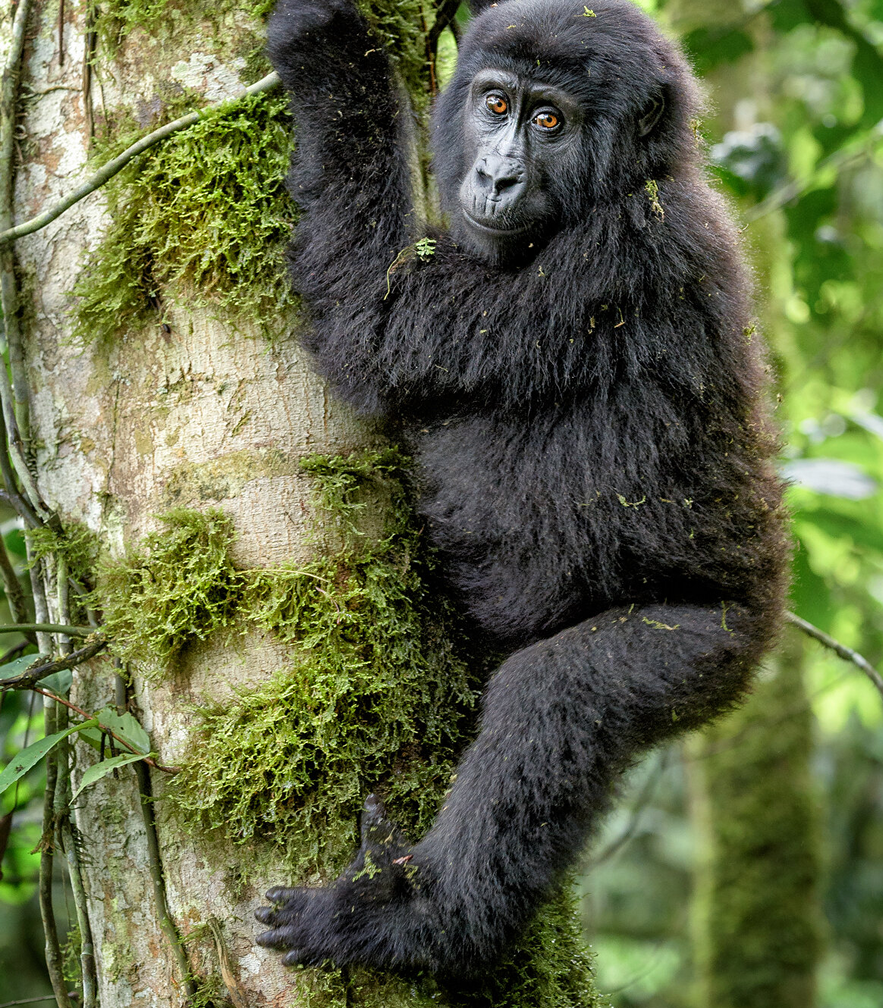
Bwindi, by contrast, represents one of Africa’s most impenetrable forests—a montane rainforest of extraordinary density and diversity. While food sources are extremely abundant, the forest’s structural complexity demands different navigation strategies. Bwindi’s gorillas become expert climbers, frequently consuming fruit from tall trees and traversing elevated branches. The abundance of terrestrial vegetation is matched by three-dimensional exploration demands absent in less dense environments.
Kubufu’s family, habituated in Volcanoes National Park, has developed specific movement patterns reflecting their volcanic environment. The group rarely travels more than 800 meters daily—they possess detailed knowledge of resource distribution across their territory and plan routes with apparent intentionality. When moving through particularly steep sections, younger animals remain closely supervised. The silverback himself often selects routes that minimize gradient steepness, evidence of both planning ability and consideration for group members with limited climbing capability.
Late Afternoon and Evening: Daily Rhythms
By 3 PM, the structured patterns governing gorilla daily life become evident. The family gravitates toward a water source, selecting a location where fresh water flows over volcanic rocks. Hydration is particularly crucial in montane environments where altitude and vegetation density create specific moisture challenges. Young animals drink tentatively, learning to avoid contaminated areas through observation and occasional parental correction.
Following water consumption, the family enters a rest period lasting 2-3 hours. This represents a crucial biological rhythm. Unlike popular misconceptions of gorillas as energetic, constantly moving animals, wild families maintain a relatively sedentary lifestyle with approximately 30% of daylight hours spent resting. This energy conservation strategy reflects the low-nutrition-density diet of fibrous vegetation. Gorillas cannot afford the constant activity of carnivores; their digestive systems require extended processing time for plant matter, and their large body mass demands significant caloric input.
During rest periods, the social bonds reinforced through grooming earlier manifest as physical proximity and tactile comfort. Juveniles nap against adults, creating clusters of interconnected bodies. Kubufu often rests somewhat apart, maintaining vigilance while allowing his body to recover from the energy demands of decision-making and constant attention to group welfare.
By 5 PM, with dusk approaching within two hours, the family begins constructing night nests. This process reveals learned behavior transferred across generations. Older females construct more sophisticated nests with superior structural integrity, while younger individuals fashion increasingly competent nests as they age. Males frequently build less substantial nests, relying partly on the expectation that they’ll relocate during the night for security purposes.
Conclusion: The Architecture of Gorilla Life
As darkness settles over Volcanoes National Park, Kubufu settles into his nest, positioned to respond instantly to nocturnal disturbances. The family’s daily rhythm has cycled through feeding, learning, social bonding, environmental navigation, rest, and preparation for the night. Each activity interlocks with others, creating a daily existence of remarkable complexity.
The habituated families of Rwanda and Uganda represent one of nature’s most sophisticated social systems. The silverback’s authority enables family stability; learning mechanisms ensure ecological knowledge preservation; social complexity maintains group harmony; environmental adaptation demonstrates cognitive flexibility; and daily rhythms reflect millions of years of evolutionary refinement. Understanding these gorilla families reveals not merely how another species survives, but illuminates the fundamental structures underlying primate social evolution itself—structures that, while expressed differently, ultimately connect all members of our family, from the smallest mouse lemur to humanity itself.
Mountain gorillas (Gorilla beringei beringei) are one of the most extraordinary wildlife encounters on Earth, and gorilla trekking has become a signature safari experience in East Africa for good reason.
Where They Live
Mountain gorillas exist in only two isolated populations, found nowhere else on the planet:
- The Virunga Massif — spanning the borders of Uganda, Rwanda, and the Democratic Republic of Congo, including Volcanoes National Park (Rwanda), Mgahinga Gorilla National Park (Uganda), and Virunga National Park (DRC)
- Bwindi Impenetrable Forest — a dense, ancient rainforest in southwestern Uganda
They live at high altitude, typically between 2,200 and 4,300 meters, in cool, misty mountain forests thick with bamboo and vegetation.
A Conservation Success Story
Mountain gorillas were once considered critically endangered, with numbers dropping below 700 individuals in the late 1980s. Thanks to decades of dedicated conservation work, anti-poaching efforts, and community-based tourism, the population has slowly recovered to just over 1,000 individuals today — one of the only great ape populations in the world that is actually increasing. This recovery is largely credited to the revenue and protection that gorilla trekking tourism generates.
Why It’s Such a Popular Safari Activity
1. Rarity and exclusivity. With only around 1,000 gorillas left and permits deliberately limited (a handful of groups per day, per park), trekking offers an experience very few people on Earth get to have. That scarcity — plus permit costs running from a few hundred to $1,500+ depending on the country — adds to its appeal as a bucket-list activity.
2. Profound closeness with a wild great ape. Habituated gorilla families allow visitors to sit within a few meters of them for a full hour, watching silverbacks, mothers, and playful youngsters go about their day. The eye contact and clear intelligence in their gaze often leaves people deeply moved — many describe it as the most emotional wildlife encounter of their lives.
3. The adventure of the trek itself. Reaching the gorillas isn’t passive — it involves hiking through dense, muddy, high-altitude rainforest, sometimes for a couple of hours, sometimes much longer. The physical effort and unpredictability make the eventual encounter feel earned.
4. Direct conservation impact. Because permit fees fund park protection and local communities, visitors know their trip is directly supporting the survival of an endangered species — a rare case where tourism dollars visibly translate into conservation outcomes.
5. Combines well with other iconic experiences. Uganda and Rwanda pair gorilla trekking with chimpanzee tracking, savanna game drives, and volcano hikes, letting travelers build a broader East African itinerary around it.
If you’re considering it, permits typically need to be booked well in advance (especially in Rwanda, where demand is highest), and July is actually within one of the better trekking windows since the dry season runs roughly June through September.