- admin
- July 4, 2026
- Mountain Gorilla Trekking
Buhoma, Ruhija, Rushaga & Nkuringo
Bwindi’s Four Trekking Sectors Explained: Buhoma, Ruhija, Rushaga & Nkuringo
Bwindi Impenetrable National Park, tucked into the misty highlands of southwestern Uganda, is home to roughly half of the world’s remaining mountain gorillas. It is a UNESCO World Heritage Site, spanning an altitude range of about 1,160 to 2,607 metres, and its dense, ancient forest holds more habituated gorilla families open to tourism than anywhere else on the planet. For travellers researching Gorilla Safaris in Uganda, it’s worth knowing upfront that Bwindi is not one single trekking ground. The park is split into four distinct sectors — Buhoma, Ruhija, Rushaga, and Nkuringo — and each one offers a genuinely different flavour of the experience, whether you’re after classic Adventure Gorilla Trekking in Uganda, a relaxed set of Gorilla tours, or more affordable Budget Gorilla safaris. The right sector is shaped by terrain, gorilla families, accommodation, and even the direction you’re likely to be arriving from, and choosing it well is arguably the single most important planning decision a visitor makes.
Why the Sector You Choose Matters
Every gorilla trekking permit in Bwindi is issued by the Uganda Wildlife Authority for a specific gorilla family in a specific sector — it is not a general park-wide ticket. That means your permit effectively locks in your trailhead, and from there, your lodge choice, your access road, and the physical demands of your day all follow. Sleeping in the same sector as your permit is strongly recommended, since a mismatch means an early, uncomfortable transfer over rough mountain roads before you’ve even started the climb. With around 20 habituated gorilla families now spread across the four sectors, and a strict cap of eight visitors per family per day to protect the animals, demand regularly outstrips supply during the dry seasons of June to September and December to February. This is one reason many operators now package flexible Gorilla Safaris in Uganda, including Budget Gorilla safaris for travellers who want to lock in a permit without paying for premium lodges.
Buhoma: The Original Gateway
Buhoma, in the north of the park, is where gorilla tourism in Bwindi began, and it remains the most established and most popular of the four sectors. It’s typically the most accessible option for travellers coming from Kampala or Entebbe, particularly those combining their trip with game drives in nearby Queen Elizabeth National Park, and it can also be reached via the northern circuit through Ishasha.
What makes Buhoma so popular is its combination of comparatively gentle trails and the widest range of accommodation of any sector, spanning basic community bandas right up to luxury lodges such as Buhoma Lodge, Mahogany Springs, Sanctuary Gorilla Forest Lodge, and the high-end Bwindi Lodge overlooking the forest canopy. Treks here tend to run shorter on average, often three to four hours, which makes Buhoma a natural fit for anyone searching out Short Gorilla trips — think first-timers, families, or travellers with older members who want a taste of gorilla trekking without the most punishing terrain Bwindi has to offer. The sector is home to several habituated families, generally cited as including the Mubare, Habinyanja, Rushegura, Muyambi, and Katwe groups, though family compositions do shift over time as groups split or merge.
Buhoma’s trade-off is that, precisely because of its popularity and accessibility, it has fewer gorilla families relative to some of the newer sectors, which can mean reduced permit availability in peak season. Its scenery, while beautiful, is also generally considered less dramatic than the volcanic backdrops found further south. Beyond gorillas, Buhoma is also the best base for cultural add-ons, including the well-known Buhoma village walk, a few hours spent exploring rural Ugandan community life with a local guide, as well as access to the Buhoma waterfall trail — both popular extensions bolted onto Gorilla tours built around this sector.
Ruhija: The Quiet, High-Altitude Birder’s Sector
East of Buhoma, and generally reached via the Kabale–Kisoro road, sits Ruhija — the highest and, in many respects, the least crowded of Bwindi’s four sectors. Ruhija sits at an elevation and is often described as cloud-forest country, with a cooler, mistier atmosphere than Buhoma. It’s this altitude and remoteness that have made Ruhija one of the premier birding destinations in the park, and indeed in the whole Albertine Rift region, with numerous localised endemic species recorded in its forests. The Mubwindi Swamp Trail, an old-growth wetland area full of massive ancient trees and orchids, is considered one of the most productive single birding routes in Bwindi, though the trail itself involves a demanding descent and a long climb back out.
For gorilla trekking, Ruhija is generally regarded as gentler and less time-intensive than the southern sectors, with treks often concluding earlier in the day, leaving visitors with a free afternoon. That accessibility, paired with the birding opportunities, makes it appealing to a broad range of ages and fitness levels — and a strong candidate for anyone piecing together Short Gorilla trips combined with a birding detour — even though the roads leading into Ruhija are known to be rough enough that a sturdy 4WD vehicle is generally required. The Bitukura and Oruzogo families are among the most commonly cited habituated groups based in this sector. On the accommodation side, Ruhija is more modest than Buhoma or the southern sectors — options like Bakiga Lodge and Gorilla Mist Camp serve the area, making it a genuinely good fit for Budget Gorilla safaris, even if there is little in the way of true luxury lodging here.
Rushaga: The Sector of Choice and Depth
South of the park, reached from the Muko turnoff along the Kabale–Kisoro highway, lies Rushaga — the sector with the largest number of habituated gorilla families of anywhere in Bwindi. Because more families are based here, more permits are typically released daily, which gives Rushaga a real practical edge for travellers trying to secure a permit during busy periods, and makes it popular with photographers and repeat visitors who want more variety in which family they might be assigned. Families associated with the sector over the years have included groups such as Nshongi, Busingye, Kahungye, Mishaya, and Bweza, among others.
What truly sets Rushaga apart, though, is that it is the only sector in Bwindi — and one of very few places in the world — offering the Gorilla Habituation Experience (GHEX). Where a standard trek allows a strictly regulated one hour with a fully habituated family, GHEX permits allow a small group of visitors to spend up to four hours with a family that is still in the process of being habituated to human presence, accompanied by researchers and rangers documenting the gorillas’ behaviour and movements. Only four people are permitted on a GHEX outing per day, making it an intimate, slower, and more research-oriented encounter than the standard trek. It also comes at a significantly higher price: as of 2026, the GHEX permit runs to around 1,500 US dollars per person for foreign non-residents, compared with roughly 800 dollars for a standard permit, and unlike standard permits, GHEX carries no seasonal discount. For serious gorilla enthusiasts, conservation-minded travellers, or anyone drawn to the science of habituation rather than a guaranteed, predictable hour with the animals, Rushaga is generally considered the best-suited sector for true Adventure Gorilla safaris. Accommodation here includes properties such as Gorilla Safari Lodge, Chameleon Hill, and Gorilla Valley Lodge, and the sector borders Mgahinga Gorilla National Park, making it a natural stop for travellers also interested in golden monkey tracking.
Nkuringo: The Ridge-Top Challenge
Also in the south, and often paired logistically with Rushaga, Nkuringo is widely regarded as the most physically demanding of Bwindi’s four sectors — and, for many, the most spectacular. Its trailhead sits high on a ridge, with sweeping views over the Virunga Volcanoes, Lake Mutanda, and, on a clear day, the forested hills of the Democratic Republic of Congo. Because the gorilla families here tend to range in the valleys below the ridge, a typical Nkuringo trek begins with a long, steep descent into the forest. It finishes with an equally punishing climb back up to the trailhead — a structure that inverts the more typical “climb first, descend last” pattern found in gentler sectors. This makes Nkuringo best suited to fit experienced hikers who are comfortable on steep, often muddy terrain, and it’s routinely singled out by operators marketing Adventure Gorilla Trekking in Uganda to travellers chasing a real physical challenge. Many lodges in the area arrange porters as standard practice given the difficulty of the walk.
Fewer habituated families call Nkuringo home compared with Rushaga — commonly cited groups include the Nkuringo and Christmas families — which, combined with the physical demands of the sector, tends to mean smaller, quieter treks and a stronger sense of remoteness than the busier northern trailheads. Beyond gorillas, Nkuringo is also home to the Buniga Forest Batwa Trail, one of the more developed versions of the Batwa Cultural Experience, in which members of the Batwa community — the forest’s original inhabitants before the park’s gazetting in 1991 — lead visitors through traditional survival skills, forest medicine, and hunting practices. Lodging options here include Clouds Mountain Gorilla Lodge and Nkuringo Bwindi Gorilla Lodge, generally more exclusive and scenic than the mid-range options found elsewhere, though naturally more limited in number.
Weighing the Four Against Each Other
Put simply: Buhoma suits first-time trekkers, families, and anyone after accessible Short Gorilla trips with the broadest choice of lodges, especially if pairing the trip with Queen Elizabeth National Park. Ruhija suits birders, older travellers, or anyone wanting a gentler trek with a free afternoon afterwards, and it’s often the pick for Budget Gorilla safaris thanks to its more modest lodging. Rushaga suits travellers who want the best odds of securing a permit, the widest variety of gorilla families, and — for those willing to pay considerably more — the unmatched depth of the four-hour Gorilla Habituation Experience, making it a top pick among serious Adventure Gorilla safaris. Nkuringo suits fit adventurous hikers chasing dramatic ridge-top scenery and a genuinely remote, less-trafficked encounter, who don’t mind a demanding climb at the end of an already long day.
Because Bwindi’s northern sectors (Buhoma and Ruhija) and southern sectors (Rushaga and Nkuringo) sit on opposite sides of the forest, many multi-day itineraries — particularly six-day double-trek packages — deliberately split time between a northern base and a southern one, transferring across the park midway through the trip so visitors experience two different sectors, two different families, and two very different characters of forest. This kind of split itinerary has become one of the most popular formats among operators selling Gorilla Safaris in Uganda, since it lets travellers sample both the gentler northern trails and the tougher, more dramatic southern ones in a single trip. Whichever sector or combination you choose, the fundamentals of the experience remain constant across all four: armed ranger escorts, experienced trackers, strict distance and hygiene rules to protect both visitors and the gorillas, and — regardless of how steep the trail or humid the forest — the same extraordinary reward at the end of it: a wild mountain gorilla family, a few metres away, going about its day as though you were simply part of the forest too.
Mountain gorillas (Gorilla beringei beringei) are one of the most extraordinary wildlife encounters on Earth, and gorilla trekking has become a signature safari experience in East Africa for good reason.
Where They Live
Mountain gorillas exist in only two isolated populations, found nowhere else on the planet:
- The Virunga Massif — spanning the borders of Uganda, Rwanda, and the Democratic Republic of Congo, including Volcanoes National Park (Rwanda), Mgahinga Gorilla National Park (Uganda), and Virunga National Park (DRC)
- Bwindi Impenetrable Forest — a dense, ancient rainforest in southwestern Uganda
They live at high altitude, typically between 2,200 and 4,300 meters, in cool, misty mountain forests thick with bamboo and vegetation.
A Conservation Success Story
Mountain gorillas were once considered critically endangered, with numbers dropping below 700 individuals in the late 1980s. Thanks to decades of dedicated conservation work, anti-poaching efforts, and community-based tourism, the population has slowly recovered to just over 1,000 individuals today — one of the only great ape populations in the world that is actually increasing. This recovery is largely credited to the revenue and protection that gorilla trekking tourism generates.
Why It’s Such a Popular Safari Activity
1. Rarity and exclusivity. With only around 1,000 gorillas left and permits deliberately limited (a handful of groups per day, per park), trekking offers an experience very few people on Earth get to have. That scarcity — plus permit costs running from a few hundred to $1,500+ depending on the country — adds to its appeal as a bucket-list activity.
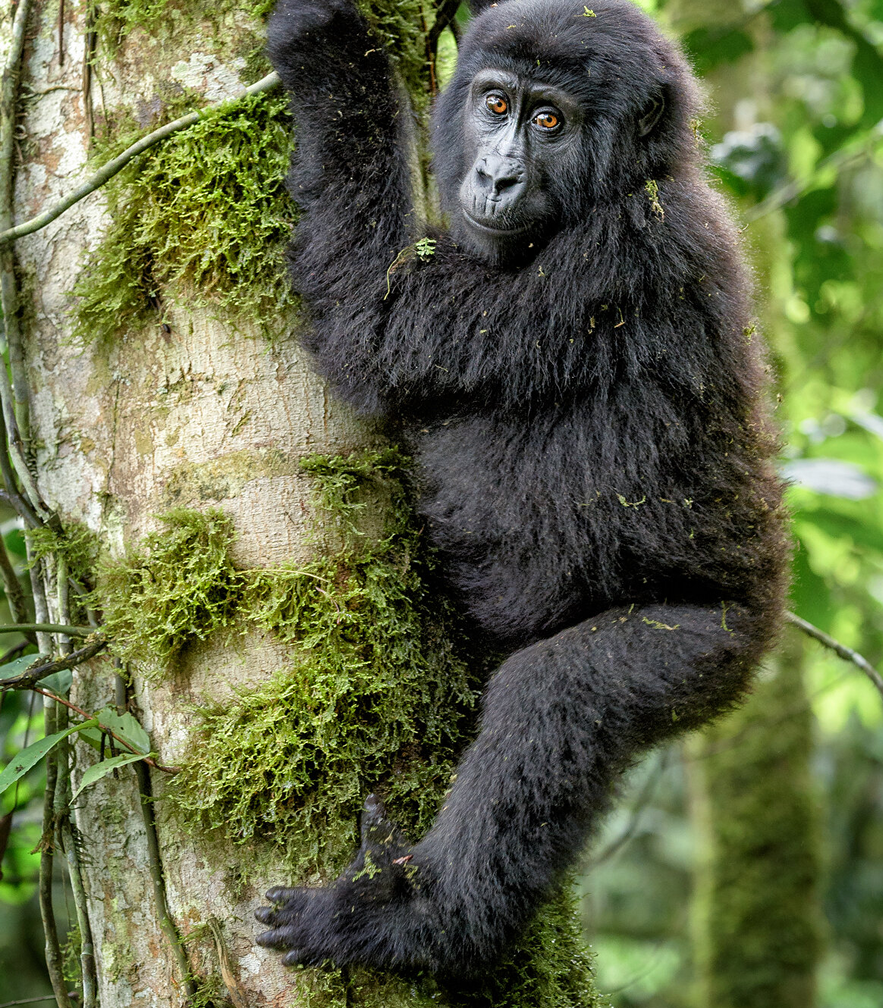
2. Profound closeness with a wild great ape. Habituated gorilla families allow visitors to sit within a few meters of them for a full hour, watching silverbacks, mothers, and playful youngsters go about their day. The eye contact and clear intelligence in their gaze often leaves people deeply moved — many describe it as the most emotional wildlife encounter of their lives.
3. The adventure of the trek itself. Reaching the gorillas isn’t passive — it involves hiking through dense, muddy, high-altitude rainforest, sometimes for a couple of hours, sometimes much longer. The physical effort and unpredictability make the eventual encounter feel earned.
4. Direct conservation impact. Because permit fees fund park protection and local communities, visitors know their trip is directly supporting the survival of an endangered species — a rare case where tourism dollars visibly translate into conservation outcomes.
5. Combines well with other iconic experiences. Uganda and Rwanda pair gorilla trekking with chimpanzee tracking, savanna game drives, and volcano hikes, letting travelers build a broader East African itinerary around it.
If you’re considering it, permits typically need to be booked well in advance (especially in Rwanda, where demand is highest), and July is actually within one of the better trekking windows since the dry season runs roughly June through September.