- admin
- July 11, 2026
- Tailor-made Safaris
Buhoma, Ruhija, Rushaga & Nkuringo
Gorilla Trekking + Uganda’s Big Game: The Complete Safari.
Why Uganda Rewards the Traveler Who Goes Beyond the Gorillas
Most people who dream of an African safari picture one of two things: a face-to-face encounter with a mountain gorilla in a misty rainforest, or a Land Cruiser rumbling across golden savanna past lions and elephants. Uganda is one of the only countries on Earth where a single trip can deliver both, without the exhausting cross-border logistics that would otherwise be required — the kind of complexity travellers often run into when trying to combine, say, Rwanda gorilla trekking in Volcanoes National Park with a separate big-game leg elsewhere. Nicknamed the “Pearl of Africa,” Uganda packs an astonishing range of ecosystems into a country roughly the size of the United Kingdom — dense Albertine Rift rainforest, rolling tea plantations, the papyrus-lined channels of the Nile, and open acacia savanna teeming with big game. A well-designed adventure safari tour, run over roughly two weeks, can move a traveller from eye-to-eye contact with a 200-kilogram silverback in Bwindi to a boat cruising beneath the thundering spray of Murchison Falls, with chimpanzee tracking in Kibale Forest and a classic game drive through Queen Elizabeth National Park stitched in between.
This account lays out how such a trip comes together: the anchor experiences, the logistics of stringing them into one itinerary, what each park adds that the others don’t, and the practical considerations — permits, timing, budget, and travel time — that make or break the trip.
The Anchor Experience: Gorilla Trekking in Bwindi
Any Uganda itinerary built around big game and primates starts with the mountain gorillas, because their numbers and locations are the most restrictive variable in the whole plan. Bwindi Impenetrable National Park, a UNESCO World Heritage Site in the southwest near the borders with Rwanda and the Democratic Republic of Congo, holds the large majority of Uganda’s habituated gorilla families across four trekking sectors — Buhoma, Ruhija, Rushaga, and Nkuringo. A smaller, quieter alternative exists at Mgahinga Gorilla National Park further south, home to a single habituated family that ranges across the Virunga volcanoes — the same volcanic range that, on the Rwandan side of the border, is home to Volcanoes National Park gorilla trekking.
Gorilla trekking permits are the linchpin of the entire trip and should be secured months in advance. As of 2026, the Uganda Wildlife Authority (UWA) prices a standard permit at $800 per person for foreign non-residents, with reduced rates of roughly $700 for foreign residents and $500 for citizens of other African countries. Some low-season months — April, May, and November — carry a discounted permit price of around $600, though these discounted permits are typically non-reschedulable — one reason Bwindi consistently pencils out as a cheaper base for budget safaris to Bwindi National Park than the Rwandan alternative, where permits run considerably higher. For travellers who want more than the standard one hour with a family, UWA also offers a Gorilla Habituation Experience in Bwindi’s Rushaga sector, which allows up to four hours with a gorilla group that is still being habituated to human presence, working alongside researchers and trackers rather than following fully accustomed gorillas — priced at $1,800 for foreign non-residents as of mid-2026.
Because permits are capped and allocated per sector per day, and because UWA now requires full payment at the time of booking rather than a holding reservation, the permit booking date effectively dictates the whole trip’s calendar. Most operators recommend locking in permits three to twelve months ahead, with the widest lead time needed for the June–September and December–February peak seasons. Trekking itself begins with an early-morning ranger briefing, followed by a hike that can range from a gentle hour to a demanding half-day scramble through dense, humid, and often muddy forest — trackers radio ahead once a family is located, and the reward is a tightly regulated hour observing gorillas at close range, moving, feeding, and interacting as a family group.
Kibale Forest: Primates Beyond the Gorillas
If Bwindi is the headline act, Kibale Forest National Park is the perfect complement rather than an afterthought. Located in western Uganda, roughly a day’s drive from Bwindi through the scenic Ishasha plains, Kibale is often billed as the primate capital of East Africa, holding one of the highest densities and diversities of primates on the continent, including habituated chimpanzee communities. Where gorilla trekking is a once-in-a-trip, tightly rationed hour, chimp tracking in Kibale is more accessible: permits are considerably cheaper than gorilla permits, sightings are common because chimps are highly vocal and mobile within known ranges, and the forest itself — tall mahogany and fig trees laced with vines — has a different character from Bwindi’s tangled undergrowth. For travellers piecing together a budget safari, Kibale’s lower permit costs make it an easy, high-value add-on to an otherwise gorilla-permit-heavy itinerary.
Kibale also offers the option of a full-day Chimpanzee Habituation Experience for travellers who want extended time with a community, plus red colobus monkeys, l’Hoest’s monkeys, grey-cheeked mangabeys, and a rich birdlife that rewards even a short walk. Just south of the main forest block, the Bigodi Wetland Sanctuary — a community-run reserve — adds an easy half-day nature walk with excellent bird photography and a direct look at how tourism revenue supports local livelihoods around the park.
Queen Elizabeth National Park: The Bridge Between Forest and Savanna
Geographically and experientially, Queen Elizabeth National Park sits between Kibale and the far north, making it a natural stop for travellers threading the two into one route. It is Uganda’s most visited savanna park and one of its most biodiverse, straddling the equator along the Rift Valley floor between Lakes George and Edward. The park delivers the classic big-game safari experience — lion, elephant, buffalo, hippo, and a long list of antelope species — with a few distinctive twists. The Ishasha sector in the park’s southern reaches is famous for tree-climbing lions, a rare behaviour seen in only a couple of places in Africa, where lions drape themselves along the low branches of fig trees during the heat of the day.
The park’s other signature experience is the Kazinga Channel boat cruise, a two-hour excursion along the natural channel connecting Lakes George and Edward that concentrates enormous numbers of hippos, Nile crocodiles, buffalo, and elephants along its banks, along with dense congregations of waterbirds. Because Queen Elizabeth lies almost directly between Bwindi/Kibale and the far north, it functions as both a wildlife destination in its own right and a logical waypoint for travelers continuing to Murchison Falls, whether by road or by the popular option of driving south and flying north (or vice versa) to save time — a routing choice that shapes the overall cost of any adventure safari tour through the region.
Murchison Falls: Uganda’s Big Game Flagship
At the northern end of a combined itinerary sits Murchison Falls National Park, Uganda’s largest protected area and, for many travellers, the emotional high point of the big-game portion of the trip. The park is named for the point where the entire Victoria Nile is forced through a gorge only a few meters wide before plunging roughly 40 meters in a thunderous, permanently misting cataract — one of the most powerful waterfalls, by force of water per meter of width, anywhere on the continent. A boat cruise from Paraa up to the base of the falls is a signature activity, passing pods of hippos, basking crocodiles, and elephants and buffalo coming down to drink, with the option to disembark and hike to the top of the falls for a view down into the gorge itself.
Murchison’s savanna and woodland stretch across both banks of the Nile, and game drives on the northern bank — the Buligi circuit in particular — are consistently productive for lion, giraffe (the localized Rothschild’s giraffe), elephant, buffalo, and Uganda kob, the antelope whose mating display grounds (leks) are a distinctive sight on the plains. The park’s proximity to Budongo Forest, a major chimpanzee tracking site in its own right, and to Ziwa Rhino Sanctuary — currently the only place in Uganda to see rhinos, since the species was hunted to local extinction and is being reintroduced through a dedicated sanctuary along the route north — adds further texture to a Murchison-based leg of the trip. A stop at Ziwa on the drive up from Kampala is a common and worthwhile add-on, giving travellers a rare on-foot tracking experience with southern white rhinos in a controlled, safe setting.
Stringing It All Together: A Sample Route
A well-paced version of this combined trip typically runs ten to fourteen days and might look like this: arrival in Entebbe, a transfer north with a stop at Ziwa Rhino Sanctuary en route to Murchison Falls for two to three nights of game drives and the Nile boat cruise; a flight or long drive south to Kibale Forest for chimpanzee tracking and the Bigodi wetland walk; a short hop to Queen Elizabeth National Park for a couple of nights including the Kazinga Channel cruise and a detour to Ishasha for the tree-climbing lions; and finally the drive into the Bwindi highlands for gorilla trekking, with a buffer day built in given the physical demands of the trek and the value of not rushing straight from a hike to a flight home.
Because road distances between parks can be substantial — Kampala to Murchison Falls is roughly four to five hours by road, and Bwindi to Kibale or Queen Elizabeth can be another five to six hours over winding roads — many operators building adventure safari tours in Uganda include one or two domestic flights, typically on light aircraft linking Entebbe, Murchison Falls, Kihihi (for Bwindi), and Mweya (for Queen Elizabeth), to keep the trip from becoming an endurance test of transfer days. Travellers with more time, a preference for overland travel, or a tighter budget can do the whole loop by road, watching the landscape change from savanna to farmland to rainforest along the way — a slower but notably cheaper way to structure a budget safari to Bwindi National Park and the parks around it, at the cost of adding several full driving days to the itinerary.
Practical Considerations
Timing matters on two fronts: gorilla and chimp trekking are more comfortable, with better trail conditions, during Uganda’s two dry seasons, roughly December to February and June to September, though trekking is possible year-round since gorillas are found regardless of rainfall. These same months are peak season for permit demand, so travellers wanting dry-season trekking dates should book especially early. The shoulder months, particularly April, May, and November, bring quieter parks, lower lodge rates, and — for gorilla permits specifically — a discounted rate, at the cost of muddier trails and less predictable weather for game drives. These shoulder-season discounts are also when budget safaris to Bwindi National Park are easiest to put together, since both permits and lodges cost less at once.
The budget is shaped overwhelmingly by the gorilla permit itself, which typically represents the single largest line item in the trip once flights are excluded. Beyond the permit, costs scale with accommodation choice — from simple guesthouses to high-end lodges perched above the forest canopy or overlooking the savanna — and with whether transport between parks is by road vehicle or light aircraft. Travellers assembling a genuine budget safari to Bwindi National Park typically lean on road transfers, guesthouse or mid-range lodge stays, and shoulder-season permit pricing to keep the trip affordable without cutting the gorilla trek itself. Several specialist operators bundle gorilla permits, chimp permits, park entrance fees, accommodation, and transfers into a single package, which simplifies planning given how many moving parts (and how many separate permits and park fees) a combined itinerary involves.
Health and packing considerations are straightforward but worth planning for: yellow fever vaccination is generally required for entry, anti-malarial precautions are standard given Uganda’s tropical climate, and gorilla trekking in particular calls for waterproof layers, gaiters or long trousers tucked into boots, and gardening gloves for handling nettles and vines on the trail. Because gorillas are highly susceptible to human respiratory illness, anyone with a cold or flu-like symptoms is asked to reschedule their trek, and a surgical mask is required during the encounter itself.
The Case for Combining Them
The real argument for pairing gorilla trekking with Uganda’s big-game parks is not simply convenience, though the compact geography makes it unusually easy compared with, say, combining Rwanda gorilla trekking with Kenyan or Tanzanian plains game. It’s that the experiences are genuinely complementary rather than repetitive. An hour with a gorilla family is intimate, quiet, and almost meditative — a negotiated peace with an animal that could kill you but won’t. A game drive through Murchison’s savanna, by contrast, is expansive and cinematic, built around distance, light, and the sudden appearance of a pride of lions on the horizon. The Nile cruise adds water and scale; Kibale adds the chatter and motion of a healthy forest ecosystem; Queen Elizabeth’s tree-climbing lions and hippo-choked channel add their own singular oddities. Strung together, they give a far more complete picture of what makes Uganda’s biodiversity remarkable than any single park could on its own — which is precisely why so many seasoned Africa travellers now treat a Uganda-based adventure safari tour, rather than a single-country gorilla trip elsewhere, as the more complete and often more affordable safari.
Mountain gorillas (Gorilla beringei beringei) are one of the most extraordinary wildlife encounters on Earth, and gorilla trekking has become a signature safari experience in East Africa for good reason.
Where They Live
Mountain gorillas exist in only two isolated populations, found nowhere else on the planet:
- The Virunga Massif — spanning the borders of Uganda, Rwanda, and the Democratic Republic of Congo, including Volcanoes National Park (Rwanda), Mgahinga Gorilla National Park (Uganda), and Virunga National Park (DRC)
- Bwindi Impenetrable Forest — a dense, ancient rainforest in southwestern Uganda
They live at high altitude, typically between 2,200 and 4,300 meters, in cool, misty mountain forests thick with bamboo and vegetation.
A Conservation Success Story
Mountain gorillas were once considered critically endangered, with numbers dropping below 700 individuals in the late 1980s. Thanks to decades of dedicated conservation work, anti-poaching efforts, and community-based tourism, the population has slowly recovered to just over 1,000 individuals today — one of the only great ape populations in the world that is actually increasing. This recovery is largely credited to the revenue and protection that gorilla trekking tourism generates.
Why It’s Such a Popular Safari Activity
1. Rarity and exclusivity. With only around 1,000 gorillas left and permits deliberately limited (a handful of groups per day, per park), trekking offers an experience very few people on Earth get to have. That scarcity — plus permit costs running from a few hundred to $1,500+ depending on the country — adds to its appeal as a bucket-list activity.
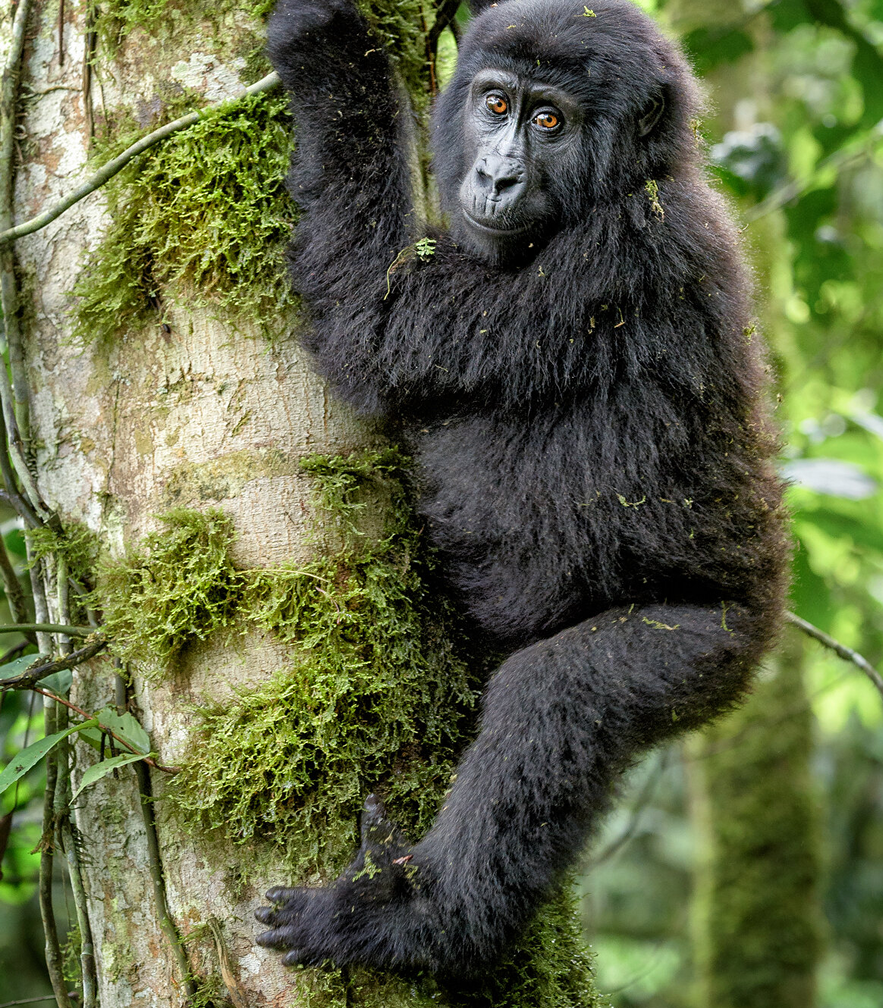
2. Profound closeness with a wild great ape. Habituated gorilla families allow visitors to sit within a few meters of them for a full hour, watching silverbacks, mothers, and playful youngsters go about their day. The eye contact and clear intelligence in their gaze often leaves people deeply moved — many describe it as the most emotional wildlife encounter of their lives.
3. The adventure of the trek itself. Reaching the gorillas isn’t passive — it involves hiking through dense, muddy, high-altitude rainforest, sometimes for a couple of hours, sometimes much longer. The physical effort and unpredictability make the eventual encounter feel earned.
4. Direct conservation impact. Because permit fees fund park protection and local communities, visitors know their trip is directly supporting the survival of an endangered species — a rare case where tourism dollars visibly translate into conservation outcomes.
5. Combines well with other iconic experiences. Uganda and Rwanda pair gorilla trekking with chimpanzee tracking, savanna game drives, and volcano hikes, letting travelers build a broader East African itinerary around it.
If you’re considering it, permits typically need to be booked well in advance (especially in Rwanda, where demand is highest), and July is actually within one of the better trekking windows since the dry season runs roughly June through September.