- admin
- July 11, 2026
- Gorilla Habituation
Beyond the Trek: Golden Monkeys, Volcano Hikes, and Dian Fossey’s Grave in Volcanoes National Park
Introduction: More Than Gorillas
Ask most travellers why they’re booking Rwanda gorilla trekking, and the answer is almost always the same: mountain gorillas. It’s a fair instinct. The hour spent in the presence of a silverback and his family, deep in the bamboo and montane forest of the Virunga Massif, is the experience that built Rwanda’s entire tourism economy and made Volcanoes National Park gorilla trekking one of the most sought-after adventure safari tours on the African continent.
But gorilla trekking, for all its magic, is only one chapter of what Volcanoes National Park has to offer. Tucked into the folds of five extinct and dormant volcanoes — Bisoke, Karisimbi, Sabyinyo, Gahinga, and Muhabura — is a landscape dense with other stories: a second primate species found almost nowhere else on Earth, summit trails that climb into crater lakes and Afro-alpine moorland, and the quiet, moving pilgrimage to the grave of the woman who arguably did more than anyone to save the mountain gorilla from extinction. For travellers with an extra day or two in Musanze, these experiences round out any well-planned adventure safari tour in ways that are less expensive, less physically demanding in some cases, and every bit as memorable as the headline attraction.
Golden Monkeys: The Park’s Playful Understudy
If gorillas are the solemn, dignified stars of Volcanoes National Park, golden monkeys are its comic relief. These small, strikingly colored primates — with fiery orange-gold backs, black limbs, and inquisitive faces — are found only in the Virunga and Gishwati-Mukura forests of the Albertine Rift, making them an Albertine endemic species and, like the gorillas, officially endangered.
What makes golden monkey trekking so appealing to visitors is the contrast with gorilla trekking. Where gorilla families move slowly, and interactions are calm and hushed, golden monkeys are frenetic. They live in large troops, sometimes eighty or more individuals in the biggest group on the slopes of Mount Sabyinyo, and they spend their days leaping through bamboo stands, chasing one another, and squabbling over shoots and fruit. Watching a troop feed is closer to watching a playground at recess than a wildlife documentary; the sheer motion and noise are half the appeal.
Treks begin early, usually with a briefing at the park headquarters in Kinigi by 7:00 a.m., before rangers guide small groups on hikes that typically last two to five hours round trip, depending on where the monkeys happen to be feeding that morning. Because the troops range across the lower, gentler slopes of the park, the walking is markedly less strenuous than most Rwanda gorilla trekking Safaris, which makes golden monkey trekking a popular add-on for families travelling with children, for travellers on a tighter budget, or simply for those who want a second forest experience without another punishing climb. The minimum age for the activity is around twelve, lower than the strict fifteen-year minimum for gorilla trekking.
Permits are a fraction of the cost of a gorilla permit. Foreign non-residents currently pay around $100 per person, compared with $1,500 for a gorilla permit — a difference that makes golden monkey trekking an easy and worthwhile second activity for anyone spending more than a single day in the park, and a smart pick for travellers piecing together budget safaris to Bwindi National Park and Volcanoes National Park in the same regional itinerary. As with gorillas, visitors get roughly an hour with the troop once it’s located, though because the monkeys move constantly, guides often let groups linger a little longer if the animals are cooperating. Flash photography is discouraged, since it startles the monkeys, and sturdy shoes are essential; the terrain underfoot, while less steep than the higher volcano trails, is often muddy and root-tangled.
Volcano Hikes: Climbing Into the Park’s Geology
Volcanoes National Park takes its name literally. The Virunga chain that gives the park its dramatic skyline is a string of eight volcanoes straddling Rwanda, Uganda, and the Democratic Republic of Congo, five of which lie within Rwandan territory. Several of these peaks are open to hikers holding a separate volcano-hiking permit, and each offers a completely different day out from anything primate-related — and a strong reason on its own to build an adventure safari tour around this corner of East Africa.
Mount Bisoke (3,711 meters) is the most popular and most accessible of the volcano hikes, and for good reason: it’s a demanding but achievable day climb, typically taking six to seven hours round trip through dense bamboo forest that gradually thins into moss-draped Hagenia woodland and finally opens onto Afro-alpine vegetation near the summit. The reward at the top is a startling one — a crater lake, its still, green-blue water sitting inside the volcano’s caldera, ringed by cloud and, on clear days, framed by views across the entire Virunga range and into neighbouring Congo and Uganda. Because Bisoke shares its lower slopes with several gorilla and golden monkey groups, hikers sometimes spot fresh signs of both animals along the trail even without a dedicated trekking permit.
Mount Karisimbi, at 4,507 meters, is the tallest peak in the range and a serious undertaking rather than a day hike. Most visitors climb it over two days, overnighting in a basic camp partway up the mountain before pushing on to the summit at dawn. The upper reaches of Karisimbi pass through a genuinely alpine environment — cold, thin-aired, and often shrouded in mist — and the climb demands real fitness and proper cold-weather gear, since nighttime temperatures near the summit can drop close to freezing even on the equator. It is not a hike to underestimate, but for serious trekkers, it offers a wilder, higher, and far less crowded experience than Bisoke.
Mount Gahinga, straddling the Rwanda-Uganda border, is a gentler climb by comparison, its slopes covered in bamboo and its summit holding a swampy crater rather than a lake. It can be climbed from either the Rwandan or Ugandan side and pairs naturally with a visit to Mgahinga Gorilla National Park just across the frontier — a handy link for travellers combining Volcanoes National Park with budget safaris to Bwindi National Park further south in Uganda. Mount Muhabura, meaning “the guide” for its visibility across the region, is a steep and strenuous climb to a small crater lake at 4,127 meters, popular with hikers looking for a challenging but single-day summit.
Each volcano hike requires its own permit, priced well below gorilla or even golden monkey permits — typically in the range of $60 to $75 for foreign visitors depending on the peak — and all are led by armed park rangers, both for navigation and for safety, since buffalo and other wildlife occasionally cross these upper trails. Porters are available and worth hiring; the volcanic soil turns slick and heavy with rain, which falls often and unpredictably at altitude, and a local porter’s help on the steeper pitches is rarely regretted.
Dian Fossey’s Grave: A Pilgrimage Into Conservation History
Of all the “beyond the trek” experiences in Volcanoes National Park, none carries the emotional weight of the hike to Dian Fossey’s grave at the old Karisoke Research Centre. Fossey, the American zoologist who arrived in Rwanda in 1967 to study mountain gorillas, spent nearly two decades living in a remote camp between Bisoke and Karisimbi, conducting research that transformed scientific understanding of gorilla behaviour and, more importantly, built the case for their protection at a time when poaching and habitat loss threatened to wipe the species out entirely.
Fossey’s methods were unorthodox, and her personality was famously uncompromising. She confronted poachers directly, destroyed snares by hand, and clashed repeatedly with local authorities and even with some conservation organisations over how aggressively to police the park. Her single-mindedness made her enemies as well as admirers, and in December 1985 she was found murdered in her cabin at Karisoke — a case that has never been definitively solved, though most researchers believe it was connected to the poaching networks she spent her career fighting. She was buried at the research camp she had built, in a small gorilla graveyard she herself had established, laid to rest beside Digit, the young silverback whose killing by poachers in 1977 had galvanised her most intense conservation efforts and drawn international attention to the gorillas’ plight.
Visiting the site today means a guided hike of roughly two to three hours each way through the same forest Fossey walked for eighteen years, climbing steadily from the park boundary toward the saddle between the two volcanoes where Karisoke once stood. Little remains of the original camp structures — the buildings have long since decayed or been dismantled — but the site itself, and the small cemetery of stone markers where Fossey and more than twenty gorillas she studied and named are buried, remain intact and carefully maintained. Guides who lead the walk typically weave in the history of the research station, stories of Fossey’s most famous gorilla subjects, and details of the broader conservation battle that her death helped intensify rather than end; the outrage over her murder is often credited with strengthening, not weakening, Rwanda’s commitment to gorilla protection in the years that followed.
The hike is physically moderate rather than extreme — comparable in effort to the golden monkey trek rather than to Karisimbi — but it is, for many visitors, the most affecting few hours they spend in the park. Standing at Fossey’s grave, within sight of the forest she fought to protect and only a short walk from gorilla families whose ancestors she once tracked by hand through the same undergrowth, tends to reframe the entire experience of Volcanoes National Park and gorilla trekking that follows or precedes it. It’s one thing to spend an hour with a habituated gorilla family; it’s another to understand, standing at that hillside grave, how narrow the margin was between the species’ survival and its disappearance, and how much of that margin was won by one obstinate researcher who never left the mountain. A permit for the hike is inexpensive relative to the park’s other activities, and it can often be combined in the same visit as a Karisoke research trail walk that covers similar ground with a slightly different focus on the science rather than the memorial itself.
Planning a Well-Rounded Visit
Because gorilla permits are capped and expensive, and because the trek itself is limited to a single hour with the animals, most visitors find that a two- or three-day stay in the Musanze area allows time to combine Rwanda gorilla trekking with one or two of these other experiences without the trip feeling rushed. A common and highly satisfying itinerary pairs a gorilla-trekking day with a golden-monkey trek the following morning. Either a Bisoke day hike or the Dian Fossey grave walk before departure — a sequence that moves from the park’s most famous and expensive encounter down through its more accessible, more varied offerings, each illuminating a different facet of what makes these volcanic forests so significant.
Travellers building a longer regional itinerary often extend this trip south across the border, pairing a few days of Volcanoes National Park gorilla trekking with budget safaris to Bwindi National Park in Uganda, where lower permit costs and a wider range of accommodation options make for a more affordable second gorilla encounter without sacrificing the quality of the experience. This kind of cross-border combination has become a popular way to structure an adventure safari tour for travellers who want more time with mountain gorillas than a single park visit allows.
All of these activities are booked through the same channel as gorilla permits: the Rwanda Development Board, either directly or, more commonly, through a licensed local tour operator who can bundle permits, park transport, and lodging into a single itinerary. Given the popularity of gorilla trekking, especially in the June-to-September and December-to-February dry seasons, it’s worth booking well in advance — but golden monkey, volcano-hiking, and Fossey grave permits tend to have more day-of availability than gorilla permits, making them a flexible way to extend a visit even for travellers planning at short notice.
What all of these experiences share, beyond their shared setting in one of Africa’s most storied conservation landscapes, is a sense of layered history and living ecology working in tandem. The gorillas draw the world’s attention, but the golden monkeys, the volcanic summits, and the quiet grave on the saddle between two mountains are what give Volcanoes National Park its full depth — turning a single bucket-list encounter into a far richer, more complete story of a place shaped as much by human devotion as by geology and wildlife.
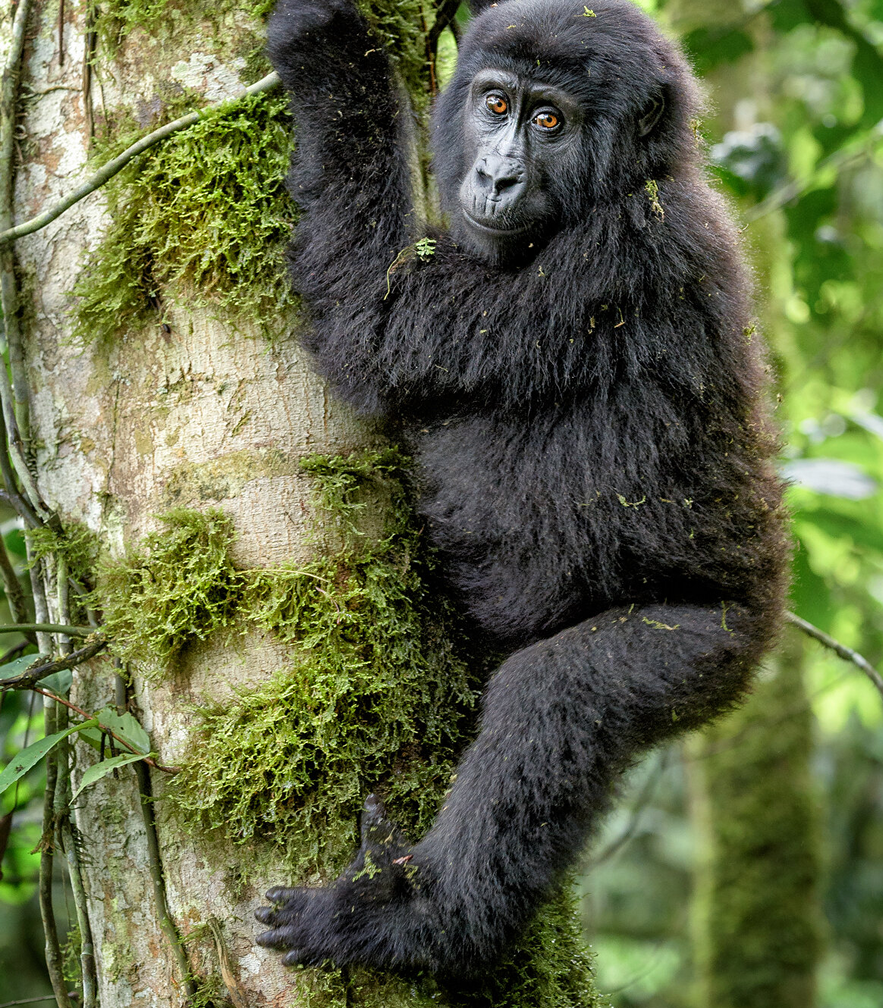
Mountain gorillas (Gorilla beringei beringei) are one of the most extraordinary wildlife encounters on Earth, and gorilla trekking has become a signature safari experience in East Africa for good reason.
Where They Live
Mountain gorillas exist in only two isolated populations, found nowhere else on the planet:
- The Virunga Massif — spanning the borders of Uganda, Rwanda, and the Democratic Republic of Congo, including Volcanoes National Park (Rwanda), Mgahinga Gorilla National Park (Uganda), and Virunga National Park (DRC)
- Bwindi Impenetrable Forest — a dense, ancient rainforest in southwestern Uganda
They live at high altitude, typically between 2,200 and 4,300 meters, in cool, misty mountain forests thick with bamboo and vegetation.
A Conservation Success Story
Mountain gorillas were once considered critically endangered, with numbers dropping below 700 individuals in the late 1980s. Thanks to decades of dedicated conservation work, anti-poaching efforts, and community-based tourism, the population has slowly recovered to just over 1,000 individuals today — one of the only great ape populations in the world that is actually increasing. This recovery is largely credited to the revenue and protection that gorilla trekking tourism generates.
Why It’s Such a Popular Safari Activity
1. Rarity and exclusivity. With only around 1,000 gorillas left and permits deliberately limited (a handful of groups per day, per park), trekking offers an experience very few people on Earth get to have. That scarcity — plus permit costs running from a few hundred to $1,500+ depending on the country — adds to its appeal as a bucket-list activity.
2. Profound closeness with a wild great ape. Habituated gorilla families allow visitors to sit within a few meters of them for a full hour, watching silverbacks, mothers, and playful youngsters go about their day. The eye contact and clear intelligence in their gaze often leaves people deeply moved — many describe it as the most emotional wildlife encounter of their lives.
3. The adventure of the trek itself. Reaching the gorillas isn’t passive — it involves hiking through dense, muddy, high-altitude rainforest, sometimes for a couple of hours, sometimes much longer. The physical effort and unpredictability make the eventual encounter feel earned.
4. Direct conservation impact. Because permit fees fund park protection and local communities, visitors know their trip is directly supporting the survival of an endangered species — a rare case where tourism dollars visibly translate into conservation outcomes.
5. Combines well with other iconic experiences. Uganda and Rwanda pair gorilla trekking with chimpanzee tracking, savanna game drives, and volcano hikes, letting travelers build a broader East African itinerary around it.
If you’re considering it, permits typically need to be booked well in advance (especially in Rwanda, where demand is highest), and July is actually within one of the better trekking windows since the dry season runs roughly June through September.