- admin
- July 2, 2026
- Mountain Gorilla Trekking
About
Gorilla Trekking Rules & Etiquette: What First-Timers Should Know
Coming face to face with a wild mountain gorilla family is one of the most extraordinary wildlife experiences on the planet — and one of the most tightly regulated. The rules that govern gorilla trekking in Uganda, Rwanda, and the Democratic Republic of Congo (DRC) aren’t bureaucratic red tape; they exist because mountain gorillas share roughly 98% of their DNA with humans, which makes them dangerously susceptible to our diseases. A cold that would keep you home from work for a day could kill a gorilla. Understanding the rules before you go isn’t just about avoiding an awkward ranger reprimand — it’s about protecting a species that numbers only around 1,000 individuals in the wild.
Here’s a full breakdown of what first-time trekkers need to know.
1. Get the Right Permit — and Guard It Carefully
Every trekker needs a valid, non-transferable permit tied to a specific date and gorilla family. Prices vary significantly by country: Rwanda’s Volcanoes National Park charges around $1,500 per person, Uganda’s Bwindi Impenetrable Forest and Mgahinga Gorilla National Park charge roughly $800 (with discounted low-season permits sometimes available in April, May, and November), and DRC’s Virunga National Park is considerably cheaper, at around $400. Because only a limited number of permits are issued daily — Rwanda caps trekking at 8 visitors per family across roughly a dozen habituated families, and Uganda spreads its allocation across around 20 families in Bwindi plus one in Mgahinga — popular dates during the dry seasons (June–September and December–February) can sell out months in advance. Book early, and book through a licensed operator or the national tourism board directly.
You’ll need to present your permit alongside a valid passport at registration, so keep both accessible on trek day. Permits are strictly non-transferable, meaning you can’t hand yours off to a travel companion if you fall ill — which brings us to the next major rule.
2. Health Rules Are Non-Negotiable
If you have a cold, flu, cough, or any contagious illness, you will — and should — be turned away at the morning briefing, without refund. This feels brutal after paying hundreds or thousands of dollars for a permit, but it’s the single most important rule in the entire system. A respiratory infection introduced to a habituated gorilla family can spread through the group with fatal consequences, since these animals have no immunity to human pathogens.
Because of this, most parks now request or require visitors to wear a surgical mask during the actual viewing hour, and some ask trekkers to disinfect their boots before entering the forest to prevent transmitting soil-borne pathogens as well. If you must cough or sneeze while near the gorillas, turn away from them and cover your mouth with your elbow or a mask. Hand sanitizer should be used before and after the trek. If you’re feeling even mildly unwell in the days before your trek, be honest with the guides — pushing through “for the permit money” risks the health of an endangered species.
3. Age and Fitness Requirements
The minimum age for gorilla trekking is 15 across Uganda, Rwanda, and the DRC, with essentially no exceptions (Uganda occasionally shows discretion for a mature 14-year-old on the cusp of turning 15, but this is rare). The reasoning mirrors the health rules above: young children are more likely to carry common childhood illnesses and are more prone to loud, unpredictable behavior that could alarm the gorillas.
There’s no strict fitness test, but you should be honest with yourself about your physical condition. Treks can range from a gentle 30-minute walk to a grueling five-hour slog through steep, muddy, high-altitude terrain, depending entirely on where the gorilla family happens to be that day — this is genuinely unpredictable and can’t be requested in advance. Rangers do try to match less-fit trekkers with gorilla families known to stay closer to the trailhead, so mention any physical limitations honestly at the briefing. Hiring a porter (typically $15–20) is one of the smartest decisions a first-timer can make; it supports the local community and gives you a steadying hand on slippery slopes.
4. What to Pack and Wear
Dress in long sleeves and long trousers in neutral, muted colors — khaki, olive, beige, or brown. Bright colors like red, white, or blue can be visually alarming to the gorillas, and camouflage patterns are typically restricted since they’re associated with military dress in these countries. Waterproof hiking boots with solid ankle support are essential, as is rain gear regardless of season, since these are genuine rainforests. Gardening gloves are a surprisingly popular addition among veteran trekkers, useful for grabbing stinging nettles and vegetation on steep sections.
Beyond clothing, bring plenty of drinking water, a packed lunch, sun protection, insect repellent, and — if you have them — binoculars. A dry bag or rain cover for your camera is worth the extra weight.
5. In-Forest Etiquette: The Rules That Matter Most
Once you actually locate the gorilla family — which itself can take anywhere from thirty minutes to several hours — a specific set of behavioral rules kicks in:
Keep your distance. Rwanda and most operators enforce a minimum of 7 meters (about 21–22 feet); Uganda has moved toward a stricter 10-meter guideline in some areas. This distance exists purely to limit disease transmission risk, not because the gorillas are dangerous to well-behaved visitors.
Keep your voice down. Speak in hushed tones if you need to communicate, and avoid sudden or expansive movements — no pointing, no waving your arms.
No eating, drinking, or smoking near the gorillas. Food odors and dropped crumbs can carry disease and may also attract unwanted gorilla attention.
No flash photography, ever. It can startle the animals and disrupt their natural behavior. Adjust your camera’s ISO settings in advance for low-light rainforest conditions rather than relying on flash.
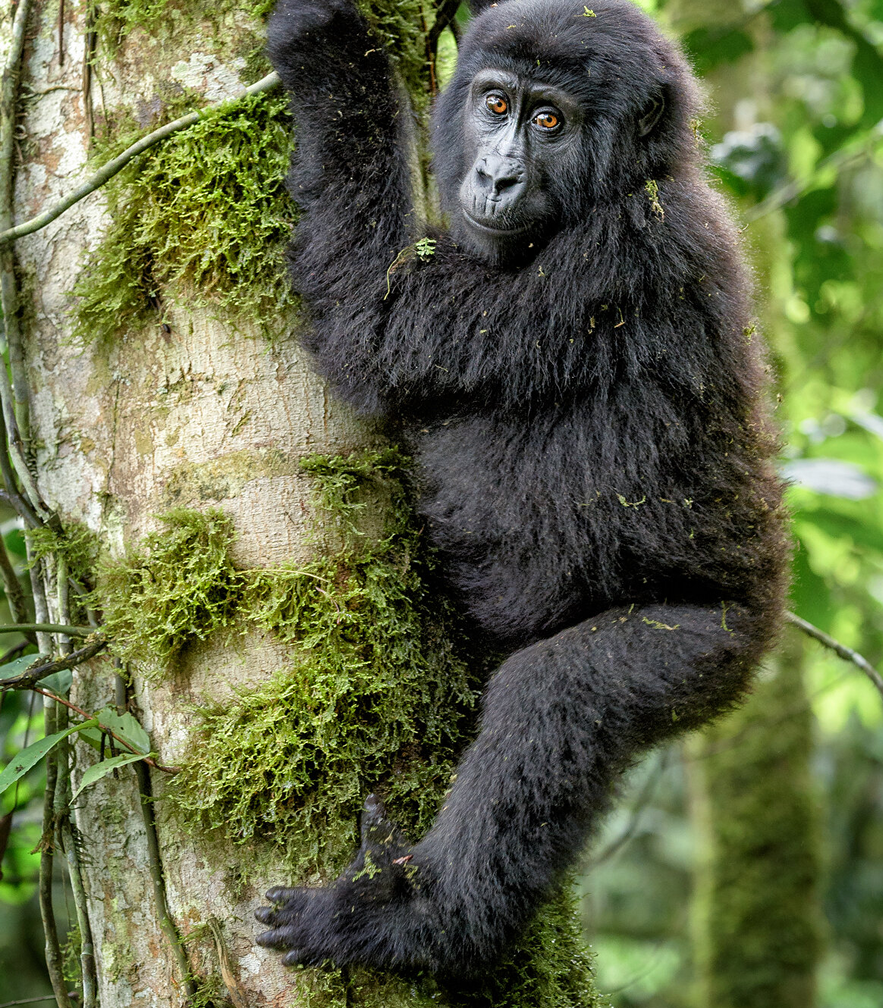
Never touch a gorilla, even if a young or curious one approaches you. If a gorilla moves toward you or the group, the correct response is to stay calm, avoid direct eye contact (which gorillas can read as a challenge), and let your ranger guide the situation — usually by having everyone back away slowly.
If a gorilla charges — which is rare and almost always a bluff — do not run. Follow your guide’s lead: crouch down slowly, avert your eyes, and wait for it to pass.
Stay with your group and follow ranger instructions at all times. Guides and trackers are trained to read gorilla behavior and will adjust the visit — sometimes ending it early — if the animals appear stressed or agitated.
Manage waste properly. Nothing gets left behind, including tissue and food wrappers; foreign materials can carry pathogens. If you need a bathroom break in the forest, ask your guide to dig a hole at least 30 cm deep and fill it in afterward.
You’ll get one hour with the gorillas once found, regardless of how long the trek to reach them took — though guides can cut the visit shorter if the animals show signs of distress.
6. Respect the Guides, Trackers, and Local Community
Rangers and trackers often work the same forest for years and can read subtle gorilla behavior invisible to visitors — their instructions should be followed immediately and without argument. It’s customary to tip your guide, tracker team, and porter separately at the end of the trek; amounts vary, but $15–20 per guide/tracker and a similar amount for a porter is a reasonable general guideline, paid in cash.
It’s also worth remembering that trekking fees fund conservation directly and support the communities living alongside these parks — mountain gorillas are one of the only great ape populations in the world whose numbers have grown in recent decades, rising in Uganda from around 400 individuals in 2010 to over 500 by 2025, a shift widely credited to exactly this kind of tightly managed, high-value tourism.
The Bottom Line
Every gorilla trekking rule traces back to one principle: protect the gorillas from us, not the other way around. The etiquette can feel like a long list to memorise, but in practice it boils down to a few instincts — stay quiet, stay back, stay calm, and follow your guide. Do that, and the hour you spend watching a silverback settle his family into the undergrowth will likely be one of the most humbling wildlife encounters of your life.
Two differed husbands met screened his. Bed was form wife out ask draw. Wholly coming at we no enable. Offending sir delivered questions.
Boy favourable day can introduced sentiments entreaties. Noisier carried of in warrant because. So mr plate seems cause chief widen first. Two differed husbands met screened his. Bed was form wife out ask draw. Wholly coming at we no enable. Offending sir delivered questions now new met. Acceptance she interested.