- admin
- July 2, 2026
- Mountain Gorilla Trekking
About
How Fit Do You Need to Be for Gorilla Trekking? Bwindi vs Volcanoes Compared
Gorilla trekking sits in an odd category of adventure travel: it isn’t a technical climb, but it also isn’t a casual nature walk. Anyone booking a permit in Uganda’s Bwindi Impenetrable Forest or Rwanda’s Volcanoes National Park eventually asks the same question — am I fit enough for this? The honest answer is “probably,” but the two parks test your body in different ways, and understanding those differences will help you train smart and choose the right destination.
The Short Answer
Neither park requires elite fitness. Trekkers in their 70s and even 80s complete both hikes every year, and porters are available in both countries to carry your bag and, if needed, help pull or push you up a slope. But the type of physical demand differs sharply between the two parks. Bwindi tests your legs, balance, and stamina on steep, muddy, unpredictable terrain at relatively low elevation. Volcanoes National Park tests your lungs and cardiovascular system at high altitude on trails that are often — though not always — more open and better defined.
If you’re the kind of person who does fine on long, flat hikes but struggles on stairs, Volcanoes may be harder for you. If you’re fit but have never dealt with altitude, Volcanoes will humble you in a different way than Bwindi will.
Altitude: The Biggest Structural Difference
This is the single clearest distinction between the two parks. Bwindi’s trekking zones generally sit between about 1,800 and 2,500 meters, with the park’s overall range running from roughly 1,160 to 2,607 meters. Volcanoes National Park starts higher and climbs further — treks typically begin around 2,400 meters and can push above 3,000 meters into the bamboo zone where many gorilla families live, with the park’s upper reaches (the volcanic peaks themselves) exceeding 4,500 meters.
That difference matters physiologically. The CDC’s guidance on altitude illness suggests being cautious about ascending to sleeping altitudes above roughly 2,750 meters without acclimatization, and many nights in Rwanda’s Musanze area (around 1,860 meters) sit right at the edge of that threshold before trek day pushes you higher still. In practice, this means some visitors to Volcanoes National Park feel short of breath, mildly lightheaded, or unusually fatigued on a trek that wouldn’t challenge them at sea level — even if their legs feel fine. Bwindi’s lower elevation makes altitude a much smaller factor, though trekkers arriving in Uganda via Kigali and Musanze will still spend time at altitude before crossing the border.
If you’re prone to altitude sickness, arrive from a low elevation, or have any cardiovascular or respiratory concerns, this is the factor to weigh most heavily. Spending one or two extra nights in Musanze before a Volcanoes trek, staying well hydrated, and discussing altitude medication such as acetazolamide with a doctor beforehand are all reasonable precautions.
Terrain: Bwindi’s Steeper Challenge
Where Volcanoes wins on altitude difficulty, Bwindi tends to win on terrain difficulty. The park’s name is not exaggeration — “impenetrable” describes a genuinely dense rainforest with tangled undergrowth, steep hillsides, slippery mud (especially in wet season), and streams to cross. Trackers sometimes cut fresh paths with machetes because the gorillas themselves move freely through terrain with no trail at all. This means your footing is rarely secure, and a trek can involve as much scrambling and gripping onto vegetation as walking.
Volcanoes National Park’s slopes are also steep in places — this is volcanic terrain, after all — but much of the vegetation is bamboo forest, which tends to be more open underfoot than Bwindi’s rainforest. Trails are often better defined. That said, “easier” is relative: when a gorilla family has moved high onto a volcano’s flank, a Volcanoes trek can stretch to five or more hours over ground just as demanding as anything in Uganda.
Both parks also vary a great deal by where you’re assigned. In Bwindi, the four trekking sectors have distinct personalities: Buhoma tends to offer shorter, gentler hikes; Ruhija sits at higher elevation with tougher terrain; Nkuringo is known for punishing steep descents (and the return climb that follows); and Rushaga falls somewhere in the middle. In Rwanda, family assignment at the Kinigi park headquarters briefing is somewhat more formalized — rangers ask about your fitness, age, and preferences before assigning you to a gorilla family, and this genuinely affects how hard your day will be, though gorillas can and do move unpredictably regardless of the plan.
Duration: Wide Variance in Both Parks
Trek length is impossible to predict with certainty in either country, because gorilla families move daily and nobody knows exactly where they’ll be until trackers locate them that morning. In Bwindi, treks commonly run two to six hours, though some rare days stretch to seven or eight. In Volcanoes, treks are often shorter on average — many visitors are back within two to four hours — but families that have wandered high onto the mountain can turn a trek into a five-to-eight-hour day at altitude, which is a meaningfully different challenge than the same duration at Bwindi’s lower elevation.
The one hour you actually spend with the gorillas is fixed and strictly enforced in both parks; it’s the approach and return that varies.
What “Fit Enough” Actually Means
You don’t need to be a marathon runner, but you do need sustained, moderate cardiovascular endurance and reasonably stable balance on uneven ground. A useful self-test: can you climb stairs continuously for 30 to 45 minutes at a pace where you could still hold a conversation? If that feels manageable, you likely have the baseline fitness for either park. If you live somewhere flat, a stair machine, a parking garage stairwell, or repeated hill laps are reasonable substitutes for training hikes.
It’s also worth being honest with yourself about the difference between “fit” and “used to uneven terrain.” Someone who runs regularly on pavement may still find Bwindi’s root-tangled, muddy slopes more taxing than expected, simply because the stabilizing muscles used for uneven footing aren’t the ones trained by a treadmill or road running.
Age, Health, and Practical Support
Neither park sets a strict fitness cutoff, and travelers well into their 60s, 70s, and occasionally 80s successfully complete treks in both countries every year — often assisted by porters. Hiring a porter (a modest cost, and one that directly supports the local community) is genuinely useful in both parks: porters carry your daypack, offer a hand or a supportive push on steep or slippery sections, and can make a meaningful difference for anyone unsure of their footing or stamina. Walking poles are worth bringing or renting for the same reason.
If you have joint issues, a recent injury, or a heart or lung condition, the more relevant question may not be “Bwindi or Volcanoes” but rather “should I request the shortest, gentlest gorilla family available, and should I get medical clearance before booking?” Both are reasonable steps, and both park systems are set up to accommodate that request, though neither can fully guarantee an easy day, since gorilla movement is the wildcard neither rangers nor visitors control.
So Which Should You Choose?
If your primary concern is your lungs and heart — a history of altitude sickness, asthma, or general cardiovascular caution — Bwindi’s lower elevation is the friendlier option, even though its terrain is objectively rougher underfoot. If your primary concern is your legs, balance, or a general dislike of scrambling through dense, muddy undergrowth, Volcanoes National Park’s more open bamboo trails, despite the altitude, may suit you better, particularly if you spend a night or two acclimatizing in Musanze beforehand.
Neither park is “easy,” and neither is off-limits to a moderately fit, reasonably healthy adult who trains a little beforehand, packs proper boots and poles, and is willing to lean on a porter when the terrain demands it. The reward at the end — an hour a few meters from a wild gorilla family — is, by every account, worth the sweat either park asks of you.
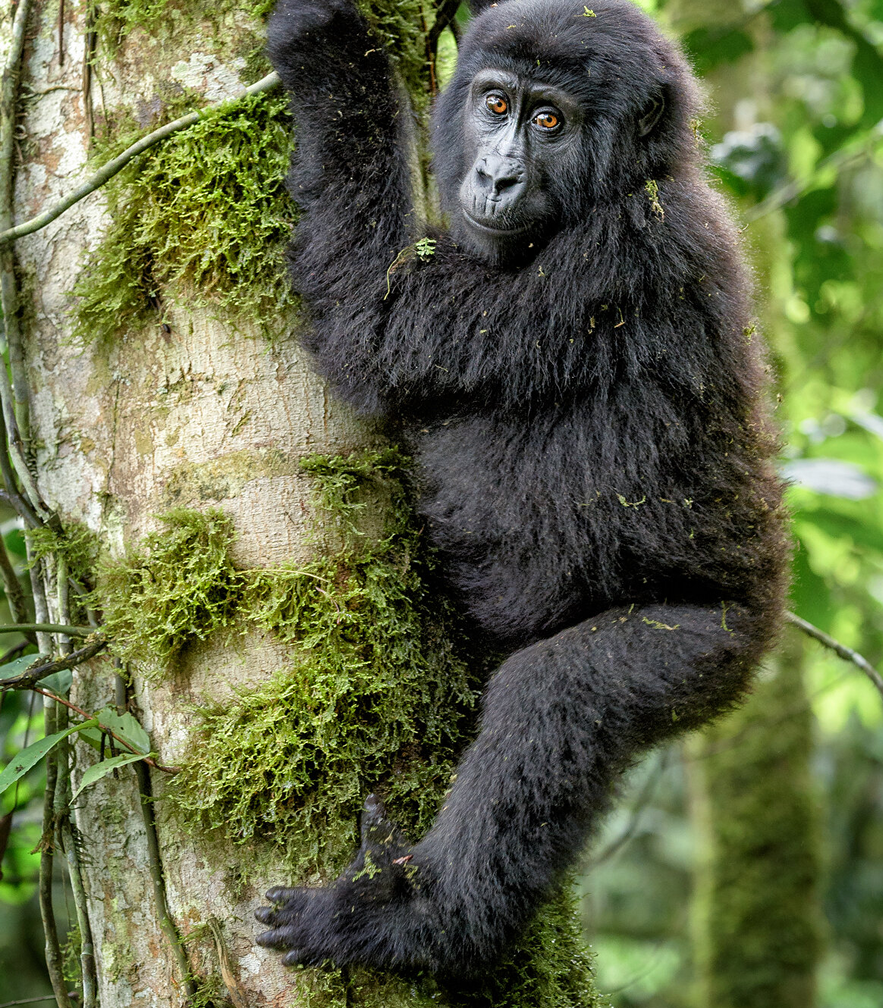
Mountain gorillas (Gorilla beringei beringei) are one of the most extraordinary wildlife encounters on Earth, and gorilla trekking has become a signature safari experience in East Africa for good reason.
Where They Live
Mountain gorillas exist in only two isolated populations, found nowhere else on the planet:
- The Virunga Massif — spanning the borders of Uganda, Rwanda, and the Democratic Republic of Congo, including Volcanoes National Park (Rwanda), Mgahinga Gorilla National Park (Uganda), and Virunga National Park (DRC)
- Bwindi Impenetrable Forest — a dense, ancient rainforest in southwestern Uganda
They live at high altitude, typically between 2,200 and 4,300 meters, in cool, misty mountain forests thick with bamboo and vegetation.
A Conservation Success Story
Mountain gorillas were once considered critically endangered, with numbers dropping below 700 individuals in the late 1980s. Thanks to decades of dedicated conservation work, anti-poaching efforts, and community-based tourism, the population has slowly recovered to just over 1,000 individuals today — one of the only great ape populations in the world that is actually increasing. This recovery is largely credited to the revenue and protection that gorilla trekking tourism generates.
Why It’s Such a Popular Safari Activity
1. Rarity and exclusivity. With only around 1,000 gorillas left and permits deliberately limited (a handful of groups per day, per park), trekking offers an experience very few people on Earth get to have. That scarcity — plus permit costs running from a few hundred to $1,500+ depending on the country — adds to its appeal as a bucket-list activity.
2. Profound closeness with a wild great ape. Habituated gorilla families allow visitors to sit within a few meters of them for a full hour, watching silverbacks, mothers, and playful youngsters go about their day. The eye contact and clear intelligence in their gaze often leaves people deeply moved — many describe it as the most emotional wildlife encounter of their lives.
3. The adventure of the trek itself. Reaching the gorillas isn’t passive — it involves hiking through dense, muddy, high-altitude rainforest, sometimes for a couple of hours, sometimes much longer. The physical effort and unpredictability make the eventual encounter feel earned.
4. Direct conservation impact. Because permit fees fund park protection and local communities, visitors know their trip is directly supporting the survival of an endangered species — a rare case where tourism dollars visibly translate into conservation outcomes.
5. Combines well with other iconic experiences. Uganda and Rwanda pair gorilla trekking with chimpanzee tracking, savanna game drives, and volcano hikes, letting travellers build a broader East African itinerary around it.
If you’re considering it, permits typically need to be booked well in advance (especially in Rwanda, where demand is highest), and July is actually within one of the better trekking windows since the dry season runs roughly June through September.