- admin
- July 2, 2026
- Mountain Gorilla Trekking
Gorilla Trekking Cost 2026: Uganda, Rwanda
Gorilla Safari Cost 2026: Budget vs Luxury Prices | Adventure Gorilla Safaris
Standing a few meters from a 400-pound silverback in a misty Central African rainforest is one of the most extraordinary wildlife experiences on Earth — and it comes with a price tag that reflects its rarity. Mountain gorilla tourism is deliberately kept small and expensive as a conservation strategy, which means there’s no truly “cheap” gorilla safari. But there is a wide range within that expense, from lean budget treks to six-figure luxury expeditions. This guide breaks down exactly what you’ll pay at each tier, and why.
The One Cost You Can’t Avoid: The Permit
Every gorilla trek starts with a government-issued permit, and this single line item does more to shape your total budget than anything else.
- Rwanda (Volcanoes National Park): $1,500 per person, the highest in the region. Discounts of around 30% (bringing it to roughly $1,050) are sometimes available in low season if you combine the trek with visits to Akagera or Nyungwe National Parks, though this promotion is typically paused during the June–October peak.
- Uganda (Bwindi Impenetrable or Mgahinga National Parks): $800 per person for foreign non-residents, with occasional low-season discounts down to around $600 in April, May, and November. Uganda also offers a Gorilla Habituation Experience — up to four hours with a semi-habituated family instead of the standard one hour — for $1,500.
- Democratic Republic of Congo (Virunga National Park): Historically the cheapest option at $400, occasionally discounted further, but Virunga has faced repeated closures due to regional insecurity, so availability is unpredictable and independent travel advisories generally urge caution.
The permit covers park entry, trackers, armed ranger escorts, and one hour face-to-face with a habituated gorilla family. It does not cover porters, tips, transport, meals, or lodging — all of which stack on top and are where the real budget divide between tiers appears.
Budget Gorilla Safaris: Roughly $1,100–$2,000 per person
Budget doesn’t mean cheap in absolute terms — it means stripping every cost down to essentials while still covering the non-negotiable permit.
What it looks like: A 3-day trip built around Uganda (since its permit is nearly half of Rwanda’s), staying in simple guesthouses or community rest camps near Bwindi such as Buhoma Community Rest Camp, traveling by shared or group safari vehicle rather than a private one, and eating at the lodge rather than seeking out fine dining.
Typical cost breakdown for a 3-day Uganda trip:
- Permit: $800
- Budget accommodation (2–3 nights): $100–$300 total, at roughly $50–$130 per night for simple en-suite rooms
- Group transport/shared vehicle: significantly cheaper than private hire, sometimes $150–$200 split among several travelers
- Meals: $10–$40 per meal if not included
- Porter fee: around $15–$30 (highly recommended, and it directly supports the local community)
Joining a scheduled group departure rather than booking a private tour is the single biggest budget lever, since vehicle and driver-guide costs are fixed regardless of group size — a group of 4–6 travelers can cut per-person costs substantially compared to a solo or couple’s private safari. Traveling in the shoulder or low season (April, May, November) also helps, both through discounted permits and lower lodge rates.
Rwanda’s high permit price makes a true “budget” Rwanda safari difficult, though it’s not impossible — a one-day trek from Kigali (in and out on the same or next day, staying at an affordable option like Hotel Muhabura) can bring the total closer to $1,700–$2,000, still well above Uganda’s floor.
Mid-Range Gorilla Safaris: Roughly $2,000–$4,500 per person
This is where most travelers land, and for good reason: mid-range trips add real comfort — en-suite rooms, better food, private transport, and a bit more flexibility — without the eye-watering price of ultra-luxury lodges.
What it looks like: A 4–7 day itinerary combining gorilla trekking with one or two other activities (a Nile boat cruise, chimpanzee tracking, a game drive), staying in comfortable mid-range lodges with swimming pools, forest views, and reliable Wi-Fi, and traveling in a private 4×4 with a dedicated driver-guide rather than a shared vehicle.
Typical cost drivers:
- Permit: $800 (Uganda) or $1,500 (Rwanda)
- Mid-range accommodation: roughly $150–$400 per night per person, for lodges like Mahogany Springs or Gorilla Forest Camp in Uganda
- Private 4×4 transport: $150–$250 per day plus fuel
- Meals: usually included as half-board or full-board at this tier
- Visa and incidentals: $50–$100
A 5-day mid-range Uganda safari commonly totals somewhere between $2,400 and $4,500 per person, while the equivalent trip in Rwanda — same comfort level, but with the pricier permit and generally higher lodge rates — tends to run from roughly $3,500 to $7,000. Combining both countries in a single 10-day trip (crossing overland between Kigali and Bwindi, which also saves on backtracking) typically lands between $6,000 and $12,000 per person depending on the accommodation tier chosen throughout.
Luxury Gorilla Safaris: $4,000 to $15,000+ per person
At the top end, the permit becomes almost a rounding error next to the accommodation and logistics bill. Luxury gorilla safaris are sold on exclusivity, comfort, and time efficiency — private chartered flights instead of long road transfers, architect-designed lodges, personal butlers, and curated multi-country itineraries.
What it looks like: Fly-in transfers by light aircraft directly to airstrips near the parks (cutting Uganda’s notorious 8–10 hour Entebbe-to-Bwindi road transfer down to about an hour), stays at destination lodges that are attractions in their own right, private vehicles and guides throughout, and often a broader itinerary that folds in a classic savanna safari, a beach extension in Zanzibar, or a gorilla-and-chimpanzee combination across multiple parks.
Signature luxury lodges include Rwanda’s Bisate Lodge, Singita Kwitonda Lodge, and Sabyinyo Silverback Lodge — properties where nightly rates alone can run from $1,000 to well over $3,000 per person — alongside Uganda options like Clouds Mountain Gorilla Lodge.
Typical price points:
- A 3-day luxury trip: roughly $2,000–$6,000 per person
- A 7-day luxury Uganda safari with flights and top-tier lodges: $7,500–$12,000
- A 9-day luxury Rwanda safari at flagship lodges: often exceeds $15,000 per person
- Ultra-premium multi-country combinations with private charters: $15,000–$20,000+ is not unusual
At this tier, per-night lodge costs can exceed $2,000–$3,000, and add-ons like a private helicopter transfer, a hot air balloon safari over Murchison Falls (around $450 per person), or a private boat cruise on the Kazinga Channel push totals higher still.
Country Choice Matters More Than Almost Anything Else
Because the permit is fixed and non-negotiable, where you trek has an outsized effect on your total cost:
- Uganda is the clear value play — a lower permit, a wider spread of budget and mid-range lodges, and a broader wildlife circuit (chimpanzees, tree-climbing lions, the Nile) that lets you diversify your trip without diversifying your spend as much.
- Rwanda trades cost for convenience and polish — a two-to-three-hour drive from Kigali International Airport versus Uganda’s much longer overland routes to Bwindi, smoother infrastructure, and the region’s most celebrated luxury lodges. Expect to pay $1,500–$2,500 more than an equivalent Ugandan itinerary.
- DR Congo offers the lowest permit price but comes with meaningfully higher security and logistical risk, and Virunga National Park has a history of unpredictable closures — it’s generally a choice for experienced regional travelers rather than first-timers.
Other Costs to Budget For, Regardless of Tier
A few expenses apply almost universally and are easy to underestimate:
- International flights: $600–$2,500 depending on origin and season
- Visas: $50–$100 for single-country visas; the East Africa Tourist Visa (covering Rwanda, Uganda, and Kenya) runs about $100
- Travel insurance: effectively mandatory — most operators won’t host guests without it, given the physical demands and remoteness of trekking
- Porter fees and tips: $15–$30 for a porter, plus discretionary tips for guides, trackers, and rangers
- Yellow fever vaccination: required documentation for entry into Uganda and DR Congo
Bottom Line
For a realistic per-person budget excluding international flights: expect $1,100–$2,000 for a lean budget Uganda trek, $2,000–$4,500 for a comfortable mid-range experience in Uganda (or $3,500–$7,000 in Rwanda), and anywhere from $4,000 to $15,000+ for a luxury itinerary depending on lodge choice, flights, and trip length. Whichever tier fits your travel style, the hour spent with a gorilla family itself is identical at every price point — the difference lies entirely in how you get there and where you sleep afterwards.
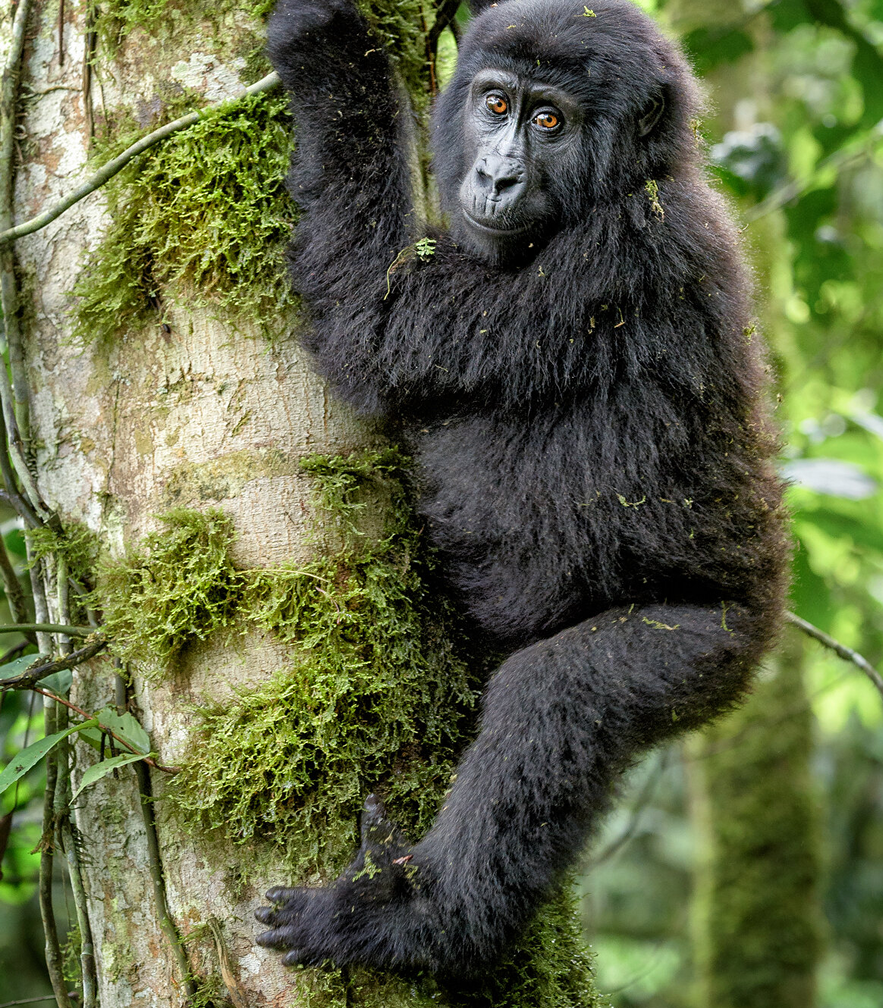
Mountain gorillas (Gorilla beringei beringei) are one of the most extraordinary wildlife encounters on Earth, and gorilla trekking has become a signature safari experience in East Africa for good reason.
Where They Live
Mountain gorillas exist in only two isolated populations, found nowhere else on the planet:
- The Virunga Massif — spanning the borders of Uganda, Rwanda, and the Democratic Republic of Congo, including Volcanoes National Park (Rwanda), Mgahinga Gorilla National Park (Uganda), and Virunga National Park (DRC)
- Bwindi Impenetrable Forest — a dense, ancient rainforest in southwestern Uganda
They live at high altitude, typically between 2,200 and 4,300 meters, in cool, misty mountain forests thick with bamboo and vegetation.
A Conservation Success Story
Mountain gorillas were once considered critically endangered, with numbers dropping below 700 individuals in the late 1980s. Thanks to decades of dedicated conservation work, anti-poaching efforts, and community-based tourism, the population has slowly recovered to just over 1,000 individuals today — one of the only great ape populations in the world that is actually increasing. This recovery is largely credited to the revenue and protection that gorilla trekking tourism generates.
Why It’s Such a Popular Safari Activity
1. Rarity and exclusivity. With only around 1,000 gorillas left and permits deliberately limited (a handful of groups per day, per park), trekking offers an experience very few people on Earth get to have. That scarcity — plus permit costs running from a few hundred to $1,500+ depending on the country — adds to its appeal as a bucket-list activity.
2. Profound closeness with a wild great ape. Habituated gorilla families allow visitors to sit within a few meters of them for a full hour, watching silverbacks, mothers, and playful youngsters go about their day. The eye contact and clear intelligence in their gaze often leaves people deeply moved — many describe it as the most emotional wildlife encounter of their lives.
3. The adventure of the trek itself. Reaching the gorillas isn’t passive — it involves hiking through dense, muddy, high-altitude rainforest, sometimes for a couple of hours, sometimes much longer. The physical effort and unpredictability make the eventual encounter feel earned.
4. Direct conservation impact. Because permit fees fund park protection and local communities, visitors know their trip is directly supporting the survival of an endangered species — a rare case where tourism dollars visibly translate into conservation outcomes.
5. Combines well with other iconic experiences. Uganda and Rwanda pair gorilla trekking with chimpanzee tracking, savanna game drives, and volcano hikes, letting travelers build a broader East African itinerary around it.
If you’re considering it, permits typically need to be booked well in advance (especially in Rwanda, where demand is highest), and July is actually within one of the better trekking windows since the dry season runs roughly June through September.